Search


09 Feb 2026
Search
09 Feb 2026

Please allow ads as they help fund our trusted local news content.
Kindly add us to your ad blocker whitelist.
If you want further access to Ireland's best local journalism, consider contributing and/or subscribing to our free daily Newsletter .
Support our mission and join our community now.
To continue reading this article, you can subscribe for as little as €0.50 per week which will also give you access to all of our premium content and archived articles!
Alternatively, you can pay €0.50 per article, capped at €1 per day.
Thank you for supporting Ireland's best local journalism!


The Prince of Wales has begun the most important foreign visit of his public career, travelling to Saudi Arabia and being hosted by the country’s controversial leader.
William began a three-day visit to the Gulf state, at the request of the Government, to strengthen ties with one of the UK’s closest Middle East allies and a major religious and political player in the region.
The future king will hold talks with Saudi leader Crown Prince Mohammed bin Salman, followed by a private dinner at his farm in a world Unesco site in the Saudi capital.
London and Riyadh are hopeful the two men, who have met before, will develop a connection – with any burgeoning relationship between the two royals likely to set the tone for Anglo-Saudi relations for decades to come.
But the crown prince – known as MBS – is a controversial figure to the West, the head of an absolute monarchy whose regime has been accused of human rights violations, while the ruler is alleged to have links to the killing of a journalist.
The Saudi ruler’s reputation was badly damaged by a US intelligence determination that claimed he had ordered the 2018 killing of journalist Jamal Khashoggi.
A source said about the Saudis: “They are delighted that he’s here.
“The fact that he’s a prince and the future king matters enormously. They want it to be a friendship that lasts.”
Ahead of the visit, the Prince and Princess of Wales issued their first public statement about the Jeffrey Epstein scandal – which has seen William’s uncle, Andrew Mountbatten-Windsor, stripped of his titles after years of being dogged by sex allegations involving Epstein.
A Kensington Palace spokesperson said: “I can confirm that the Prince and Princess of Wales have been deeply concerned by the continued revelations.
“Their thoughts remain focused on the victims.”
The statement was issued a few hours ahead of the prince’s arrival in Riyadh, and there was a real sense from Kensington Palace they wanted the position of the prince and princess to be known – so William could focus on the trip.
But the Epstein scandal escalated after Thames Valley Police said it is assessing claims that Andrew shared confidential reports from his role as the UK’s trade envoy.
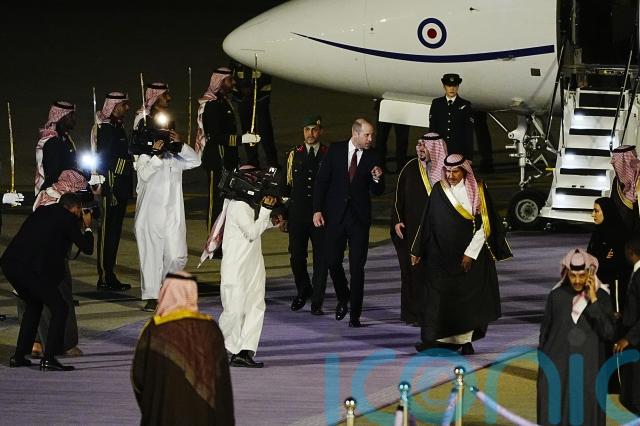
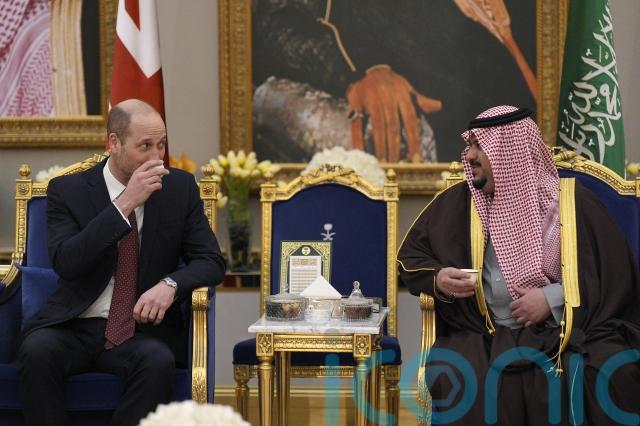
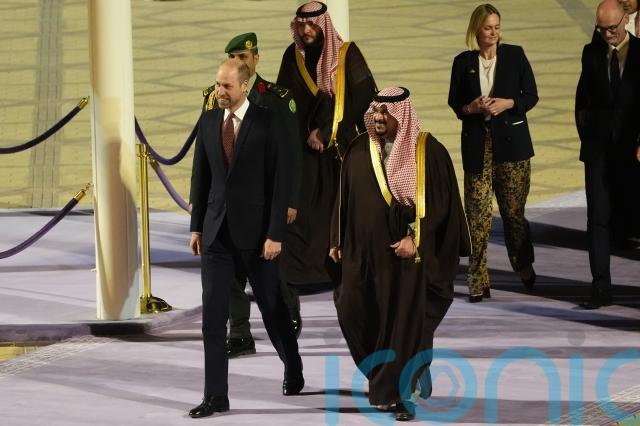
William was greeted at King Khalid International Airport, after arriving on a RAF plane, by the deputy governor of Riyadh, Prince Mohammed bin Abdulrahman bin Abdulaziz.
After a welcome gahwa – Arabic coffee flavoured with cardamon – and a brief chat with dignitaries in the royal terminal, the prince was whisked off for his first royal engagement with the crown prince.
The prince discussed the trip with his father the King, who has made a number of public and private visits to Saudi Arabia, and was also briefed by UK’s ambassador the country Stephen Hitchen.
William and the crown prince are due to tour the Unesco World Heritage Site, At-Turaif in the Diriyah area of the capital, one of the worlds largest mud brick settlements, before sitting down for talks followed by a private intimate dinner.
The Saudi leader does not like formality, and the two men could enjoy a traditional meal of lamb around a fire with the crown prince due to be joined by a few senior members of his family and William accompanied by his private secretary Ian Patrick and the UK’s ambassador.
It is not known what will be discussed during the formal talks and whether any human rights issues will be broached, but in the local culture private discussions on sensitive topics are the norm rather than publicly airing disagreements.
Felix Jakens, head of campaigns at Amnesty International, said: “We’ve asked Prince William to raise the case of British national Ahmed Al Doush, who was arrested visiting Saudi Arabia on holiday in 2024, and sentenced to 10 years in prison, as he understands over tweets from 2018.
“The ordeal Ahmed has had to endure has been harrowing, and toll on his wife and four children is unimaginable. Any influence Prince William is able to exert behind closed doors could be critical in securing his release.”
The crown prince is the driving force behind Saudi Arabia’s Vision 2030, a modernisation of the country to transform the kingdom into a diversified and sustainable economy – with goals that include attracting foreign investment, empowering women, and positioning Saudi Arabia as a global hub for business and culture by the end of the decade.
Women have seen greater freedoms introduced since the crown prince came to power in 2017, with the following year seeing women legally allowed to drive.
Mr Jakens said: “Saudi Arabia’s Vision 2030 has aimed in part to reposition the country as a tourist hotspot. But visitors should be aware that the country’s human rights record remains grim, with more people executed last year than Amnesty has ever recorded in a single year, and severe punishments for those deemed to be critical of the regime.”
mfl

Subscribe or register today to discover more from DonegalLive.ie
Buy the e-paper of the Donegal Democrat, Donegal People's Press, Donegal Post and Inish Times here for instant access to Donegal's premier news titles.
Keep up with the latest news from Donegal with our daily newsletter featuring the most important stories of the day delivered to your inbox every evening at 5pm.

This publication supports the work of the Press Council of Ireland and Office of the Press Ombudsman, and our staff operate within the Code of Practice of the Press Council. You can obtain a copy of the Code, or contact the Council, at www.presscouncil.ie, Lo-call 1800 208 080 or email: info@presscouncil.ie.