Search


21 Apr 2026
Search
21 Apr 2026

Please allow ads as they help fund our trusted local news content.
Kindly add us to your ad blocker whitelist.
If you want further access to Ireland's best local journalism, consider contributing and/or subscribing to our free daily Newsletter .
Support our mission and join our community now.
To continue reading this article, you can subscribe for as little as €0.50 per week which will also give you access to all of our premium content and archived articles!
Alternatively, you can pay €0.50 per article, capped at €1 per day.
Thank you for supporting Ireland's best local journalism!


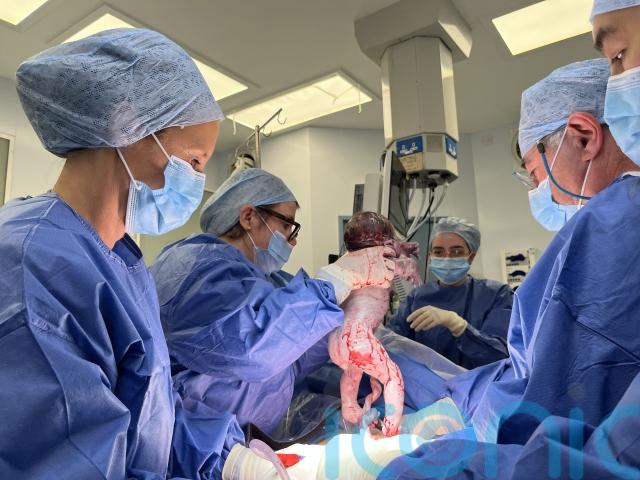
Doctors who worked around the clock to deliver a womb transplant baby have described the moments of joy as he was born.
Hugo Powell was born weighing 6lb 13oz (3.1kg) in December at Queen Charlotte’s and Chelsea Hospital in London, after his mother received a womb from a dead donor and had a successful pregnancy.
Bryony Jones, consultant obstetrician at Imperial College Healthcare NHS Trust, who has delivered both the babies born in the UK after womb transplants, told the Press Association: “I have the best job – delivering any baby is really exciting.
“But this baby was particularly special, especially as we had seen the patient right from the start.
“We had the whole of the team with us on that day, so it is very exciting, and we’re all delighted.”
Ms Jones said she and other doctors who give their time voluntarily via the charity Womb Transplant UK are honest with patients.
They admit there is limited experience of looking after women who have undergone transplants involving the womb, which is also called the uterus.
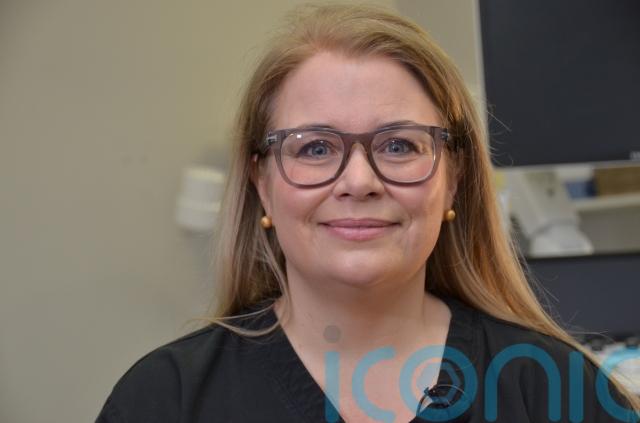
“However, we have lots of experience in looking after women who have had other organ transplantation, and so many of those skills in looking after complicated and complex pregnancies are transferable when we look after women who have uterine transplants,” she said.
“We are very honest with the patients who are part of the programme that our knowledge – worldwide – isn’t great about this, and clearly it’s part of ongoing research, but lots of the skills that we have from having looked after other women are transferable and we are able to look after them.”
Women having womb transplants must undergo additional appointments and extra scans to monitor how the baby is growing inside the womb, as well as regular blood tests.
Overall, more than 30 expert staff are involved in looking after each womb transplant patient.
Isabel Quiroga, consultant surgeon and clinical lead for organ retrieval at the Oxford Transplant Centre, part of Oxford University Hospitals, has carried out both womb transplants in the UK.
She explained that there is a “precious amount of time” when the organ can be used from a donor who has died. The team thinks this time period is about 12 hours.
“This is a ground-breaking operation in the sense that we know, technically, there’s more failures internationally – early failures – after the transplant from the deceased than from the living,” she said.
“Equally, there’s not many babies to date that have been born after a deceased donor transplant.
“The fact that we have the third in Europe, the first in the UK, is very, very important.
“And of course, it opens the door maybe to other women who do not have living donors, to have the opportunity to be mothers with these type of donors.
“And of course, it gives the possibility of other women, not only to donate lifesaving organs…but to be able to allow another woman to create life.
“I think it’s just truly magnificent, fabulous.”
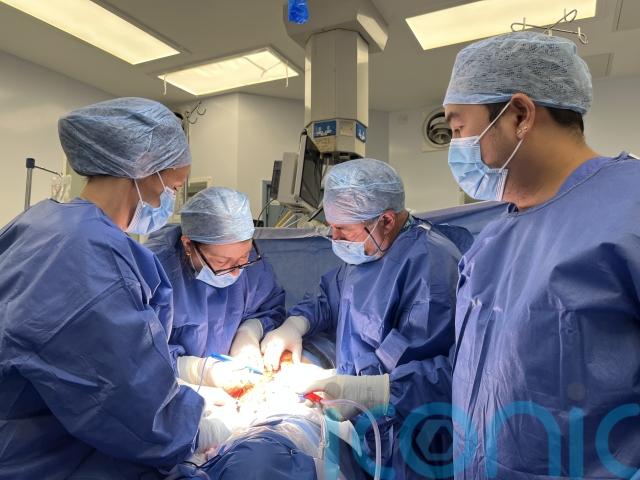
Miss Quiroga said that, even though she carries out transplants almost every week, she is “still in complete awe” of donor families.
“These families want to help others. They want to give life and to give health to other patients. I’m incredibly grateful,” she said.
Professor Richard Smith, clinical lead at Womb Transplant UK and consultant gynaecological surgeon at Imperial College Healthcare NHS Trust, said the charity needs more funds to continue its programme into womb transplants.
To date, surgeons have carried out five womb transplants in the UK – two womb transplants involving a living donor and three using a deceased donor. The charity has funded them all.
Prof Smith is in talks with NHS leaders about the NHS possibly providing future funding for women who have no other way of having their own baby.
“Both the living and deceased programmes have got capacity for expansion,” he explained.
“We’re constrained mainly by cash.
“I think it’s really important to say that most of the women who’ve come through our system so far have been born with no womb, but there’s a huge number of women out there who’ve lost their womb because of cancer or haemorrhage.
“So there’s a lot more people out there who may potentially benefit from this procedure.
“Probably, we know 5,000 women in the UK are born with no womb, but we also know there’s probably in total about 15,000 women of reproductive age who would potentially like to have a womb.”

Subscribe or register today to discover more from DonegalLive.ie
Buy the e-paper of the Donegal Democrat, Donegal People's Press, Donegal Post and Inish Times here for instant access to Donegal's premier news titles.
Keep up with the latest news from Donegal with our daily newsletter featuring the most important stories of the day delivered to your inbox every evening at 5pm.

This publication supports the work of the Press Council of Ireland and Office of the Press Ombudsman, and our staff operate within the Code of Practice of the Press Council. You can obtain a copy of the Code, or contact the Council, at www.presscouncil.ie, Lo-call 1800 208 080 or email: info@presscouncil.ie.