
A veil of sadness has fallen over County Limerick following the tragic passing of Ruth Staunton
Search


16 Mar 2026

Please allow ads as they help fund our trusted local news content.
Kindly add us to your ad blocker whitelist.
If you want further access to Ireland's best local journalism, consider contributing and/or subscribing to our free daily Newsletter .
Support our mission and join our community now.
To continue reading this article, you can subscribe for as little as €0.50 per week which will also give you access to all of our premium content and archived articles!
Alternatively, you can pay €0.50 per article, capped at €1 per day.
Thank you for supporting Ireland's best local journalism!


A school pupil is the second person to have died following an outbreak of meningitis in Kent.
The student was in Year 13 at Queen Elizabeth’s Grammar School in Faversham and is understood to have died on Saturday.
The other person who died attended the University of Kent.
A local nightclub has said it has been contacted by officials to try and trace people who may be affected.
The UK Health Security Agency (UKHSA) said it had been notified of 13 cases with signs and symptoms of meningitis from Friday to Sunday in the Canterbury area of Kent.
Some students at the University of Kent have been given antibiotics while others are in hospital. The specific strain of meningitis has not yet been identified.
A spokeswoman for the UKHSA told the Press Association: “We can confirm that UKHSA has worked with the University of Kent to provide advice letters to all 16,000 students, advising on recent cases, signs and symptoms, how to obtain antibiotics, and what to do if they feel unwell.”
Not all 16,000 students at the university will be given antibiotics, only those who are regarded as “close contacts” of those affected, such as living in the same accommodation block.
Helen Whately, the Conservative MP for Faversham and Mid Kent, told PA she was expecting to be briefed on Monday about the situation.

“I’ve been in contact with the Health Secretary and I’m expecting to hear from the UKHSA this morning,” she said.
“I’m trying to get information about what is being done locally to trace contacts and identify which students and school pupils are at risk.
“Also I want schools to be given briefings on what steps they should take and the advice to give to parents.”
The UKHSA said on Sunday specialists are interviewing affected individuals and their families to “help identify all close contacts and arrange antibiotics to limit spread”.
Meningococcal bacteria can cause serious illness, including inflammation of the lining of the brain and blood poisoning, which can rapidly lead to sepsis.
Anyone can get meningitis but it is most common in babies, children, teenagers and young adults and it can spread very quickly in places such as universities and colleges.

Louise Jones-Roberts, owner of Club Chemistry in Canterbury, told PA the venue had been contacted by the UK Health Security Agency (UKHSA) in the hope of tracing anyone affected.
“We have been told somebody was in our club at the weekend who has since been diagnosed with meningitis,” she said.
“They have asked us if we have any methods for tracing who has been in to us.
“We have an ID scanner but that is more of a security measure… It takes pictures of some driving licences, ID cards and on so on.
“We’ve got tickets for events so we could trace ticket holders, but most people pay on the door.”
She said her thoughts were with the families of those affected by the meningitis outbreak.
We are deeply saddened to confirm that one student from the University of Kent has died following a case of invasive meningitis.
Our thoughts are with the student’s family, friends and the wider university community at this extremely difficult time.
The safety of our students… pic.twitter.com/tjnYvMssXR
— University of Kent (@UniKent) March 15, 2026
“I’m devastated,” she said. “I can’t imagine what the families are going through.
“Our thoughts are with the families. Meningitis affects healthy, young people and this is devastating.
“We will stay closed until we get further advice from the UKHSA.”
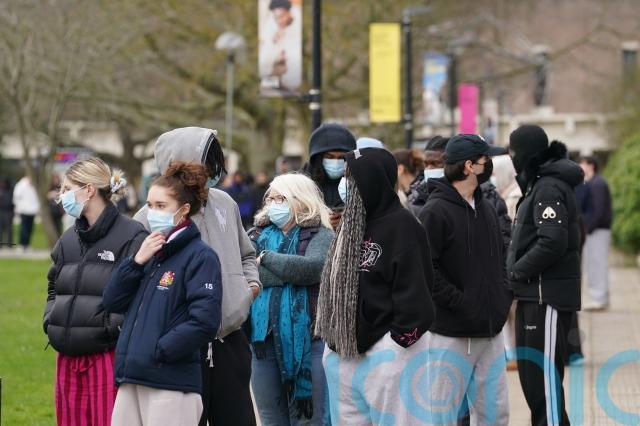
Long queues could be seen at the university Senate building on Monday morning as students waited for antibiotics.
A University of Kent spokesperson said: “We are deeply saddened to confirm that one student from the University of Kent has died following a case of invasive meningitis.
“Our thoughts are with the student’s family, friends and the wider university community at this extremely difficult time.
“The safety of our students and staff remains our highest priority. We are working closely with public health teams and are in touch with staff and students to ensure they get the advice and support they need.”
Trish Mannes, UKHSA regional deputy director for the South East, said: “We understand that many people at the university and in the wider community will be affected by this sad news and we would like to offer our condolences to the friends and family involved.

“Students and staff will understandably be feeling worried about the risk of further cases; however, we would like to reassure them that close contacts of cases have been given antibiotics as a precautionary measure.
“Advice and support is being offered to the wider student community, and to local hospitals and NHS 111, and we’re monitoring the situation closely.
“Meningococcal disease can progress rapidly, so it’s essential that students and staff are alert to the signs and symptoms of meningococcal meningitis and septicaemia, which can include a fever, headache, rapid breathing, drowsiness, shivering, vomiting and cold hands and feet.
“Septicaemia can also cause a characteristic rash that does not fade when pressed against a glass.
“Students are particularly at risk of missing the early warning signs of meningitis because they can be easily confused with other illnesses such as a bad cold, flu or even a hangover.
“That’s why it’s vital that, if a friend goes to bed unwell, you check on them regularly and don’t hesitate to seek medical help by contacting their GP or calling NHS 111 if they have these symptoms or you’re concerned about them. This could save their life.”

Subscribe or register today to discover more from DonegalLive.ie
Buy the e-paper of the Donegal Democrat, Donegal People's Press, Donegal Post and Inish Times here for instant access to Donegal's premier news titles.
Keep up with the latest news from Donegal with our daily newsletter featuring the most important stories of the day delivered to your inbox every evening at 5pm.

This publication supports the work of the Press Council of Ireland and Office of the Press Ombudsman, and our staff operate within the Code of Practice of the Press Council. You can obtain a copy of the Code, or contact the Council, at www.presscouncil.ie, Lo-call 1800 208 080 or email: info@presscouncil.ie.