Search


19 Mar 2026
Search
19 Mar 2026

Please allow ads as they help fund our trusted local news content.
Kindly add us to your ad blocker whitelist.
If you want further access to Ireland's best local journalism, consider contributing and/or subscribing to our free daily Newsletter .
Support our mission and join our community now.
To continue reading this article, you can subscribe for as little as €0.50 per week which will also give you access to all of our premium content and archived articles!
Alternatively, you can pay €0.50 per article, capped at €1 per day.
Thank you for supporting Ireland's best local journalism!


Reopening the Strait of Hormuz is “the best thing to do” to prevent interest rates rising, Bank of England governor Andrew Bailey has said.
In an interview on Thursday evening after the Bank’s Monetary Policy Committee (MPC) voted unanimously to leave the rate unchanged at 3.75%, Mr Bailey said any further cuts are “not on the horizon” as he hinted at possible hikes.
It is the first time that all members have voted the same way since September 2021.
Iran effectively closed the vital oil and gas shipping route after the US and Israel attacked the country, which has pushed up global prices.
Mr Bailey said the war in the Middle East is hitting petrol pumps now, will likely increase household energy costs in summer, and put pressure on food prices.
He told LBC’s Andrew Marr: “The duration of this problem is crucial.
“I would also say very clearly that the best way to solve this situation is not through monetary policy. It is through sorting out at the source of what’s going on.
“Frankly, reopening the Strait of Hormuz is the best thing to do. Get the energy market back on its normal footing, as it were.”
Asked if he has a message for US President Donald Trump, Israeli Prime Minister Benjamin Netanyahu, and “whoever’s in charge in Tehran”, Mr Bailey said: “The best thing we can do actually for the world economy… is to sort out the problem in terms of reopening the energy supply lines, because that is in the best interest of people in the world.”
UK military planners have joined the US Central Command to help formulate proposals for opening the Strait.
The MPC now expects Consumer Prices Index inflation to be around 3% in the second quarter of 2026, up from the 2.1% that had been forecast in February, with a potential rise in inflation up to 3.5% in the third quarter.
Mr Bailey was asked if he foresees, in the final two years of his term, the ambition to reduce inflation to at or below 2% being fulfilled.
He told the programme: “If you’d asked me this question three weeks ago, I was very optimistic on this.”
The governor added: “We are fully committed to the inflation target, and our job, frankly, is to deal with the shocks as they come along.
“I have to do that. I don’t wish them. I wish they were not happening, but they are and we will have to deal with them.”
He said the impact of the war will likely feed through into a higher Ofgem energy price cap from July.
It was put to Mr Bailey that the Middle East crisis comes at a time when the UK economy has already “not been growing strongly”.
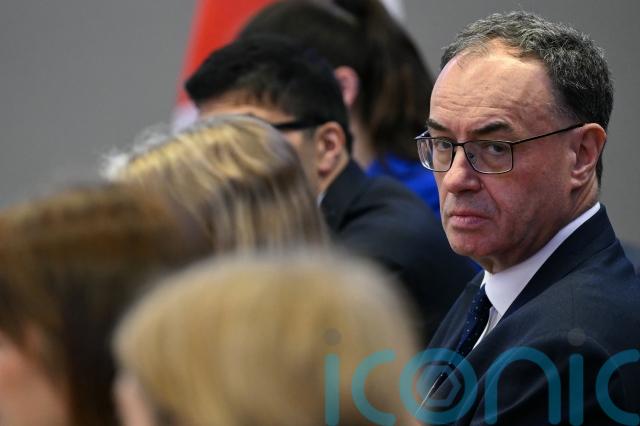
He responded: “It is a very difficult time to have this happen, but frankly, any time would be pretty difficult to have this happen.
“This is a major shock to energy prices, and we have to deal with it.”
He said the “sustainable rate of growth” in the UK needs to be raised which could come from investment from pensions and artificial intelligence.
“I’m not starry-eyed about it, but it is probably the most likely area that we’re going to raise the growth rate of the economy and that’s important”, he said of AI.
The MPC signalled that if the conflict persists and has a bigger impact on UK prices, it would need to take a “more restrictive policy stance”, which indicates higher interest rates to control inflation.
The governor added: “The longer it goes on… I’m afraid to say, but it is rather an obvious point, the effect will be larger.”
He said that is why it is “imperative” that “everything is done that can be done to alleviate this effect”, adding: “That is the critical thing.”

Subscribe or register today to discover more from DonegalLive.ie
Buy the e-paper of the Donegal Democrat, Donegal People's Press, Donegal Post and Inish Times here for instant access to Donegal's premier news titles.
Keep up with the latest news from Donegal with our daily newsletter featuring the most important stories of the day delivered to your inbox every evening at 5pm.

This publication supports the work of the Press Council of Ireland and Office of the Press Ombudsman, and our staff operate within the Code of Practice of the Press Council. You can obtain a copy of the Code, or contact the Council, at www.presscouncil.ie, Lo-call 1800 208 080 or email: info@presscouncil.ie.