Search


01 Apr 2026
Search
01 Apr 2026

Please allow ads as they help fund our trusted local news content.
Kindly add us to your ad blocker whitelist.
If you want further access to Ireland's best local journalism, consider contributing and/or subscribing to our free daily Newsletter .
Support our mission and join our community now.
To continue reading this article, you can subscribe for as little as €0.50 per week which will also give you access to all of our premium content and archived articles!
Alternatively, you can pay €0.50 per article, capped at €1 per day.
Thank you for supporting Ireland's best local journalism!


Rachel Reeves said the Government is “preparing for all eventualities” as the Iran war hits the economy and pushes up fuel and energy costs for consumers.
But the Chancellor indicated there was no prospect of immediate help from the Treasury for hard-hit motorists who have seen the cost of filling up at petrol stations soar since the Middle East crisis began.
And she suggested a package of support for energy bills would not come until the autumn, because most households are covered by the current price cap until the end of June and the next cap will cover the summer when gas usage is generally lower.
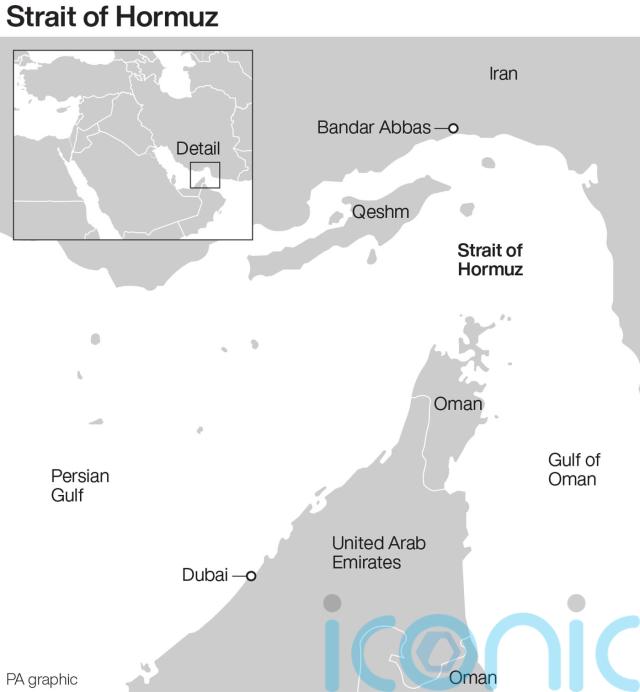
Ms Reeves’s comments to BBC Breakfast came ahead of Sir Keir Starmer updating the nation from Downing Street on the Government’s response to the cost-of-living squeeze resulting from Iran’s effective closure of the Strait of Hormuz oil and gas shipping route.
The Chancellor said: “We’re preparing for all eventualities.
“We’ve already taken action with heating oil, for example, fuel duty is frozen until September and people will see from today a fall in their energy bills.
“But my principle – and judge me on my actions because ever since I became Chancellor, almost two years ago, I have been doing everything in my power to drive down the cost of living – we want to keep down prices for everyone, and then also have more targeted support.”
Ms Reeves has already indicated that she will not provide a Liz Truss-style blanket energy bailout for households, instead focusing help if it is needed on the poorest.
The price most households pay for energy under regulator Ofgem’s price cap fell by 7%, or £117 a year, to £1,641 from Wednesday.
But respected energy analyst Cornwall Insight said its prediction for the watchdog’s price cap from July to September now stands at £1,929 for a typical dual fuel household – an increase of £288 or 18% on April’s cap.
She indicated that help may not be in place until regulator Ofgem sets the price cap from October until the end of the year.
She said: “From July to September, gas usage, especially by families and pensioners, is the lowest of any months of the year, because it is the summer months.
“And then it will be, really from the autumn onwards, that people’s gas usage starts increasing.
“So at the moment, we’re working on a range of contingencies, and we are looking at more targeted measures.”
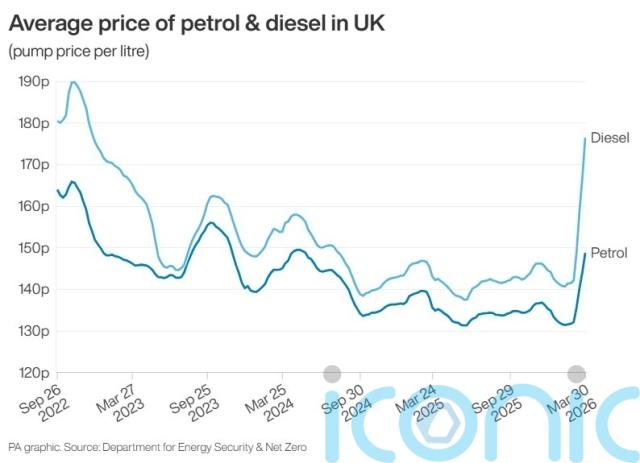
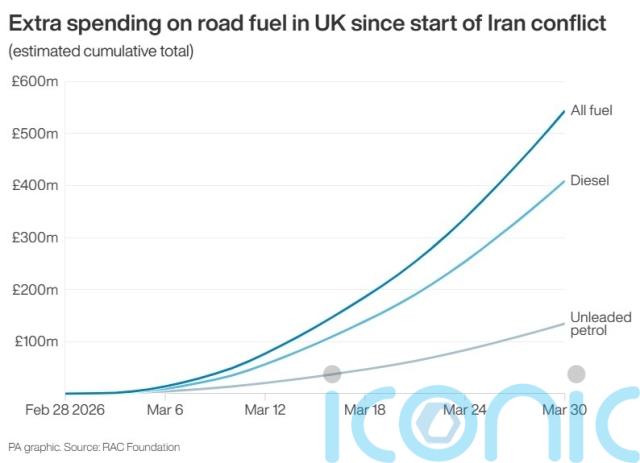
The spike in oil prices has pushed up the cost on forecourts across the country.
Average diesel prices on Tuesday were 182.8p per litre, up 40p since the start of the conflict on February 28, with petrol at 152.8p per litre, an increase of 20p.
Fuel duty is frozen until September and the scheduled increase is under review, but other countries have already cut taxes on petrol and diesel.
But Ms Reeves said she had to be cautious with the nation’s finances to avoid increasing inflation, interest rates and Government borrowing costs.
“If I promised that I could alleviate every price increase for every person, I wouldn’t be telling the truth, because all that you will be doing if you do that is pushing up inflation, interest rates and taxes in the future,” she said.
“We’re working now on contingencies for a whole range of scenarios to ensure that we can step in without spending money that we can’t afford as a country and will only end up putting up prices.”
The Chancellor will meet supermarket bosses and regulators on Wednesday to discuss the impact on consumers.
The extent of the economic disruption could depend on US President Donald Trump’s approach to the Strait of Hormuz.
He has indicated he is prepared to walk away from the military campaign he started with Israel against Iran without securing the reopening of the vital maritime chokepoint.
The US president said the UK and other countries that did not take part in strikes against Iran should secure the Strait of Hormuz themselves and “go get your own oil”.
Mr Trump claimed the UK was among several countries which “can’t get jet fuel” ahead of the Easter bank holiday weekend – a suggestion denied by industry body Airlines UK.
Sir Keir has faced calls to ease the cost of living from Conservative shadow chancellor Sir Mel Stride, who said his party “will get Britain drilling in the North Sea, cut bills by £200, lower taxes, and deliver a stronger economy and a stronger country”.

Subscribe or register today to discover more from DonegalLive.ie
Buy the e-paper of the Donegal Democrat, Donegal People's Press, Donegal Post and Inish Times here for instant access to Donegal's premier news titles.
Keep up with the latest news from Donegal with our daily newsletter featuring the most important stories of the day delivered to your inbox every evening at 5pm.

This publication supports the work of the Press Council of Ireland and Office of the Press Ombudsman, and our staff operate within the Code of Practice of the Press Council. You can obtain a copy of the Code, or contact the Council, at www.presscouncil.ie, Lo-call 1800 208 080 or email: info@presscouncil.ie.