Search


10 Apr 2026
Search
10 Apr 2026

Please allow ads as they help fund our trusted local news content.
Kindly add us to your ad blocker whitelist.
If you want further access to Ireland's best local journalism, consider contributing and/or subscribing to our free daily Newsletter .
Support our mission and join our community now.
To continue reading this article, you can subscribe for as little as €0.50 per week which will also give you access to all of our premium content and archived articles!
Alternatively, you can pay €0.50 per article, capped at €1 per day.
Thank you for supporting Ireland's best local journalism!


This fact check was written by Full Fact, the UK’s largest fact checking charity working to find, expose and counter the harms of bad information.
Over the past few months, both Labour and the Conservatives have claimed Reform UK and the party’s leader Nigel Farage MP have broken promises made during last year’s local elections that Reform councils would cut council tax.
Mr Farage has denied this, saying repeatedly that he never promised to cut council tax, while Reform has defended its record, claiming that it has implemented lower council tax increases than other political parties and that some of its councils have delivered a “real terms tax cut” by increasing council tax by less than the rate of inflation.
So did Reform break its promises? We couldn’t find any evidence that Mr Farage had explicitly promised to cut or freeze council tax, but some local Reform candidates did say they would (including some now running local authorities), and that has not yet happened.
This article focuses on council tax in England (local taxes are devolved in Northern Ireland, Scotland and Wales). The figures throughout are based on council tax rates set by upper-tier local authorities in England (London boroughs, metropolitan boroughs, county councils and unitary authorities) for Band D properties, excluding parish precepts, for 2026/27.
Did Nigel Farage promise to ‘cut council tax’?
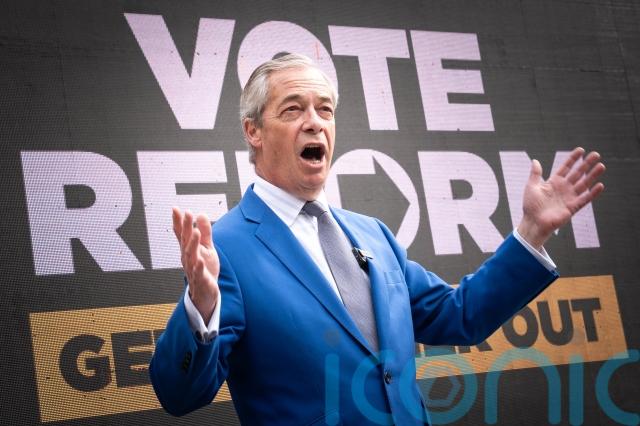
Both Labour and the Conservatives have cited a leaflet circulated widely by Reform UK during the 2025 local election campaign with a pledge to “reduce waste and cut your taxes” next to an image of Mr Farage, while the Conservatives also highlighted a speech Mr Farage gave in March 2025, in which he said “we will cut taxes”.
Neither of these specifically mention council tax, and while it could be reasonably assumed that during a local election campaign references to cutting taxes might be taken to mean council tax, there’s also some evidence that this pledge referred to what Reform would do at a national level were it to be in government.
For example, the mention of cutting taxes in Mr Farage’s speech came during a section where he talked about what his party would do if it won the next general election, and was immediately followed by a specific commitment to increase income tax thresholds (which are not set by local authorities).
Similarly, the leaflet pledge to “reduce waste and cut your taxes” doesn’t specifically mention council tax, and is listed alongside two other commitments (to “freeze immigration and stop the boats” and to “scrap Net Zero to cut your energy bills”) which are clearly national pledges. (Mr Farage said in March 2026 that all three of these commitments referred to national policies).
We’ve asked both Labour and the Conservatives if they’ve any evidence of Mr Farage specifically referencing cutting or freezing council tax during the 2025 local election campaign, but have not received a response from either.
Some Reform UK candidates did pledge to cut council tax
Although we couldn’t find any evidence of Mr Farage himself specifically pledging to cut council tax, we’ve found several examples of local candidates promising to “cut” or “freeze” council tax during last year’s local elections.
In North Northamptonshire, which Reform UK won control of in 2025, a letter signed by three local candidates, all of whom are now councillors (although one currently sits as an independent) explicitly pledged to “freeze council tax”.
In Leicestershire, shortly after being confirmed as council leader, Reform’s Dan Harrison said: “We’re now looking at the cost, the efficiency, we’ll then have money for frontline [services] but we’ll also be able to cut council tax.”
A spokesperson for Mr Harrison was unable to provide comment due to pre-election restrictions, but directed us to a press release which noted that Leicestershire’s council tax increase for 2026/27 was “the first time in a decade that the maximum increase hasn’t been taken”.
Following his election last year, Durham council leader Andrew Husband said: “It is our ambition not to have another council tax increase next year” (though he described this as “something to strive for” rather than a firm commitment).
Mr Husband told Full Fact: “There are targets still in place to relieve the financial pressure on our residents and nine months under the bonnet and we were able to deliver the lowest council tax increase in 15 years with no use of reserves, at 1.99% increase on social care precept and 0% on core council tax.” He added: “If Labour hadn’t [have] increased our NI contribution by £8m gross annually we would have achieved 0% on the social care precept too.”
Other leaflets promoting Reform candidates who ultimately weren’t elected pledged to “fight to reduce council tax” and to “freeze council tax & business rates”, while one local candidate said “Reform Councils will freeze, then cut your council tax bills”.
We’ve asked Reform UK whether these commitments were authorised by the party, but did not receive a response. We found at least one example of a local candidate committing to “lowering council tax” being shared by the party’s official X account.
In addition, a Reform leaflet featuring a picture of Nigel Farage alongside text which says “we fight for lower council tax” circulated in several different local areas.
Asked in an interview about this particular pledge, Mr Farage said that Reform had delivered lower council tax increases than other parties.
Another leaflet which circulated in a number of local areas, including West Northamptonshire (won by Reform), included a pledge to “reduce council waste to help cut your taxes” alongside an image of Mr Farage. While this doesn’t explicitly refer to council tax, it appears implied by linking the pledge to reducing council waste.
What has actually happened?
Council tax increases have now been confirmed for 2026/27. Among upper-tier councils, every single one has increased council tax, and three-quarters increased it by the maximum allowed without holding a referendum (4.99%). None of the upper-tier local authorities mentioned above where Reform explicitly pledged to freeze or cut council tax have done so.
Currently, Reform has majority control of nine upper-tier local authorities—the council tax increases for these are:
– Derbyshire (4.9%)
– Durham (1.99%)
– Kent (3.99)
– Lancashire (3.8%)
– Lincolnshire (2.9%)
– North Northamptonshire (4.99%)
– Nottinghamshire (3.99%)
– Staffordshire (3.99%)
– West Northamptonshire (4.95%)
Reform has minority control of three upper-tier local authorities—the council tax increases for these are:
– Leicestershire (2.99%)
– Warwickshire (4.44%)
– Worcestershire (8.98%, with special permission from the UK government to increase beyond 4.99% without holding a referendum).
One local authority, Doncaster City Council, has a Reform majority, but is nominally controlled by Labour under its directly-elected mayor. A proposed increase of 4.99% was lowered to 2% by a Reform amendment.
Based on the current rate of CPI inflation (around 3%), three councils controlled by Reform (Durham, Lincolnshire and Leicestershire) have implemented effective real terms decreases.
How does Reform compare to other parties?
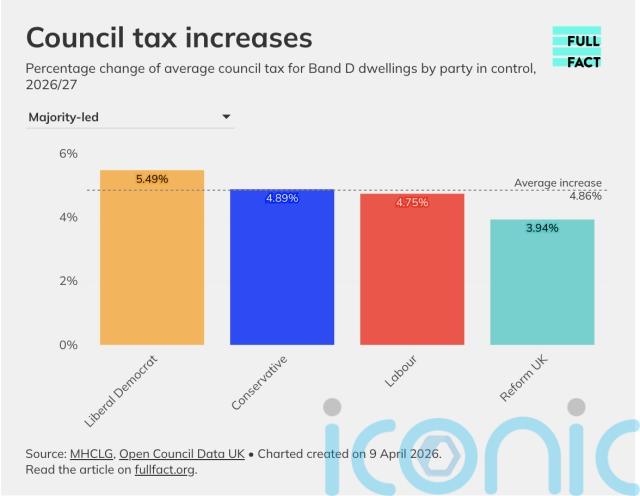
Reform claims to have delivered the lowest average council tax increase of any major party, at 3.94%. Looking specifically at upper-tier councils where one party has majority control, this is correct. The nine upper-tier councils controlled by a Reform majority increased Band D council tax for 2026/27 by an average of 3.94%—lower than the overall average increase of 4.86%.

Subscribe or register today to discover more from DonegalLive.ie
Buy the e-paper of the Donegal Democrat, Donegal People's Press, Donegal Post and Inish Times here for instant access to Donegal's premier news titles.
Keep up with the latest news from Donegal with our daily newsletter featuring the most important stories of the day delivered to your inbox every evening at 5pm.

This publication supports the work of the Press Council of Ireland and Office of the Press Ombudsman, and our staff operate within the Code of Practice of the Press Council. You can obtain a copy of the Code, or contact the Council, at www.presscouncil.ie, Lo-call 1800 208 080 or email: info@presscouncil.ie.