Search


22 Apr 2026
Search
22 Apr 2026

Please allow ads as they help fund our trusted local news content.
Kindly add us to your ad blocker whitelist.
If you want further access to Ireland's best local journalism, consider contributing and/or subscribing to our free daily Newsletter .
Support our mission and join our community now.
To continue reading this article, you can subscribe for as little as €0.50 per week which will also give you access to all of our premium content and archived articles!
Alternatively, you can pay €0.50 per article, capped at €1 per day.
Thank you for supporting Ireland's best local journalism!


Inflation climbed higher last month as the knock-on-effects from the Iran war started to hit the cost of living for UK households.
The Office for National Statistics reported an annual rate of Consumer Prices Index (CPI) inflation of 3.3% for March, increasing from 3% last month.
It meant inflation picked up to its highest level since December, with higher fuel prices a significant driver.
Here, the Press Association looks at what caused the rise in inflation, how high it might climb, and what it could mean for households.
– What is inflation?
Inflation is the term used to describe the rising price of goods and services.
The inflation rate refers to how quickly prices are going up.
March’s inflation rate of 3.3% means if an item cost £100 a year ago, it would now cost £103.30.
It means that prices are rising are at the same pace they were a month earlier.
– What caused inflation to increase?
The March data showed that higher fuel prices were the main driver in the uptick in inflation.
The price of motor fuels jumped by 8.7% month-on-month – the largest increase since June 2022, shortly after the Russian invasion of Ukraine.
It came after the conflict between US-Israeli and Iranian forces since the end of February impacted energy production and transportation through the Strait of Hormuz, putting pressure on oil and gas supply and therefore driving prices higher.
The average price of petrol rose by 8.6p per litre between February and March to 140.2p per litre. This marked the highest price since August 2024.
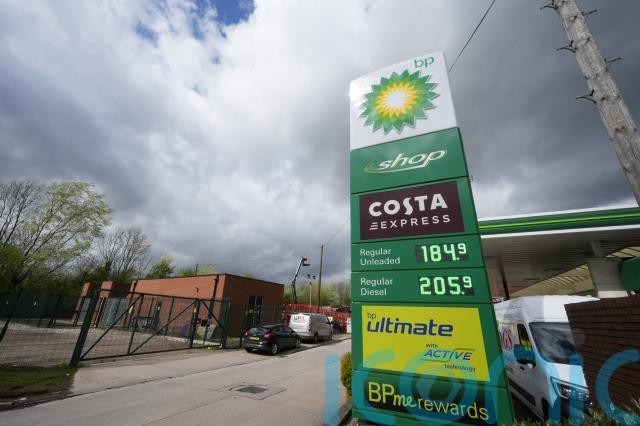
Diesel prices meanwhile increased by 17.6p per litre in March to an average of 158.7p per litre, the highest price since November 2023.
An increase in the cost of air travel also contributed to the higher rate of inflation.
The 14.5% year-on-year rise in air fares, which analysts partly linked to the early timing of the Easter holidays, was the highest since July last year.
Elsewhere, food and drink price inflation also accelerated, driven by monthly increases in the price of products such as chocolate, coffee and fresh fish.
– Is inflation falling in any areas?
Not all prices have been increasing despite the broader rise in UK inflation.
The data showed that clothing and footwear had a downward pressure on inflation, as prices dipped 0.8% for the month.
Sales and discounting activity pulled inflation in the category to its lowest level since March 2021.
Some food products have also dipped in recent months, such as bacon, cheese and bread, which all fell month-on-month in March.
– Will the Iran war lead to further inflation?
The ONS indicated that fuel prices was the main area where the impact of the Iran conflict has already fed into their data.
While jet fuel costs have risen, the ONS said that air fares are based on previously booked flights, meaning that the March data was not yet impacted by inflation linked to the conflict.
It therefore means that air fare inflation is likely to continue to rise further into this year as higher jet fuel costs are passed onto passengers.
Analysts at Cornwall Insight have also predicted that future household energy bills will increase as a result of the conflict.
However, this increase – most recently predicted to be around 12% – will come into force in July, with energy bills in April actually set to fall by an average of 7% due to a previously announced cap.
The Consumer Prices Index (CPI) rose by 3.3% in the 12 months to March 2026, up from 3.0% in the 12 months to February 2026.
Read more on the March inflation figures ➡️ https://t.co/IkzAuUmbLX pic.twitter.com/aesupoNkFJ
— Office for National Statistics (ONS) (@ONS) April 22, 2026
– How high could inflation go?
Inflation is likely to have dipped in April, largely due to the impact of the lower energy price cap, when data is released next month.
Adam Hoyes, analyst at Rathbones, predicted that inflation will slow to 3% next month as a result.
Nevertheless, inflation is then expected to return to an upward trajectory as more conflict-linked price increases feed into the figures.
Matt Swannell, chief economic adviser to the ITEM Club, said he expects “inflation to rise to close to 4%” in the second half of 2026 before easing back.
However, other analysts were more cautious about the potential increase.
ING’s James Smith estimated that current changes in energy prices are “consistent with inflation peaking around 3.5%”.
Commenting on today’s inflation figures, ONS Chief Economist Grant Fitzner said 💬 pic.twitter.com/W7g2569Xws
— Office for National Statistics (ONS) (@ONS) April 22, 2026
– What does it mean for interest rates?
Last month, the Bank of England voted to maintain interest rates at their current level of 3.75%, highlighting uncertainty linked to the conflict.
Higher interest rates are typically used as a tool to drag on demand in an effort to offset concerns over rising inflation, with the central bank seeking to bring inflation to around 2%.
The Bank’s monetary policy committee (MPC), a nine-strong group of policymakers, will vote over whether to maintain, increase or decrease interest rates next week.
Rob Wood, chief UK economist at Pantheon Macroeconomics, suggested that current inflation projections are “not high enough to scare the MPC into hiking rates imminently”.
Investec’s Philip Shaw also indicated that the Bank’s rate-setters could “sit tight and avoid raising rates”, predicting that interest rates reductions could be “back on the cards at some stage in early 2027”.

Subscribe or register today to discover more from DonegalLive.ie
Buy the e-paper of the Donegal Democrat, Donegal People's Press, Donegal Post and Inish Times here for instant access to Donegal's premier news titles.
Keep up with the latest news from Donegal with our daily newsletter featuring the most important stories of the day delivered to your inbox every evening at 5pm.

This publication supports the work of the Press Council of Ireland and Office of the Press Ombudsman, and our staff operate within the Code of Practice of the Press Council. You can obtain a copy of the Code, or contact the Council, at www.presscouncil.ie, Lo-call 1800 208 080 or email: info@presscouncil.ie.