RIP: Tragic update from gardaí as search for missing boy (14) is stood down
Search


14 Dec 2025

Please allow ads as they help fund our trusted local news content.
Kindly add us to your ad blocker whitelist.
If you want further access to Ireland's best local journalism, consider contributing and/or subscribing to our free daily Newsletter .
Support our mission and join our community now.
To continue reading this article, you can subscribe for as little as €0.50 per week which will also give you access to all of our premium content and archived articles!
Alternatively, you can pay €0.50 per article, capped at €1 per day.
Thank you for supporting Ireland's best local journalism!


Second World War veterans watched military aircraft fly over a Dutch town as the Netherlands marked the 80th anniversary of its liberation by Allied troops from Nazi Germany’s occupation.
Festivities in Wageningen centred on a square outside the Hotel de Wereld, where German top brass signed papers on May 5 1945 that formally ended the brutal five-year occupation as the war drew to a close across Europe.
A small group of veterans, their chests decorated with medals and legs covered in blankets, sat on the front row watching the ceremony. They were given a standing ovation as they arrived.
Germany finally surrendered on May 8, now known as Victory in Europe Day.
Liberation Day in the Netherlands is celebrated on May 5, a day after the country observes two minutes of silence to honour its war dead.
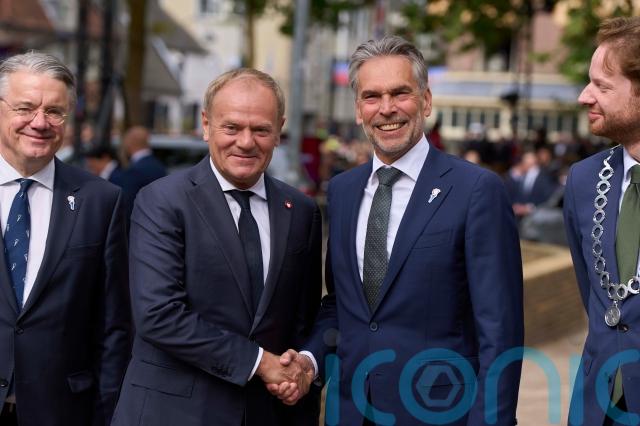
Dutch defence minister Ruben Brekelmans used the occasion to call for renewed efforts to nurture peace.
“War and aggression are back in Europe and it is up to us to protect peace,” he said.
Mr Brekelmans’ speech was briefly disturbed by a small group of protesters who shouted “Free Palestine”. Police detained five people as Mr Brekelmans continued to address the crowd, some of whom booed at the demonstrators as they were led away.
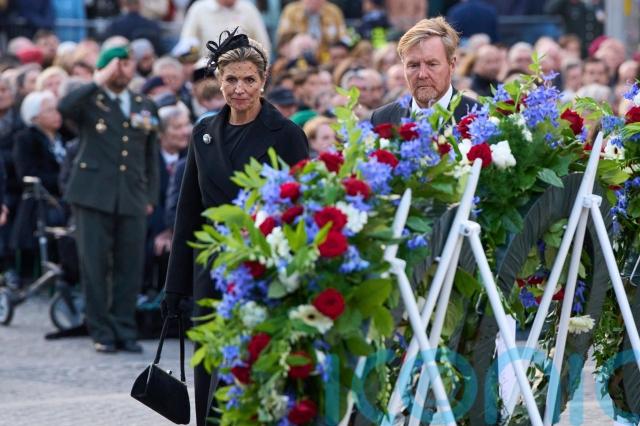
On Sunday, Dutch King Willem-Alexander and others laid wreaths at the national monument in Amsterdam, and two veterans lit a liberation fire in Wageningen hours later.
Mervyn Kersh, a 100-year-old veteran from Britain, and Nick Janicki, 101, from Canada, ignited the flame. Some 50 veterans from around the world were expected to attend Monday’s celebrations.
Polish President Donald Tusk, whose country holds the rotating European Union presidency, also gave a speech at the event. Polish troops were among Allied forces who helped liberate the Netherlands.
The country’s southern regions were freed in 1944 but the populous western regions had to wait months and endure famine known as the Hunger Winter that killed thousands.
Mr Tusk made an impassioned plea for European and transatlantic unity, saying: “The experience gained 80 years ago tells us that only when (we) stand together can we overcome.”
He added that “in the face of the threat posed by (President Vladimir) Putin’s Russia we need to deepen our European and transatlantic life, and we need genuine solidarity.”
Events across Europe marking the end of the war come as the traditional friendly links with the United States, whose forces helped liberate the Netherlands and much of the continent, are fraying.
The European Union and the administration of President Donald Trump are now embroiled in a trade war.
Mr Tusk appealed for unity at a time of global insecurity.
“Genuine solidarity between people and nations that will prevent the evil from shaping our present and future,” he said. “The time of Europe’s carefree comfort, joyous unconcern is over. Today is the time of European mobilisation around our fundamental values and our security.”
On Sunday in Amsterdam, Prime Minister Dick Schoof discussed the grief his family felt over the death of his grandfather, who was executed by Nazi soldiers for his work in the resistance.
“On this day, in the two minutes of silence, that echo sounds extra loud. When we think of all the people who were murdered for who they were, who died of hunger or exhaustion, or who fought for peace and freedom — our peace and freedom,” Mr Schoof said.

Subscribe or register today to discover more from DonegalLive.ie
Buy the e-paper of the Donegal Democrat, Donegal People's Press, Donegal Post and Inish Times here for instant access to Donegal's premier news titles.
Keep up with the latest news from Donegal with our daily newsletter featuring the most important stories of the day delivered to your inbox every evening at 5pm.

This publication supports the work of the Press Council of Ireland and Office of the Press Ombudsman, and our staff operate within the Code of Practice of the Press Council. You can obtain a copy of the Code, or contact the Council, at www.presscouncil.ie, Lo-call 1800 208 080 or email: info@presscouncil.ie.