The numbers in last night’s (10th January) Lotto draw were: 5, 10, 24, 30, 36, 40 and the Bonus was 42
Search


11 Jan 2026

Please allow ads as they help fund our trusted local news content.
Kindly add us to your ad blocker whitelist.
If you want further access to Ireland's best local journalism, consider contributing and/or subscribing to our free daily Newsletter .
Support our mission and join our community now.
To continue reading this article, you can subscribe for as little as €0.50 per week which will also give you access to all of our premium content and archived articles!
Alternatively, you can pay €0.50 per article, capped at €1 per day.
Thank you for supporting Ireland's best local journalism!


A crackdown on nationwide protests in Iran has killed at least 538 people and even more are feared dead, activists said, while Tehran warned that the US military and Israel would be “legitimate targets” if America uses force to protect demonstrators.
More than 10,600 people have been detained over the two weeks of protests, said the US-based Human Rights Activists News Agency, which has been accurate in previous rounds of unrest in Iran in recent years.
It relies on activists in Iran cross-checking information.
With the internet down in Iran and phone lines cut off, gauging the demonstrations from abroad has grown more difficult.
The Iranian government has not offered overall casualty figures for the demonstrations.
The Associated Press has been unable to independently assess the toll, given that internet and international phone calls are now blocked in Iran.
Those abroad fear the information blackout is emboldening hardliners within Iran’s security services to launch a bloody crackdown.
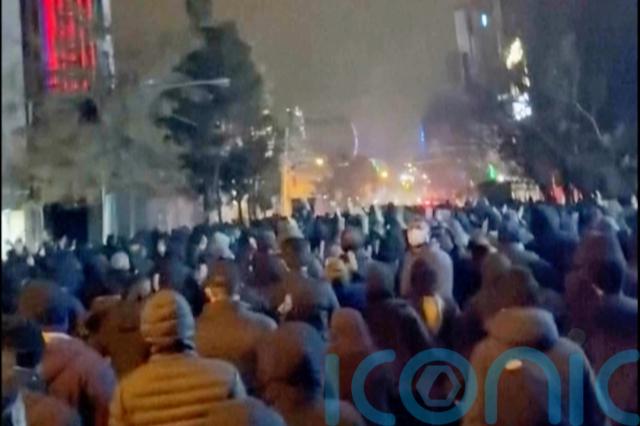
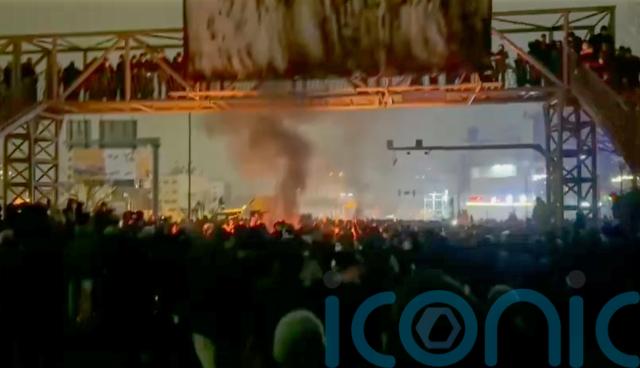
Protesters flooded the streets in the country’s capital Tehran and its second-largest city again on Sunday morning.
US President Trump offered support for the protesters, saying on social media that “Iran is looking at FREEDOM, perhaps like never before. The USA stands ready to help!!!”
Mr Trump and his national security team have been weighing a broad range of potential responses against Iran, including cyber attacks and direct strikes by either US or Israel, according to two people familiar with internal White House discussions.
The White House, which did not immediately respond to a request for comment, has not indicated it has made any decisions.
The massive ongoing US military deployment to the Caribbean has created another factor that the Pentagon and Mr Trump’s national security planners must consider.
The threat to strike the US military and Israel came during a parliamentary speech on Sunday from Mohammad Baagher Qalibaf, the hardliner speaker of the body who has run for the presidency in the past.
He directly threatened Israel, “the occupied territory” as he referred to it, and the US military, possibly with a pre-emptive strike.
“In the event of an attack on Iran, both the occupied territory and all American military centres, bases and ships in the region will be our legitimate targets,” Mr Qalibaf said.
“We do not consider ourselves limited to reacting after the action and will act based on any objective signs of a threat.”
Legislators rushed the dais in the Iranian parliament, shouting: “Death to America!”
It remains unclear just how serious Iran is about launching a strike, particularly after its air defences were destroyed during the 12-day war in June with Israel.
Any decision to go to war would rest with Iran’s 86-year-old Supreme Leader Ayatollah Ali Khamenei.
The US military has said in the Middle East it is “postured with forces that span the full range of combat capability to defend our forces, our partners and allies and US interests”.
Iran targeted US forces at Al Udeid Air Base in Qatar back in June, while the US navy’s Middle East-based 5th Fleet is stationed in the island kingdom of Bahrain.
Israel, meanwhile, is “watching closely” the situation between the US and Iran, said an Israeli official.
Israeli Prime Minister Benjamin Netanyahu spoke to US secretary of state Marco Rubio overnight on topics including Iran, the official added.
“The people of Israel, the entire world, are in awe of the tremendous heroism of the citizens of Iran,” said Mr Netanyahu, a longtime Iran hawk.
At the Vatican, Pope Leo XIV mentioned Iran as a place “where ongoing tensions continue to claim many lives”.
“I hope and pray that dialogue and peace may be patiently nurtured in pursuit of the common good of the whole of society,” he said.
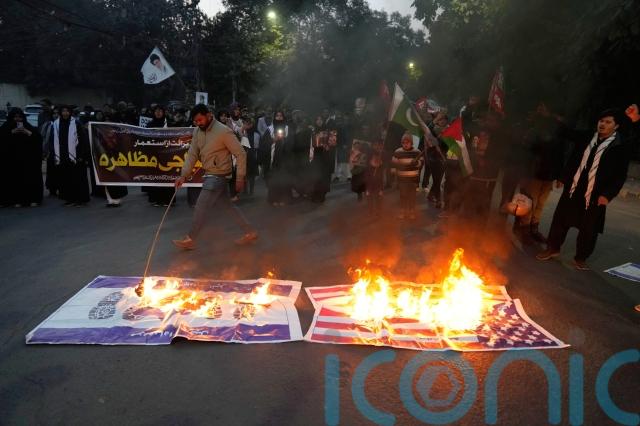
Demonstrations were held in some international capitals in support of the protesters.
A spokesperson said UN secretary-general Antonio Guterres was “shocked” by reports of violence against protesters resulting in “scores of deaths” and called on Iranian authorities to use maximum restraint and restore communications.
Online videos sent out of Iran, likely to be using Starlink satellite transmitters, purportedly showed demonstrators gathering in northern Tehran’s Punak neighbourhood.
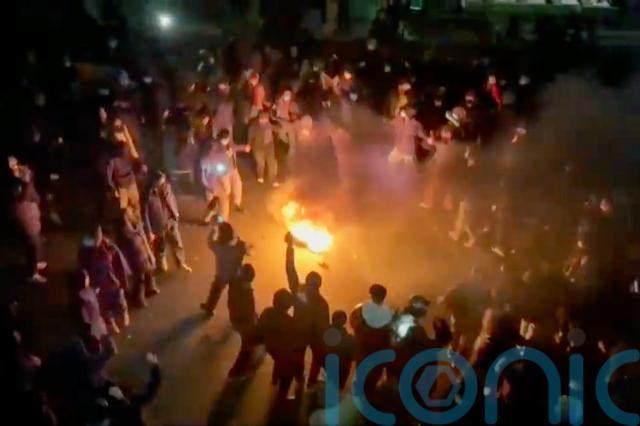
There, it appeared authorities shut off streets, with protesters waving their lit mobile phones.
Others banged metal while fireworks went off.
“The pattern of protests in the capital has largely taken the form of scattered, short-lived, and fluid gatherings, an approach shaped in response to the heavy presence of security forces and increased field pressure,” the Human Rights Activists News Agency said.
“Reports were received of surveillance drones flying overhead and movements by security forces around protest locations, indicating ongoing monitoring and security control.”
In Mashhad, Iran’s second-largest city some 725 kilometres (450 miles) north east of Tehran, footage purported to show protesters confronting security forces.
Protests also appeared to happen in Kerman, 800 kilometres (500 miles) south east of Tehran.
Iranian state television on Sunday morning had their correspondents appear on the streets in several cities to show calm areas with a date stamp shown on screen.
Tehran and Mashhad were not included.
Government rhetoric also ratcheted up on Sunday.
Ali Larijani, a top security official, accused some demonstrators of “killing people or burning some people, which is very similar to what Isis does”, referring to the so-called Islamic State group by an acronym.
State TV aired funerals of killed security force members while reporting another six had been killed in Kermanshah.
In Fars province, violence killed 13 people, and seven security forces were killed in North Khorasan province, it added.
It also showed a pick-up truck full of bodies in body bags and later a morgue.
Even Iran’s reformist president Masoud Pezeshkian, who had been trying to ease anger before the demonstrations exploded in recent days, offered a hardening tone in an interview aired on Sunday.
“People have concerns, we should sit with them and if it is our duty, we should resolve their concerns,” Mr Pezeshkian said.
“But the higher duty is not to allow a group of rioters to come and destroy the entire society.”
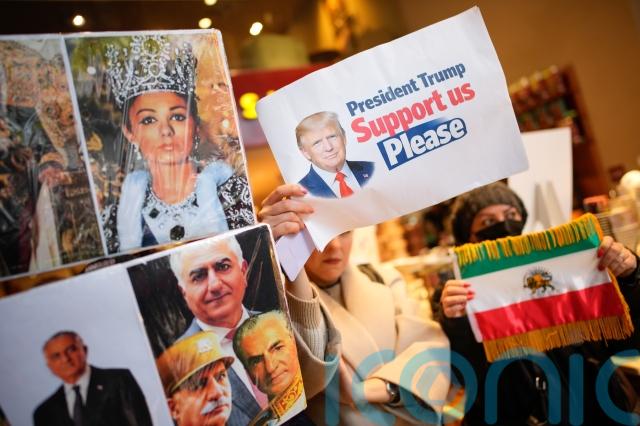
Iran’s exiled Crown Prince Reza Pahlavi asked in his latest message for demonstrators to take to the streets on Sunday.
Demonstrators have shouted in support of the shah in some protests, but it is not clear whether that is support for Mr Pahlavi himself or a desire to return to a time before the 1979 Islamic Revolution.
Mr Pahlavi’s support of and from Israel has drawn criticism in the past, particularly after the 12-day war.
The demonstrations began on December 28 over the collapse of the Iranian rial currency, which trades at more than 1.4 million to one dollar, as the country’s economy is squeezed by international sanctions in part levied over its nuclear programme.
The protests intensified and grew into calls directly challenging Iran’s theocracy.

Subscribe or register today to discover more from DonegalLive.ie
Buy the e-paper of the Donegal Democrat, Donegal People's Press, Donegal Post and Inish Times here for instant access to Donegal's premier news titles.
Keep up with the latest news from Donegal with our daily newsletter featuring the most important stories of the day delivered to your inbox every evening at 5pm.

This publication supports the work of the Press Council of Ireland and Office of the Press Ombudsman, and our staff operate within the Code of Practice of the Press Council. You can obtain a copy of the Code, or contact the Council, at www.presscouncil.ie, Lo-call 1800 208 080 or email: info@presscouncil.ie.