Search


23 Jan 2026
Search
23 Jan 2026

Please allow ads as they help fund our trusted local news content.
Kindly add us to your ad blocker whitelist.
If you want further access to Ireland's best local journalism, consider contributing and/or subscribing to our free daily Newsletter .
Support our mission and join our community now.
To continue reading this article, you can subscribe for as little as €0.50 per week which will also give you access to all of our premium content and archived articles!
Alternatively, you can pay €0.50 per article, capped at €1 per day.
Thank you for supporting Ireland's best local journalism!


Negotiators from Ukraine, Russia and the United States are expected to meet for peace talks in Abu Dhabi on Friday.
Volodymyr Zelensky said the future of Ukraine’s eastern Donbas region will be a key focus as negotiators from all three nations hold talks for the first time since Russia’s full-scale invasion of Ukraine nearly four years ago.
The three-way talks come hours after Russian President Vladimir Putin discussed the settlement in Ukraine with US President Donald Trump’s envoys during marathon overnight talks. The Kremlin insisted that to reach a peace deal, Kyiv must withdraw its troops from the areas in the east that Russia illegally annexed but never fully captured.
Mr Zelensky, meanwhile, reiterated his openness to establishing a free trade zone under Ukraine’s control in the country’s east. He said he discussed the proposal with Mr Trump in Davos, Switzerland, on Thursday and told reporters: “I think it will be positive for our business.”
Friday is the first known time that officials from the Trump administration simultaneously meet with negotiators from both Ukraine and Russia. While it is unclear how the talks will unfold and many obstacles to peace remain, some see it as a sign that the parties are making headway in closing a deal.
Mr Zelensky told reporters after meeting with Mr Trump that while the future status of land in eastern Ukraine currently occupied by Russia remains unresolved, the peace proposals are “nearly ready”.
Davos. Support for Ukraine. Air defense for Ukraine. Meetings for Ukraine.
We are returning home with agreements on a new package of critically needed air defense for the protection of our people. pic.twitter.com/o0PezBKvXJ
— Volodymyr Zelenskyy / Володимир Зеленський (@ZelenskyyUa) January 22, 2026
“Today’s meeting will be in the format of Ukraine, Russia and the United States, and afterward the Europeans will certainly receive feedback from us,” he told journalists in a WhatsApp audio message.
The Kremlin offered little detail beyond calling the meeting a “working group on security issues”.
Kremlin spokesman Dmitry Peskov said that the Russian delegation is comprised of military officials. He said the talks could extend into Saturday “if necessary”.
Separately, Mr Putin’s envoy Kirill Dmitriev will hold talks with Mr Trump’s envoy Steve Witkoff on economic issues, he confirmed.
The Kremlin meeting, which lasted past 3am on Friday, came hours after Mr Zelensky sharply criticised his European allies on Thursday for what he cast as their slow and fragmented response that he said has left Ukraine at the mercy of Mr Putin amid an ongoing US push for a peace settlement.
Kremlin foreign affairs adviser Yuri Ushakov, who participated in Mr Putin’s meeting with Mr Trump’s envoys Mr Witkoff and Jared Kushner, said “it was reaffirmed that reaching a long-term settlement can’t be expected without solving the territorial issue”.
Mr Zelensky said after meeting on Thursday with Mr Trump in Davos, Switzerland, that the future status of land in eastern Ukraine currently occupied by Russia remains unresolved but that peace proposals are “nearly ready”.
Mr Ushakov noted that Mr Trump’s envoys informed Mr Putin about Mr Trump’s meeting with Mr Zelensky, as well as earlier discussions they had with Ukrainian and European officials. The Kremlin talks that he described as “frank, constructive” and “fruitful” began when it was just before midnight in Moscow and lasted nearly four hours.
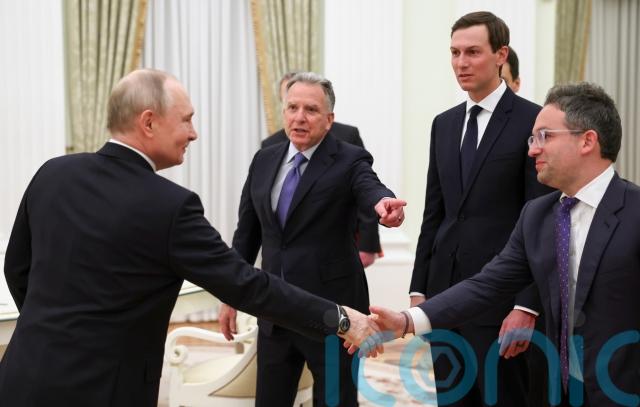
Mr Witkoff and Mr Kushner were joined by Josh Gruenbaum, the head of the Federal Acquisition Service who serves as a senior adviser on Mr Trump’s Board of Peace that Russia has been invited to join. While Russia is considering the invitation, Mr Putin reaffirmed his offer to send 1 billion dollars (£740 million) to the board from Russian assets frozen in the US to help fund rebuilding Gaza.
Asked about Mr Putin’s proposal to use Russia’s frozen assets for the contribution to the Board of Peace, Mr Trump said he thought it was fine. “If he’s using his money, that’s great,” he said
Mr Zelensky met with Mr Trump behind closed doors for about an hour at the World Economic Forum in Davos, describing the meeting as “productive and meaningful”.
Speaking to reporters aboard Air Force One as he flew back to Washington DC from Davos, Mr Trump said his meeting with Mr Zelensky went well, adding that both Mr Putin and Mr Zelensky want to reach a deal and that “everyone’s making concessions” to try to end the war.
He said the sticking points in talks remain the same as they have been during talks held during the past six or seven months, noting “boundaries” was a key issue. “The main hold-up is the same things that’s been holding it up for the last year,” he said.
Russia’s bigger army has managed to capture about 20% of Ukraine since hostilities began in 2014 and its full-scale invasion of 2022. But the battlefield gains along the roughly 600-mile front line have been costly for Moscow, and the Russian economy is feeling the consequences of the war and international sanctions.
Ukraine is short of money and, despite significantly boosting its own arms manufacturing, still needs Western weaponry. It is also short-handed on the front line. Its defence minister last week reported some 200,000 troop desertions, and draft-dodging by around two million Ukrainians.
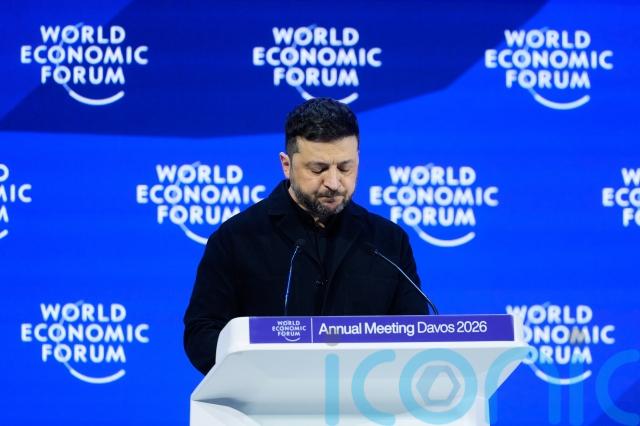
Addressing the World Economic Forum after meeting with Mr Trump, Mr Zelensky listed a litany of grievances and criticisms of Europe.
European countries, which see their own future defence at stake in the war on its eastern flank, have provided financial, military and humanitarian support for Kyiv. But not all members of the 27-nation European Union are helping.
Ukraine has also been frustrated by political disagreements within Europe over how to deal with Russia, as well as the bloc’s at times slow-moving responses.
“Europe looks lost,” Mr Zelensky said in his speech, urging the continent to become a global force. He contrasted Europe’s response with Washington’s bold steps in Venezuela and Iran.
The former comic actor referred to the movie Groundhog Day, in which the main character must relive the same day over and over again.
“Just last year, here in Davos, I ended my speech with the words: Europe needs to know how to defend itself. A year has passed. And nothing has changed. We are still in a situation where I must say the same words again,” Mr Zelensky said.
He condemned Europe for being slow to act on key decisions, spending too little on defence, failing to stop Russia’s “shadow fleet” of oil tankers that are breaking international sanctions, and balking at using its frozen assets in Europe to finance Ukraine, among other things.

Subscribe or register today to discover more from DonegalLive.ie
Buy the e-paper of the Donegal Democrat, Donegal People's Press, Donegal Post and Inish Times here for instant access to Donegal's premier news titles.
Keep up with the latest news from Donegal with our daily newsletter featuring the most important stories of the day delivered to your inbox every evening at 5pm.

This publication supports the work of the Press Council of Ireland and Office of the Press Ombudsman, and our staff operate within the Code of Practice of the Press Council. You can obtain a copy of the Code, or contact the Council, at www.presscouncil.ie, Lo-call 1800 208 080 or email: info@presscouncil.ie.