Search


03 Apr 2026
Search
03 Apr 2026

Please allow ads as they help fund our trusted local news content.
Kindly add us to your ad blocker whitelist.
If you want further access to Ireland's best local journalism, consider contributing and/or subscribing to our free daily Newsletter .
Support our mission and join our community now.
To continue reading this article, you can subscribe for as little as €0.50 per week which will also give you access to all of our premium content and archived articles!
Alternatively, you can pay €0.50 per article, capped at €1 per day.
Thank you for supporting Ireland's best local journalism!


Palestinians lined up on Tuesday on both sides of Gaza’s border with Egypt, hoping to pass through the Rafah crossing after its long-awaited reopening the previous day was marred by delays and uncertainty over who would be allowed through.
On the Egyptian side were Palestinians who had undergone medical treatment in Egypt and had left Gaza earlier in the Israel-Hamas war, according to Egypt’s state-run Al-Qahera News television.
On the Gaza side, Palestinians in need of treatment unavailable in Gaza were brought in busses by the Palestinian Red Crescent from the agency’s headquarters in the territory, hoping for word that they would be allowed to cross the other way.
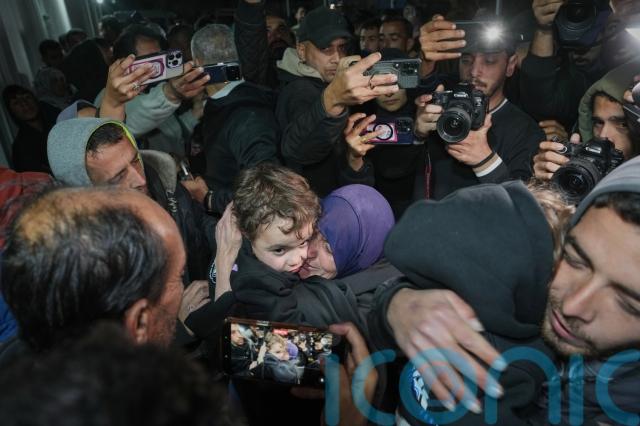
The crossing’s reopening on Monday – though hailed as a step forward for the US-backed, fragile ceasefire struck in October – was marred by delays. It took more than 10 hours for only about a dozen returnees and a small group of medical evacuees to cross in each direction.
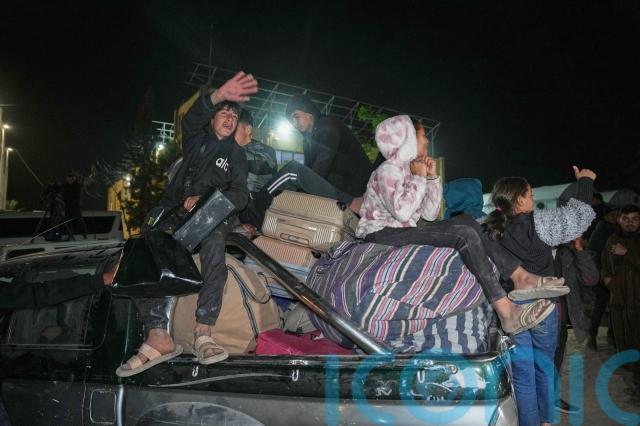
The numbers fell short of the 50 people that officials had said would be allowed in each direction and barely began to address devastated Gaza’s mounting needs – tens of thousands of Palestinians are hoping to be evacuated for treatment or to return home.
Iman Rashwan waited for hours in the Gaza city of Khan Younis until her mother and sister were brought back from Egypt. She said she hopes others would be as lucky to see their loved ones soon.
“God willing, the crossing will open for everyone, for all the sick and for all the wounded,” she said while waiting, adding that everyone just wants things to “return to normal as they were before the war”.
On Tuesday morning, the evacuation effort converged around a Red Crescent hospital in Khan Younis, where a World Health Organisation (WHO) team arrived and a vehicle carrying patients and their relatives rolled in from another hospital.
Then the group of WHO vehicles and Palestinian ambulances headed towards Rafah.
Yesterday, @WHO and partners supported the medical evacuation of 5 patients and 7 companions to #Egypt via the #Rafah Crossing — the first medical evacuation through this route since mid-March 2025. WHO’s role focused on ensuring the safe transfer of patients from #Gaza to the… pic.twitter.com/I1PeuY6cdq
— Tedros Adhanom Ghebreyesus (@DrTedros) February 3, 2026
Palestinian Red Crescent spokesperson Raed al-Nims told the Associated Press on Tuesday that only 16 patients with chronic conditions and war wounds, accompanied by 40 relatives, were brought from Khan Younis to the Gaza side of Rafah.
This was far less than the 45 patients and wounded the Red Crescent was told would be allowed into Egypt, along with 90 relatives, on Tuesday, he said.
Officials say the number of crossings could gradually increase if the system works, with Israel and Egypt vetting those allowed in and out. But security concerns and bureaucratic snags quickly tempered expectations raised by officials who for weeks had cast the reopening as a major step in the ceasefire deal.
On Monday, things got bogged down in disagreements over luggage allowances. The returnees were carrying more than anticipated with them, requiring additional negotiations, a person familiar with the situation told AP.
“They didn’t let us cross with anything,” Rotana Al-Regeb said as she returned around midnight on Monday to Khan Younis. “They emptied everything before letting us through. We were only allowed to take the clothes on our backs and one bag per person.”
The initial number of Palestinians allowed to cross is mostly symbolic. Israeli and Egyptian officials have said that 50 medical evacuees would depart – along with two caretaker escorts – and 50 Palestinians who left during the war would return.
More than 10,000 patients have been evacuated from Gaza since the war began, according to the WHO. But the pace slowed to a crawl, with an average of 17 patients a week leaving since Israel seized the crossing in May 2024 and until the ceasefire.
At a pace of about 50 a day, many of the roughly 20,000 sick and wounded people who Gaza’s Health Ministry has said need treatment abroad will still face long waits. About 150 hospitals across Egypt are ready to receive patients, authorities said.
Who and what would be allowed through Rafah was a central concern for both Israel and Egypt.
Israeli Prime Minister Benjamin Netanyahu has said that anyone who wants to leave will eventually be permitted to do so, but fearing that Israel could use the crossing to push Palestinians out of Gaza, Egypt has repeatedly said it must open in both directions.
Nasser Hospital in Khan Younis said Ahmed Abdel-Al, 19, was shot and killed by Israeli troops on Tuesday morning in a part of the southern Gaza city, some distance away from the area under the Israeli military’s control.
He was the latest of the more than 520 Palestinians killed by Israeli fire since the October 10 start of the ceasefire, according to Gaza’s Health Ministry.
They are among the more than 71,800 Palestinians killed since the start of the war, according to the ministry, which does not say how many were fighters or civilians.
The ministry, part of Gaza’s Hamas-led government, keeps detailed casualty records that are seen as generally reliable by UN agencies and independent experts.

Subscribe or register today to discover more from DonegalLive.ie
Buy the e-paper of the Donegal Democrat, Donegal People's Press, Donegal Post and Inish Times here for instant access to Donegal's premier news titles.
Keep up with the latest news from Donegal with our daily newsletter featuring the most important stories of the day delivered to your inbox every evening at 5pm.

This publication supports the work of the Press Council of Ireland and Office of the Press Ombudsman, and our staff operate within the Code of Practice of the Press Council. You can obtain a copy of the Code, or contact the Council, at www.presscouncil.ie, Lo-call 1800 208 080 or email: info@presscouncil.ie.