Search


04 Mar 2026
Search
04 Mar 2026

Please allow ads as they help fund our trusted local news content.
Kindly add us to your ad blocker whitelist.
If you want further access to Ireland's best local journalism, consider contributing and/or subscribing to our free daily Newsletter .
Support our mission and join our community now.
To continue reading this article, you can subscribe for as little as €0.50 per week which will also give you access to all of our premium content and archived articles!
Alternatively, you can pay €0.50 per article, capped at €1 per day.
Thank you for supporting Ireland's best local journalism!


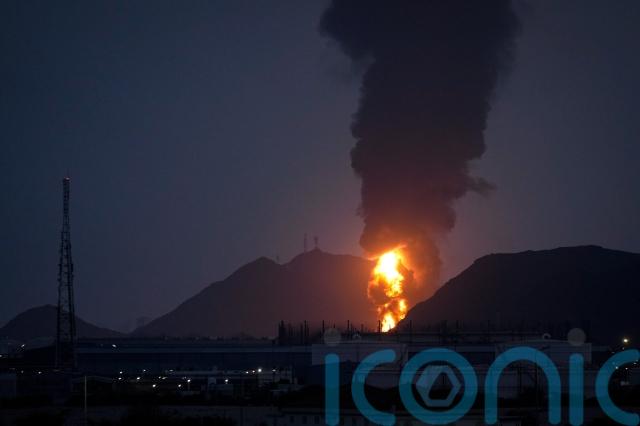
Explosions sounded in Iran’s capital city on Wednesday as its war with the US and Israel entered a fifth day.
The latest attacks followed earlier strikes on an Iranian nuclear site and retaliatory strikes by the Islamic Republic across the Gulf region.
Iranian state television reported explosions around Tehran as dawn broke while Israel said its air defences were activated due to incoming missile fire from Iran.
US-Israeli strikes have killed at least 787 people in Iran, according to the Red Crescent Society.
In Lebanon, where Israel launched retaliatory strikes on the Iranian-supported militant group Hezbollah, 50 people were killed, including seven children, Lebanon’s health ministry said.
Lebanon’s state-run media reported that at least four people were killed in an Israeli strike that hit a residential complex in the city of Baalbeck.
Kuwait, which had previously reported a single death, said on Wednesday that an 11-year-old girl was killed by falling shrapnel as Kuwaiti forces were intercepting “hostile aerial targets”. In addition, three people were killed in the United Arab Emirates and one in Bahrain.
A vessel was hit by a projectile early on Wednesday in the Gulf of Oman off the United Arab Emirates, the United Kingdom Maritime Trade Operations Centre said. There were no reported casualties.
Qatar’s Ministry of Defence said early on Wednesday that Iran launched two ballistic missiles against it and one hit Al-Udeid Qatari Base, but did not cause casualties.
The other missile was intercepted by air defence, the ministry said.
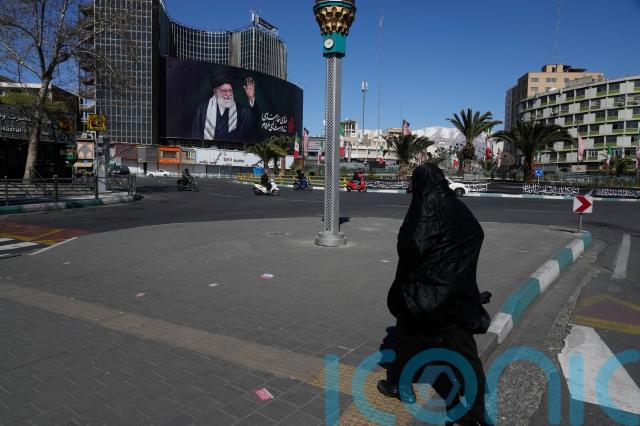
A day earlier, Israel launched airstrikes against Iranian missile launchers and a nuclear research site and Iran struck back against Israel and others, targeting US embassies and disrupting energy supplies and travel.
The American embassy in Saudi Arabia and the US consulate in the United Arab Emirates came under drone attacks. Iran has fired dozens of ballistic missiles at Israel, although most of the incoming fire has been intercepted. Eleven people in Israel have been killed since the conflict began.
US embassies in Saudi Arabia, Kuwait and Lebanon said they were closed to the public.
The US State Department said early on Wednesday it had authorised non-emergency government personnel and family members to evacuate Saudi Arabia should they choose due to the war having previously ordered the evacuation of non-emergency personnel and family in Kuwait, Bahrain, Iraq, Qatar, Jordan and the United Arab Emirates.
US citizens were urged to leave more than a dozen Middle Eastern countries, although many were stranded because of airspace closures.
President Donald Trump’s administration has offered various objectives, including destroying Iran’s missile capabilities, wiping out its navy, preventing it from obtaining a nuclear weapon and ensuring it cannot continue to support allied armed groups.
While the initial US-Israeli strikes killed Iranian Supreme Leader Ayatollah Ali Khamenei and Mr Trump urged Iranians to overthrow their government, senior administration officials have since said regime change was not the goal.
Mr Trump on Tuesday seemed to downplay the chances of the war ending Iran’s theocratic rule, saying that “someone from within” the Iranian regime might be the best choice to take power once the campaign is finished.
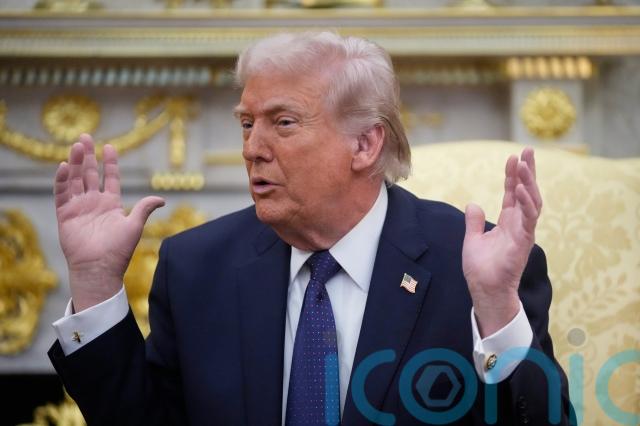
Speaking on Tuesday from the Oval Office, Mr Trump said Reza Pahlavi, the exiled son of Iran’s toppled shah, is not someone that his administration has considered in depth to take over.
As far as possible leaders inside Iran, “the people we had in mind are dead,” Mr Trump said.
“I guess the worst case would be do this, and then somebody takes over who’s as bad as the previous person, right? That could happen,” he said. “We don’t want that to happen.”
Iran’s leaders are scrambling to replace Mr Khamenei, who ruled the country for 37 years. It is only the second time since the 1979 Islamic Revolution that a new supreme leader is being chosen. Potential candidates range from hard-liners committed to confrontation with the West to reformists who seek diplomatic engagement.
The top US military commander in the Middle East said American forces have struck nearly 2,000 targets in Iran since the operation against the Islamic Republic began.
Admiral Brad Cooper, head of Central Command, said in a video posted on X on Tuesday that the US military has “severely degraded Iran’s air defences” and taken out hundreds of ballistic missiles, launchers and drones.
He said Iran has launched more 500 ballistic missiles and more than 2,000 drones in retaliation.
But he said the US is “hunting” Iran’s last remaining mobile ballistic missile launchers to eliminate their “lingering launch capability” while the operation has involved more than 50,000 troops, 200 fighter jets, two aircraft carriers and bombers, and “more capability is on the way”.
“We’ve just begun,” he said.

Subscribe or register today to discover more from DonegalLive.ie
Buy the e-paper of the Donegal Democrat, Donegal People's Press, Donegal Post and Inish Times here for instant access to Donegal's premier news titles.
Keep up with the latest news from Donegal with our daily newsletter featuring the most important stories of the day delivered to your inbox every evening at 5pm.

This publication supports the work of the Press Council of Ireland and Office of the Press Ombudsman, and our staff operate within the Code of Practice of the Press Council. You can obtain a copy of the Code, or contact the Council, at www.presscouncil.ie, Lo-call 1800 208 080 or email: info@presscouncil.ie.