RIP: Body found in search for missing man (63) as heartbreaking statement is issued
Search


09 Mar 2026

Please allow ads as they help fund our trusted local news content.
Kindly add us to your ad blocker whitelist.
If you want further access to Ireland's best local journalism, consider contributing and/or subscribing to our free daily Newsletter .
Support our mission and join our community now.
To continue reading this article, you can subscribe for as little as €0.50 per week which will also give you access to all of our premium content and archived articles!
Alternatively, you can pay €0.50 per article, capped at €1 per day.
Thank you for supporting Ireland's best local journalism!


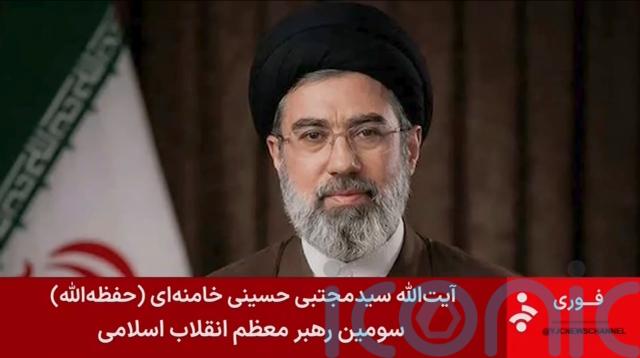
Iran has named Ayatollah Mojtaba Khamenei, a son of its late supreme leader, as its next ruler, putting a hard-line cleric in charge as the war spreading across the Middle East sent oil prices skyrocketing with the Islamic Republic launching new attacks on regional energy infrastructure.
With Iran’s theocracy under assault by the United States and Israel for more than a week, the country’s Assembly of Experts chose the secretive, 56-year-old cleric with close ties to the country’s paramilitary Revolutionary Guard as the new supreme leader.
Russian President Vladimir Putin sent a telegram to Mojtaba Khamenei to congratulate him on becoming Iran’s new leader.
The message, published on the Kremlin’s website on Monday, reaffirmed Moscow’s “unwavering support for Tehran”, and said that “Russia has been and will remain a reliable partner of the Islamic Republic”.
“At a time when Iran is opposing armed aggression, your tenure in this high post will undoubtedly require great courage and dedication. I am sure that you will honourably continue your father’s work and unite the Iranian people,” Mr Putin’s message read.
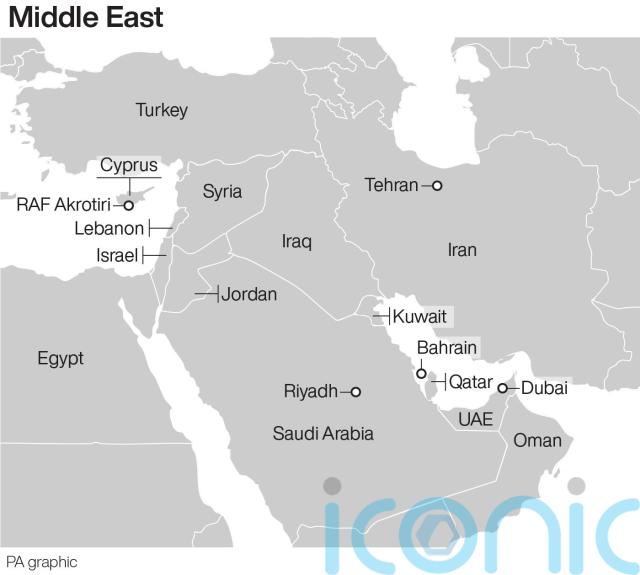
The Revolutionary Guard has been firing missiles and drones at Israel and Gulf Arab states since the younger Khamenei’s father, Ayatollah Ali Khamenei, was killed on February 28 during the war’s opening salvo.
Turkey’s defence ministry said Nato defences intercepted a ballistic missile that entered the country’s airspace.
Monday’s interception was second since the start of the Iran war. Iran has fired missiles and drones at several countries across the region since the US and Israel attacks began. There was no damage or casualties.
Iran’s stranglehold on the Strait of Hormuz has also all but stopped tankers from using the shipping lane between the Persian Gulf and Gulf of Oman through which a fifth of the world’s oil is carried.
The price of Brent crude briefly surged to 119.50 dollars per barrel on Monday – its highest level since the summer after Russia invaded Ukraine in 2022. West Texas Intermediate, which is produced in the United States, also soared to 119.48 dollars per barrel at one point.
Those prices fell to just under the 100 dollars later on Monday. But barrels of Brent and US crude are still 36% and 42% more expensive, respectively, than they were before the US and Israel launched the war against Iran on February 28.
Iran exports roughly 1.6 million barrels of oil a day, mostly to China, which has called for an immediate end to the fighting.
The Group of Seven major industrialised powers on Monday decided against using strategic reserves for now to counter the impact on oil prices from the war.
“We’re not there yet,” French Finance Minister Roland Lescure said after chairing a meeting of his G7 counterparts.
“We are ready to take necessary and co-ordinated steps in order to stabilise markets, such as strategic stockpiling,” Mr Lescure told reporters in Brussels.
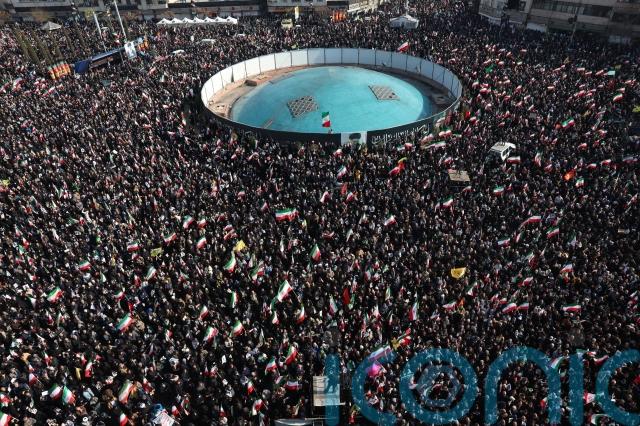
As global economic concerns grew, US President Donald Trump downplayed the spike in prices as temporary.
“Short term oil prices, which will drop rapidly when the destruction of the Iran nuclear threat is over, is a very small price to pay for U.S.A., and World, Safety and Peace,” Mr Trump wrote on social media.
Overnight he wrote on his Truth Social platform: “There is not an oil shortage.”
“Prices will drop again soon,” he added, suggesting shipments from Venezuela to the US could help offset the price spike.
Stock markets shuddered worldwide on Monday on worries about whether the global economy can withstand spiking prices for oil, which hit their highest level for four years.
The S&P 500 fell 1%, coming off its worst week since October. The Dow Jones Industrial Average was down 576 points, or 1.2%, as of 9.35am Eastern time, and the Nasdaq composite was 0.8% lower. That followed even worse losses in European and Asian stock markets.
US stocks went on to recover much of the early losses.
Iran has targeted Israel and American bases in the region since the start of the war. On Monday, a man was killed in central Israel in a missile strike, raising the country’s death toll in the war to 11.
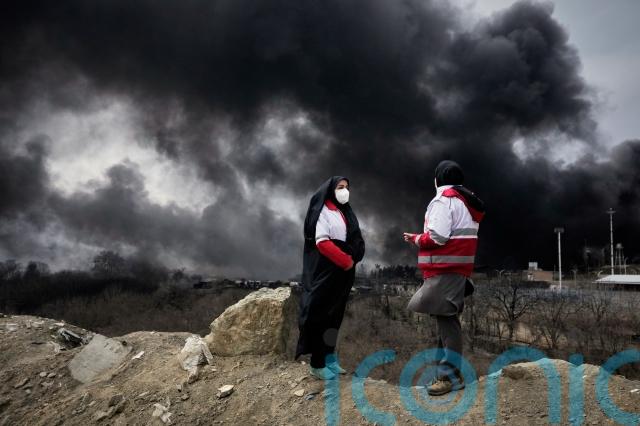
As Iran continued to hit regional energy infrastructure, a fire broke out on Monday at an oil facility that was attacked in Fujairah, in the United Arab Emirates. Bahrain’s only oil refinery was apparently also hit and Saudi Arabia said it had intercepted several drones attacking its Shaybah oil field.
Israel, meantime, claimed strikes on targets in Iran’s city of Isfahan, saying it hit command centres for the Revolutionary Guard and its volunteer Basij force, as well as a rocket engine production facility and missile launch sites.
On Monday, Israel said it had begun “a wide-scale wave of strikes” in Iran’s capital, Tehran, and in southern Iran. It said the number of missiles launched from Iran in each barrage aimed at Israel is decreasing.
In the early days of the war there were barrages with dozens of missiles, but that has dropped to fewer than 10 or 20 missiles being launched at a time, said Israeli military spokesperson Lt Col Nadav Shoshani.
In Israel, sirens blared multiple times across the country as Iran’s drones and missiles landed. A woman was wounded by debris in central Israel.
The younger Khamenei, who had not been seen or heard from publicly since the war started, had long been considered a potential successor – even before the Israeli strike killed his father. His wife, Zahra Haddad Adel, was killed in the same Israeli strike that killed the 86-year-old Ayatollah Ali Khamenei.
Political figures within Iran have criticised the idea of handing over the supreme leader’s title based on heredity and thereby creating a clerical version of the rule of the shah, who was toppled during the 1979 Islamic Revolution.
But top clerics in the Assembly of Experts likely wanted Mr Khamenei to prosecute the war.
Mr Khamenei, who is believed to hold views that are even more hard-line than his late father, now will be in charge of Iran’s armed forces and any decision regarding Tehran’s nuclear programme.
While the country’s key nuclear sites are in tatters after the US bombed them during the 12-day Israel-Iran war in June, there’s still highly enriched uranium in Iran that is a technical step away from weapons-grade levels. Mr Khamenei could choose to do what his father never did – build a nuclear bomb.
An Iranian state TV report suggested the younger Khamenei may have been wounded in a strike, though a state TV analyst later appeared to amend the report, saying he had been wounded in the 1980s Iran-Iraq war in which he served.
Israel has already described him as a potential target, while Mr Trump had called him “unacceptable”.
“We want someone that will bring harmony and peace to Iran,” Mr Trump had said.
Iran’s Revolutionary Guard issued a statement expressing support, as did the Iran-backed Lebanese militant group Hezbollah.
Top Iranian security official Ali Larijani, speaking to Iranian state television, praised the Assembly of Experts for “courageously” convening even as air strikes continued in Tehran. He said the younger Khamenei had been trained by his father and “can handle this situation”.
Saudi Arabia lashed out at Iran following a thwarted drone attack on its massive Shaybah oil field, saying Tehran would be the “biggest loser” if it continues to attack Arab states.
The Foreign Ministry said Iranian attacks mean “further escalation which will have a grave impact on the relations, currently and in the future”.
In addition to energy facilities in the UAE, authorities there said the capital of Abu Dhabi was targeted by Iranian missiles and two were hurt by shrapnel from interceptions.
Later, the UAE announced the deaths of two noncombat members of its armed forces following the crash of a helicopter because of a “technical malfunction”.
Iran attacked Kuwait, Qatar and Bahrain, where it hit a residential area wounding 32 people, including several children, according to authorities. Another attack appeared to have started a fire at Bahrain’s only oil refinery, sending thick plumes of smoke into the air.
Qatar’s Defence Ministry said it intercepted all 17 missiles and six drones launched from Iran toward the Gulf nation on Monday. There was no damage or casualties, the ministry said.
Bahrain has also accused Iran of damaging one of its desalination plants, though its electricity and water authority said supplies remained online. Desalination plants supply water to millions of residents in the region and thousands of stranded travellers, raising new fears of catastrophic risks in parched desert nations.
On Monday, the island kingdom’s state oil company declared force majeure for its oil shipments, state-run Bahrain News Agency reported, a legal move that releases a company of its contractual obligations because of extraordinary circumstances. It insisted that local demand could still be met.
In Iraq, air defences shot down a drone as it attacked a US military compound inside the Baghdad International Airport, a security source told the AP.
There were no reported injuries or damage and it was not immediately clear who was behind the attack, but Pro-Iranian Iraqi militias have previously targeted the base.
Elsewhere, the US military had said a service member died of injuries from an Iranian attack on troops in Saudi Arabia on March 1. Seven US soldiers have now been killed.
The US State Department on Monday ordered non-essential personnel and families of all staff to leave Saudi Arabia following the escalation in attacks.
Later it ordered non‑emergency staff and family members to leave the US Consulate in Adana, in southern Turkey. It also advised American citizens to leave south-east Turkey.
The decision marks the 10th US diplomatic mission placed on ordered departure since the start of the war, and the first such move involving a Nato ally.
The other US diplomatic missions have ordered all but key staff to leave are: Bahrain, Iraq, Jordan, Kuwait, Lebanon, Qatar, the United Arab Emirates and the consulate in Karachi, Pakistan.
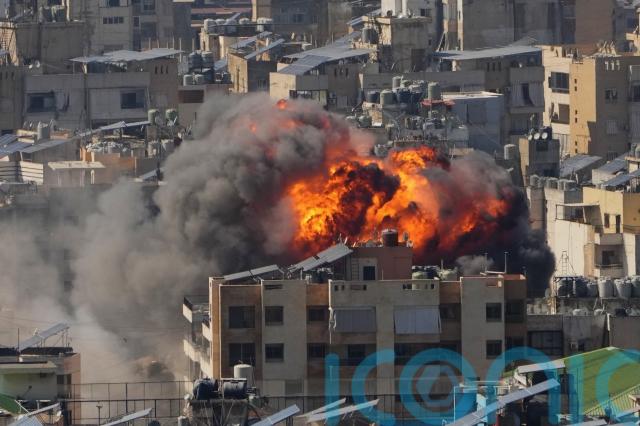
Smoke billowed over Beirut in Lebanon after Israel carried out air strikes on its southern suburbs on Monday.
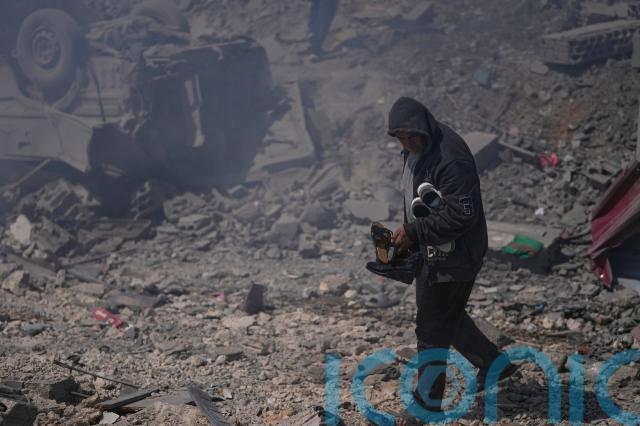
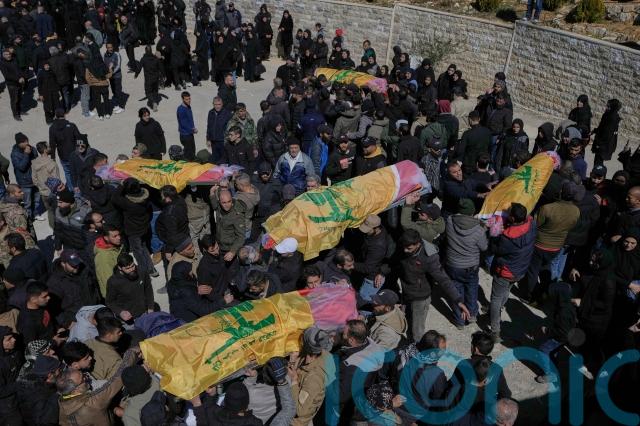
The war has killed at least 1,230 people in Iran, at least 397 in Lebanon and 11 in Israel, according to officials.
Another person died in Israel of an asthma attack on her way to a shelter. Israel reported its first soldier deaths on Sunday, saying two were killed in southern Lebanon, where its military is fighting Hezbollah.

Subscribe or register today to discover more from DonegalLive.ie
Buy the e-paper of the Donegal Democrat, Donegal People's Press, Donegal Post and Inish Times here for instant access to Donegal's premier news titles.
Keep up with the latest news from Donegal with our daily newsletter featuring the most important stories of the day delivered to your inbox every evening at 5pm.

This publication supports the work of the Press Council of Ireland and Office of the Press Ombudsman, and our staff operate within the Code of Practice of the Press Council. You can obtain a copy of the Code, or contact the Council, at www.presscouncil.ie, Lo-call 1800 208 080 or email: info@presscouncil.ie.