The alarm was raised at around 5.30pm this Friday after emergency services responded to the discovery of the woman's body at a house in Ballincollig | FILE PHOTO
Search


14 Mar 2026

Please allow ads as they help fund our trusted local news content.
Kindly add us to your ad blocker whitelist.
If you want further access to Ireland's best local journalism, consider contributing and/or subscribing to our free daily Newsletter .
Support our mission and join our community now.
To continue reading this article, you can subscribe for as little as €0.50 per week which will also give you access to all of our premium content and archived articles!
Alternatively, you can pay €0.50 per article, capped at €1 per day.
Thank you for supporting Ireland's best local journalism!


Iran has openly threatened a neighbouring country’s non-US assets for the first time, warning people to immediately evacuate the busiest port in the Middle East and two others in the United Arab Emirates as the war entered its third week.
It came as a missile struck a helipad inside the US Embassy compound in Baghdad on Saturday, and debris from an intercepted Iranian drone hit the Fujairah oil facility in the UAE, further increasing global anxiety about oil supplies.
Iran threatened to attack cities in the UAE, home to Dubai and one of the world’s busiest airports, saying the US used “ports, docks and hideouts” there to launch strikes on Iran’s Kharg Island, without providing evidence.
It urged people to evacuate areas where it said US forces are sheltering, naming Dubai’s Jebel Ali port – the busiest in the Middle East – as well as Abu Dhabi’s Khalifa port and Fujairah port.
Iran has fired hundreds of missiles and drones at Arab Gulf neighbours during the war, but it said it was targeting US assets, even as hits or attempts were reported on civilian ones such as airports and oil fields.
Images published on Saturday showed the extent of a fire at Fujairah that broke out after what authorities said was a drone interception, and smoke rising over the embassy compound in the Iraqi capital.
It came hours after Donald Trump said US forces had “obliterated” military targets on a Kharg Island, which is vital to Iran’s oil network, and warned its oil infrastructure could be next if Tehran continues to interfere with the passage of ships through the Strait of Hormuz.
Last night, U.S. forces executed a large-scale precision strike on Kharg Island, Iran. The strike destroyed naval mine storage facilities, missile storage bunkers, and multiple other military sites. U.S. forces successfully struck more than 90 Iranian military targets on Kharg… pic.twitter.com/2X1glD4Flt
— U.S. Central Command (@CENTCOM) March 14, 2026
Kharg is the primary terminal that handles Iran’s oil exports, and earlier this week the speaker of the Iranian Parliament had warned Tehran would “abandon all restraint” if the islands came under attack – adding that Mr Trump will be responsible for “the blood of American soldiers”.
The US Central Command released a video on X showing the strike and said it destroyed naval mine storage facilities, missile storage bunkers and multiple other military sites.
Iran’s semi-official Fars news agency reported at least 15 explosions with thick smoke rising over Kharg Island.
It said the strikes targeted an air defence facility, a naval base, the airport control tower and an offshore oil company’s helicopter hangar, adding that no oil infrastructure was damaged.
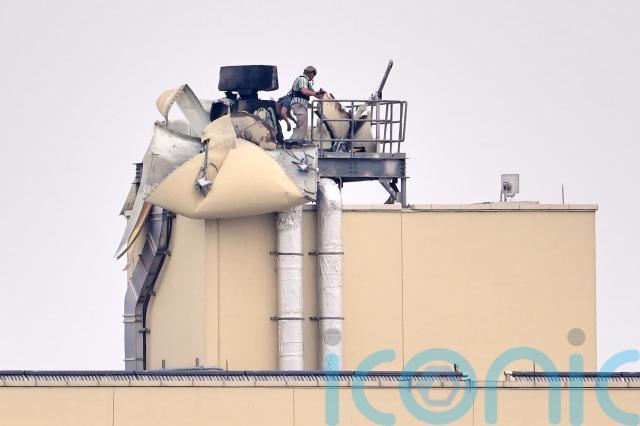
In the hours after the attack, Iran’s joint military command reiterated its threat that it will attack the US-linked oil and energy facilities in the region if oil infrastructure of the Islamic Republic is hit.
Ebrahim Zolfaghari, spokesman for the Khatam al-Anbiya Central Headquarters, warned they will target “all oil, economic, and energy infrastructures belonging to oil companies across the region that have American shares or co-operate with America”.
In addition, it threatened to attack cities in the United Arab Emirates, claiming they were used by US forces to launch strikes on Iran’s Abu Musa and Kharg islands.
Meanwhile, an American official said 2,500 more Marines and an amphibious assault ship are being sent to the Middle East.
Elements from the 31st Marine Expeditionary Unit and the amphibious assault ship USS Tripoli have been ordered to the region.
Earlier in the week, the US Navy had 12 ships, including the aircraft carrier USS Abraham Lincoln and eight destroyers, operating in the Arabian Sea. Should the Tripoli join this flotilla, it would be the second-largest ship behind the Lincoln in the region.
While the total number of US service members on the ground in the Middle East is not clear, Al-Udeid Air Base alone, one of the largest in the region, typically houses some 8,000 American troops in Qatar.
It comes as Iran continues to launch widespread missile and drone attacks on Israel and neighbouring Gulf states, and has effectively closed the Strait of Hormuz, through which a fifth of the world’s traded oil passes, even as US and Israeli warplanes pummel military and other targets across Iran.
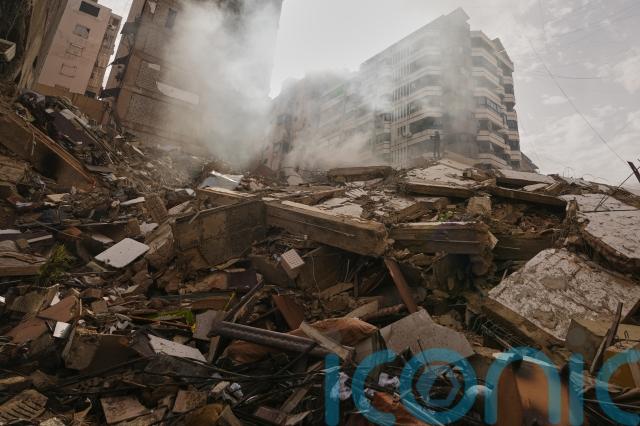
The humanitarian crisis in Lebanon deepened, with nearly 800 people killed and 850,000 displaced as Israel launched waves of strikes against Iran-backed Hezbollah militants and warned there would be no let up.
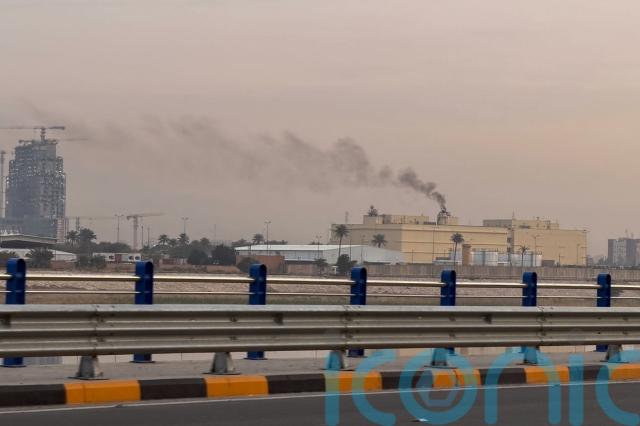
Saudi Arabia’s defence ministry said early on Saturday it downed a drone in the al-Jawf region, a sparsely populated province near the Jordan border that hosts military and energy infrastructure, and shot down seven drones headed toward the kingdom’s eastern region which is home to major oil installations.
Dubai’s Media Office said debris from an interception struck the facade of a building in the city centre, adding the incident was contained, with no fire or injuries reported.
Qatar’s defence ministry said early on Saturday it had intercepted a missile attack.
The ministry said earlier that authorities were evacuating “a number” of areas as a temporary precaution, without identifying the locations. Emergency alerts were sent to people’s phones.
An Israeli strike hit a health care centre in the village of Burj Qalaouiyah in the Bint Jbeil District, killing 12 doctors, paramedics and nurses who were on duty, Lebanon’s health ministry said.
The ministry said it was the second attack on the health sector within hours, after another Israeli strike on the southern village of Souaneh killed two paramedics and wounded five others when it hit a paramedic centre.

Subscribe or register today to discover more from DonegalLive.ie
Buy the e-paper of the Donegal Democrat, Donegal People's Press, Donegal Post and Inish Times here for instant access to Donegal's premier news titles.
Keep up with the latest news from Donegal with our daily newsletter featuring the most important stories of the day delivered to your inbox every evening at 5pm.

This publication supports the work of the Press Council of Ireland and Office of the Press Ombudsman, and our staff operate within the Code of Practice of the Press Council. You can obtain a copy of the Code, or contact the Council, at www.presscouncil.ie, Lo-call 1800 208 080 or email: info@presscouncil.ie.