Credit: West Midlands Police
Search


17 Mar 2026

Please allow ads as they help fund our trusted local news content.
Kindly add us to your ad blocker whitelist.
If you want further access to Ireland's best local journalism, consider contributing and/or subscribing to our free daily Newsletter .
Support our mission and join our community now.
To continue reading this article, you can subscribe for as little as €0.50 per week which will also give you access to all of our premium content and archived articles!
Alternatively, you can pay €0.50 per article, capped at €1 per day.
Thank you for supporting Ireland's best local journalism!


Iran’s top security official and the head of the Revolutionary Guard’s Basij militia were killed in overnight strikes in a blow to the country’s leadership, Israel’s defence minister said.
Both security official Ali Larijani and General Gholam Reza Soleimani were “eliminated last night”, Israel Katz said in a statement.
Iran’s 86-year-old Supreme Leader Ayatollah Ali Khamenei died in an air strike on February 28, the first day of the war launched by the United States and Israel, and other top leaders from the Iranian theocracy have been killed since then.
Iranian state media did not immediately confirm either death. However, it said a message from Mr Larijani’s office would be published shortly.
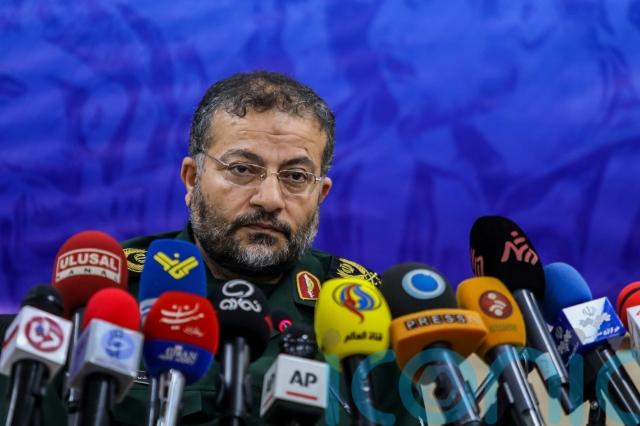
The announcement came after the Israeli military earlier said it had carried out a “wide-scale wave of strikes” across Iran’s capital and stepped up strikes on Iran-backed Hezbollah militants in Lebanon. Israel also reported two incoming salvos before dawn from Iran aimed at Tel Aviv and elsewhere, and said Hezbollah targeted Israel’s north.
Incoming Iranian missiles on the United Arab Emirates prompted Dubai, a major transit hub for international travel, to briefly shut its airspace and a man was killed by the debris of a missile intercepted over Abu Dhabi.
Mr Larijani hails from one of Iran’s most famous political families. A former parliamentary speaker and senior policy adviser, he was appointed to advise the late Mr Khamenei on strategy in nuclear talks with the Trump administration.
He also served as the secretary of Iran’s Supreme National Security Council, its top security body.
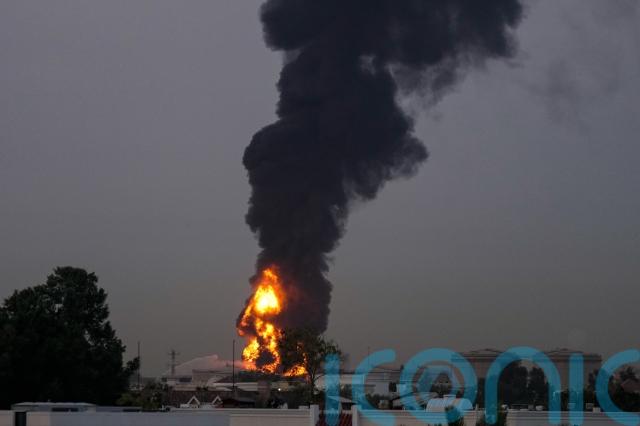
Soleimani was the head of the Basij militia forces, which Israel’s military called an “armed apparatus of the Iranian terror regime”.
An Israeli military spokesperson said: “During internal protests in Iran, particularly in recent periods as demonstrations intensified, Basij forces under Soleimani’s command led the main repression operations, employing severe violence, widespread arrests and the use of force against civilian demonstrators.”
The US Treasury lists Soleimani as having been born in 1965. He has been sanctioned by the US, the European Union and other nations over his role in helping suppress dissent for years through the Basij.
Since the war began on February 28, Israel has launched specific attacks targeting Iran’s leadership, killing 86-year-old Supreme Leader Ayatollah Ali Khamenei and other military commanders.
Killing Soleimani could further strain the command and control of the Basij, which would be crucial in putting down any uprising against the theocracy. The Basij and other internal security forces have been a target of attack by both the Americans and the Israelis so far.
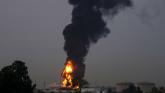
Iran has kept up the pressure on the energy infrastructure of its Gulf Arab neighbours, hitting an oil facility in Fujairah, located on the east coast of the United Arab Emirates (UAE), with the Gulf of Oman that has been repeatedly targeted. State-run WAM news reported that no one had been injured in the blast from the drone strike.
Iran’s attacks on Gulf nations and its stranglehold on the Strait of Hormuz, through which a fifth of the world’s oil is transported, have given rise to increasing concerns of a global energy crisis.
Early on Tuesday, it hit a tanker anchored off the coast of Fujairah, one of about 20 vessels hit since Israel and the United States started the war with an attack on Iran on February 28.
With Washington under increasing pressure over rising oil prices, Brent crude, the international standard, remained over 100 dollars (£75) a barrel, up more than 40% since the war started.
US President Donald Trump said he had demanded that roughly a half-dozen countries send warships to keep the Strait of Hormuz open.
But his appeals brought no immediate commitments, with many saying they are hesitant to get involved in a war with no defined exit plan and sceptical that they could do more than the US Navy.
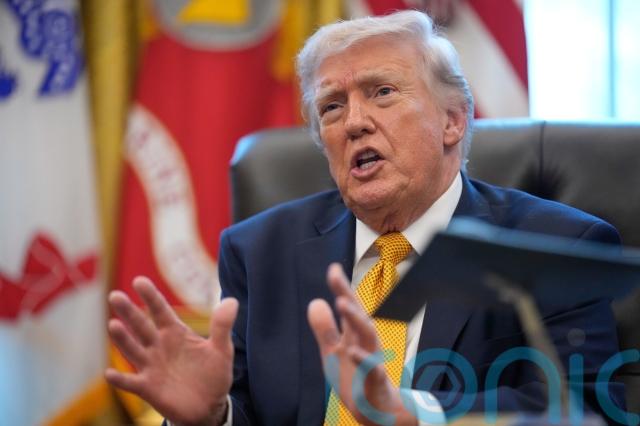
Saudi Arabia’s Defence Ministry reported intercepting a dozen drones on Tuesday morning over the country’s vast Eastern Province, home to oil infrastructure.
In Qatar, the sounds of explosions boomed over the capital early in the day as defences worked to intercept incoming fire. Qatar’s Defence Ministry said later that it had successfully thwarted a missile attack on the city, though a fire broke out in an industrial area from a downed projectile.
Attacks from Iran-linked proxy forces continued in Iraq, as the US Embassy in Baghdad was hit with shrapnel from drones that had been intercepted.
The embassy’s air defences were able to shoot down all four drones targeting the facility, according to two Iraqi security officials, speaking on condition of anonymity to discuss intelligence matters.
A separate strike targeted a house in the heavily fortified Presidential Compound in Baghdad’s al-Jadriya area, the officials said.
It was not clear who carried out either attack, but Iran-allied militias have regularly been attacking American targets inside Iraq since the conflict began.

Subscribe or register today to discover more from DonegalLive.ie
Buy the e-paper of the Donegal Democrat, Donegal People's Press, Donegal Post and Inish Times here for instant access to Donegal's premier news titles.
Keep up with the latest news from Donegal with our daily newsletter featuring the most important stories of the day delivered to your inbox every evening at 5pm.

This publication supports the work of the Press Council of Ireland and Office of the Press Ombudsman, and our staff operate within the Code of Practice of the Press Council. You can obtain a copy of the Code, or contact the Council, at www.presscouncil.ie, Lo-call 1800 208 080 or email: info@presscouncil.ie.