Search


27 Mar 2026
Search
27 Mar 2026

Please allow ads as they help fund our trusted local news content.
Kindly add us to your ad blocker whitelist.
If you want further access to Ireland's best local journalism, consider contributing and/or subscribing to our free daily Newsletter .
Support our mission and join our community now.
To continue reading this article, you can subscribe for as little as €0.50 per week which will also give you access to all of our premium content and archived articles!
Alternatively, you can pay €0.50 per article, capped at €1 per day.
Thank you for supporting Ireland's best local journalism!


Israel has launched a new wave of strikes on Iran after US president Donald Trump claimed talks on ending the war were going well, and gave Tehran more time to open the Strait of Hormuz – though there is no sign of Iran backing down.
With stock markets reeling and economic fallout from the war extending far beyond the Middle East, Mr Trump is under growing pressure to end Iran’s chokehold on the strait, a strategic waterway through which a fifth of the world’s oil is usually shipped.
The US has offered Iran a 15-point proposal for a ceasefire that includes it relinquishing control of the strait, but at the same time has ordered thousands more troops to the region, possibly in preparation for a military attempt to wrest the waterway from Iran’s grip.
With time running out on a deadline set by Mr Trump for Iran to open the strait, after which he had threatened to destroy Iran’s energy plants, he pushed his self-imposed deadline back to April 6 on Thursday, saying that talks on ending the conflict were going “very well”.
Iran, however, maintains it is not engaged in any negotiations.
Israel’s attack on Friday on targets “in the heart of Tehran” struck sites used by Iran to produce ballistic missiles and other weapons, the Israeli military said. It also hit missile launchers and storage sites in western Iran.
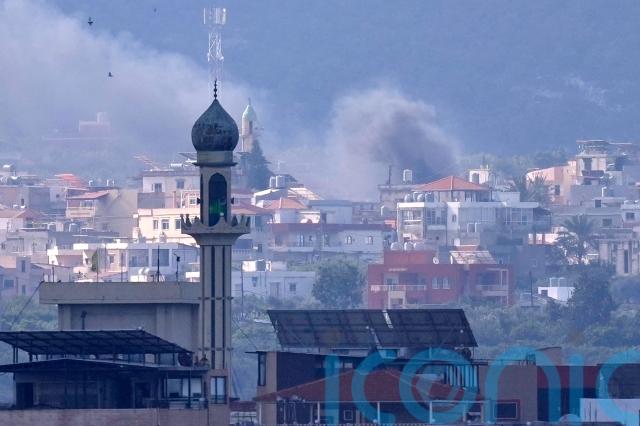
Smoke also rose over the Lebanese capital Beirut, while air raid sirens sounded in Israel as the military said it was working to intercept Iranian missiles. Iran also kept firing missiles and drones at its Gulf Arab neighbours, with sirens warning of attacks in Bahrain, Qatar and the United Arab Emirates.
Kuwait said its Shuwaikh Port in Kuwait City had sustained “material damage” in an attack, but that nobody was hurt.
After Wall Street’s worst day since the war began, Asian shares mostly fell on Friday over growing doubts about the chances of de-escalation.
Oil prices rose again, the Brent crude, the international standard, at 107 dollars a barrel in morning trading, up more than 45% since Israel and the US attacked Iran on February 28 to start the war.
Iran’s stranglehold on shipping through the Strait of Hormuz, has caused growing concerns of a global energy crisis, and appears part of a strategy to get the US to back down by roiling the world economy.
A Gulf Arab bloc said Iran is now exacting tolls from ships to ensure their safe passage through the waterway.
Trump envoy Steve Witkoff said Washington has delivered a 15-point “action list” to Iran for a possible ceasefire, using Pakistan as an intermediary. The list includes restrictions on Iran’s nuclear programme and re-opening the Strait of Hormuz.
More than 1 million people are now displaced in Lebanon, fleeing continued Israeli strikes and evacuation warnings.
1/3 are children.
They deserve more than survival.They deserve a childhood. pic.twitter.com/Rso20PmzZI
— UNHCR, the UN Refugee Agency (@Refugees) March 27, 2026
Iran has rejected the US offer and put forth its own five-point proposal, which includes reparations and recognition of its sovereignty over the Strait of Hormuz.
Diplomats from several countries have been trying to organise a direct meeting between envoys from the US and Iran, possibly in Pakistan.
Egypt’s foreign ministry said the country’s foreign minster Badr Abdelatty held phone calls the day before with his Turkish and Pakistani counterparts as part of their “intensive efforts” to organise the talks.
Mr Abdelatty said he hoped the tri-country effort would result in “gradual de-escalation efforts that would ultimately lead to the end of the war”.
As the diplomatic efforts went on, a group of US ships drew closer to the region with some 2,500 marines. Also, at least 1,000 paratroopers from the 82nd Airborne – trained to land in hostile territory to secure key territory and airfields – have been ordered to the region.
Middle East war: LIVE from the UN today, starting with the Human Rights Council’s Urgent Debate on the school strike in Minab, Iran, on the first day of Israeli and US bombing. We’ll also have updates from UN agencies providing relief in the region #HRC61https://t.co/nXys0WUkmM
— UN News (@UN_News_Centre) March 27, 2026
As American and Israeli attacks on Iran continued, the UN Security Council scheduled closed consultation on Iran for Friday in New York, diplomats said.
They added that Russia had asked for the meeting on US-Israeli attacks on civilian infrastructure in the country, and that the United States, which holds the Security Council presidency, had scheduled it.
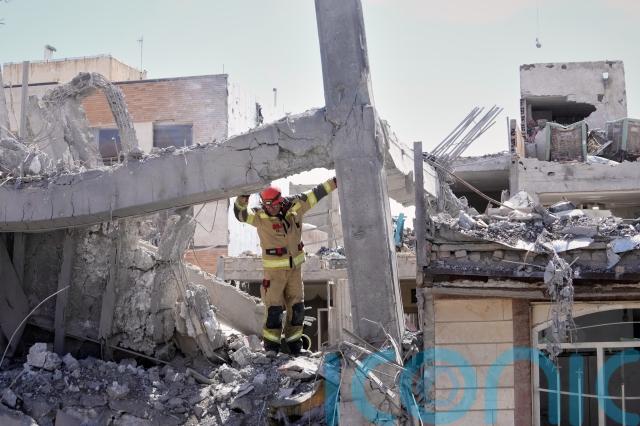
Jan Egeland, secretary general of the Norwegian Refugee Council, said the humanitarian organisation’s teams in Iran have reported that “countless homes, hospitals and schools have been damaged or destroyed” and that nearly every neighbourhood in Tehran has sustained damage.
“Civilians are paying the highest price for this war – it must end” he said in a statement.
The International Organisation for Migration said Friday that 82,000 civilian buildings, including hospitals and the homes of 180,000 people have been damaged in Iran so far.
“If this war continues, we risk a far wider humanitarian disaster,” Mr Egeland said. “Millions could be forced to flee across borders, placing immense pressure on an already overstretched region.”
Since the war began, more than 1,900 people have been killed in Iran, according to the health ministry.
Eighteen people have died in Israel, while at least three Israeli soldiers have also been killed in Lebanon.
At least 13 American troops have been killed. Four people in the occupied West Bank and 20 in Gulf Arab states have also died.
Authorities said more than 1,100 people have died in Lebanon. In Iraq, where Iranian-supported militia groups have entered the conflict, 80 members of the security forces have been killed.

Subscribe or register today to discover more from DonegalLive.ie
Buy the e-paper of the Donegal Democrat, Donegal People's Press, Donegal Post and Inish Times here for instant access to Donegal's premier news titles.
Keep up with the latest news from Donegal with our daily newsletter featuring the most important stories of the day delivered to your inbox every evening at 5pm.

This publication supports the work of the Press Council of Ireland and Office of the Press Ombudsman, and our staff operate within the Code of Practice of the Press Council. You can obtain a copy of the Code, or contact the Council, at www.presscouncil.ie, Lo-call 1800 208 080 or email: info@presscouncil.ie.