Search


02 Apr 2026
Search
02 Apr 2026

Please allow ads as they help fund our trusted local news content.
Kindly add us to your ad blocker whitelist.
If you want further access to Ireland's best local journalism, consider contributing and/or subscribing to our free daily Newsletter .
Support our mission and join our community now.
To continue reading this article, you can subscribe for as little as €0.50 per week which will also give you access to all of our premium content and archived articles!
Alternatively, you can pay €0.50 per article, capped at €1 per day.
Thank you for supporting Ireland's best local journalism!


Iran has responded to US president Donald Trump’s address to Americans on the Middle East war with new missile attacks targeting Israel and the Gulf Arab states.
The move underlines Tehran’s insistence that it rejects Washington’s moves toward a ceasefire while maintaining its grip on the Strait of Hormuz.
Meanwhile, the UK plans to hold a call with nearly three dozen countries about how to reopen the strait, through which 20% of all oil and natural gas traded passes in peacetime.
The 35 countries, including all G7 industrialised democracies except the US, as well as the United Arab Emirates and Bahrain, signed a declaration last month demanding Iran stop blocking the strait.
The call will discuss “diplomatic and political measures” that could restore shipping once the fighting is over.
Washington has insisted that Iran should allow ships to freely transit the strait, but Mr Trump this week has said it is not up to the US to force it, and in his address encouraged countries that receive oil through Hormuz to “build some delayed courage” and go “take it”.
President Trump delivered a powerful speech tonight. He was clear about our objectives in Iran:
• Destroy their weapons factories• Destroy their navy• Destroy their air force• Destroy their chances of ever having a nuclear weapon
The President’s leadership sends a…
— Secretary Marco Rubio (@SecRubio) April 2, 2026
In his address, Mr Trump said the US would hit Iran “extremely hard over the next two to three weeks”, while also insisting American “core strategic objectives are nearing completion”.
Just before Mr Trump began his 18-minute address on Wednesday, explosions were heard in Dubai as air defences worked to intercept an Iranian missile barrage.
Less than a half hour after the president had ended his address, Israel said its military was working to intercept incoming missiles.
Sirens sounded in Bahrain, home to the US Navy’s 5th Fleet, immediately after the speech.
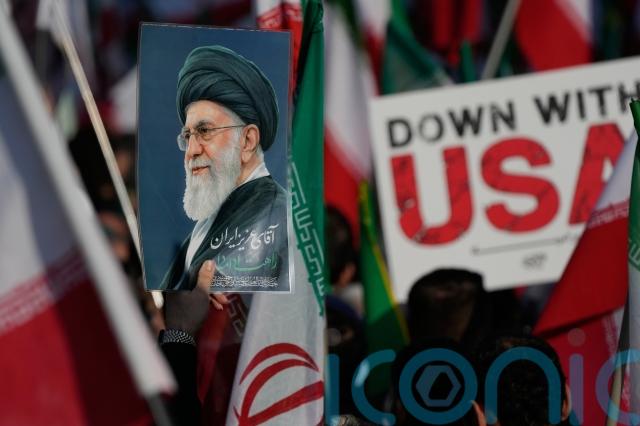
Following a joint statement in March condemning Iranian attacks on unarmed commercial vessels that called upon Iran to “cease immediately its threats, laying of mines, drone and missile attacks and other attempts to block the strait”, the 35 signatories were to hold a virtual meeting on Thursday hosted by UK Foreign Secretary Yvette Cooper.
Though the oil and gas that typically transits the Strait of Hormuz is primarily sold to Asian nations, Japan and South Korea were the only two countries from the region joining the call.
The New York-based Soufan Centre think tank wrote after the address: “Trump’s message was that the United States can sustain its own economic and energy ecosystem, while countries dependent on regional exports will either have to buy from the United States or manage the Strait themselves.
.@POTUS: "Tonight, I am pleased to say that these core strategic objectives are nearing completion… We think especially of the 13 American warriors who have laid down their lives in this fight… Now, we must honor them by completing the mission for which they gave their… pic.twitter.com/K4V1h7kJgr
— Rapid Response 47 (@RapidResponse47) April 2, 2026
“While Trump explicitly thanked US allies in the Persian Gulf for their cooperation and allyship, an expedited US withdrawal without securing the strait will leave many of these countries, whose economies are dependent on energy exports, in the lurch.”
No country appears willing to try and open the strait by force while the war is raging. Prime Minister Sir Keir Starmer said the group “will assess all viable diplomatic and political measures we can take to restore freedom of navigation, guarantee the safety of trapped ships and seafarers and to resume the movement of vital commodities”.
Bahrain, which now holds the presidency of the United Nations Security Council, has been working to get the world body to address the crisis as well.
Though Iran has allowed a trickle of ships through the strait, it remains largely closed. Iran has also been repeatedly attacking Gulf Arab energy infrastructure, sending oil prices skyrocketing and giving rise to broader economic problems worldwide.
Rising energy prices and stock market jitters have been putting increasing domestic pressure on Mr Trump, who used his address to offer a defence of the war while also suggesting it was close to winding down.
He acknowledged American service members who had been killed and said: “We are going to finish the job, and we’re going to finish it very fast. We’re getting very close.”
The US has presented Iran with a 15-point plan for a ceasefire, but Mr Trump did not say anything about the diplomatic efforts or bring up his April 6 deadline for Iran to reopen the Strait of Hormuz or face severe retaliation from the US.
More than 1,900 people have been killed in Iran during the war, while 19 have been reported dead in Israel. More than two dozen people have died in Gulf states and the occupied West Bank, while 13 US service members have been killed.
More than 1,200 people have been killed in Lebanon and more than one million displaced, according to authorities. Ten Israeli soldiers have also died there.

Subscribe or register today to discover more from DonegalLive.ie
Buy the e-paper of the Donegal Democrat, Donegal People's Press, Donegal Post and Inish Times here for instant access to Donegal's premier news titles.
Keep up with the latest news from Donegal with our daily newsletter featuring the most important stories of the day delivered to your inbox every evening at 5pm.

This publication supports the work of the Press Council of Ireland and Office of the Press Ombudsman, and our staff operate within the Code of Practice of the Press Council. You can obtain a copy of the Code, or contact the Council, at www.presscouncil.ie, Lo-call 1800 208 080 or email: info@presscouncil.ie.