A photo of Scarlett Faulkner surrounded by candles in a church I PICTURE: Facebook
Search


02 Apr 2026

Please allow ads as they help fund our trusted local news content.
Kindly add us to your ad blocker whitelist.
If you want further access to Ireland's best local journalism, consider contributing and/or subscribing to our free daily Newsletter .
Support our mission and join our community now.
To continue reading this article, you can subscribe for as little as €0.50 per week which will also give you access to all of our premium content and archived articles!
Alternatively, you can pay €0.50 per article, capped at €1 per day.
Thank you for supporting Ireland's best local journalism!


Iran fired more missiles at Israel and Gulf Arab states on Thursday, demonstrating Tehran’s continued ability to attack even as US President Donald Trump claimed the threat from the country was nearly eliminated and predicted the war would end soon.
Iran’s strikes on its neighbours along with its chokehold on the Strait of Hormuz have disrupted the world’s energy supplies with effects far beyond the Middle East.
That has proved to be Iran’s greatest strategic advantage in the war.
The UK planned to hold a call with nearly three dozen countries about how to reopen the strait once the fighting is over.
Mr Trump has said the strait can be taken by force but that it is not up to the US to do that.
In his address to the American people on Wednesday he encouraged countries that depend on oil from Hormuz to “build some delayed courage” and go “take it”.
Before the US and Israel started the war on February 28 with strikes on Iran, 20% of all traded oil used passed through the waterway.
Iran responded defiantly to Mr Trump’s speech, in which the American president claimed US military action had been so decisive that “one of the most powerful countries” is “really no longer a threat”.
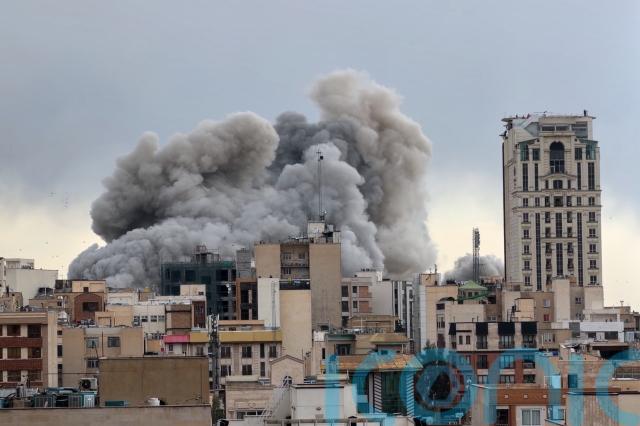
A spokesman for Iran’s military said on Thursday that Tehran maintains hidden stockpiles of arms, munitions and production facilities.
“The centres you think you have targeted are insignificant, and our strategic military productions take place in locations of which you have no knowledge and will never reach,” Lt Col Ebrahim Zolfaghari said.
Just before Mr Trump began his address, in which he said US “core strategic objectives are nearing completion”, explosions were heard in Dubai as air defences worked to intercept an Iranian missile barrage.
Less than half an hour after the president finished his speech, Israel said its military was also working to intercept incoming missiles. Sirens sounded in Bahrain, home to the US Navy’s 5th Fleet, immediately after the speech.
Attacks continued across Iran on Thursday, with strikes reported in multiple cities.
We make it clear to the American-Zionist adversaries: your understanding of our military strength and capabilities is far from complete. You have no real knowledge of the full scope of our advanced and strategic power. pic.twitter.com/6w2ndcO1Op
— Ebrahim Zolfaghari (@Irantimes72) April 2, 2026
More than 1,900 people have been killed in Iran during the war, while 19 have been reported dead in Israel. More than two dozen people have died in Gulf states and the occupied West Bank, while 13 US service members have been killed.
More than 1,200 people have been killed and more than one million displaced in Lebanon, home to Iran-backed Hezbollah militants who are fighting Israel. Ten Israeli soldiers have also died there.
Iranian attacks on about two dozen commercial ships, and the threat of more, have halted nearly all traffic in the waterway that connects the Persian Gulf to the open ocean.
Since March 1, traffic through the strait has dropped 94% over the same period last year, according to the Lloyds List Intelligence shipping data firm.
Two ships are confirmed to have paid a fee, the firm said, while others were allowed through based on agreements with their home governments.
In order to bypass Hormuz, Saudi Arabia has been piping more oil to a Red Sea port, and Iraq said on Thursday that it had started to take oil by lorries across Syria to the Mediterranean.
The 35 countries speaking on Thursday, including all G7 industrialised democracies except the US, as well as the United Arab Emirates and Bahrain, signed a declaration last month demanding Iran stop blocking the strait.
But no country appears willing to try to open the strait by force while the war is raging. There is a concern that Iran might limit traffic through the strait even after US and Israeli attacks on it cease.
The conflict is driving up prices for oil and natural gas, roiling stock markets, pushing up the cost of petrol and threatening to make a range of goods, including food, more expensive.
On Thursday, Brent crude, the international standard, rose again and was at 108 US dollars in spot trading, up about 50% from February 28.

Subscribe or register today to discover more from DonegalLive.ie
Buy the e-paper of the Donegal Democrat, Donegal People's Press, Donegal Post and Inish Times here for instant access to Donegal's premier news titles.
Keep up with the latest news from Donegal with our daily newsletter featuring the most important stories of the day delivered to your inbox every evening at 5pm.

This publication supports the work of the Press Council of Ireland and Office of the Press Ombudsman, and our staff operate within the Code of Practice of the Press Council. You can obtain a copy of the Code, or contact the Council, at www.presscouncil.ie, Lo-call 1800 208 080 or email: info@presscouncil.ie.