
Commemoration for Derry IRA man George McBrearty
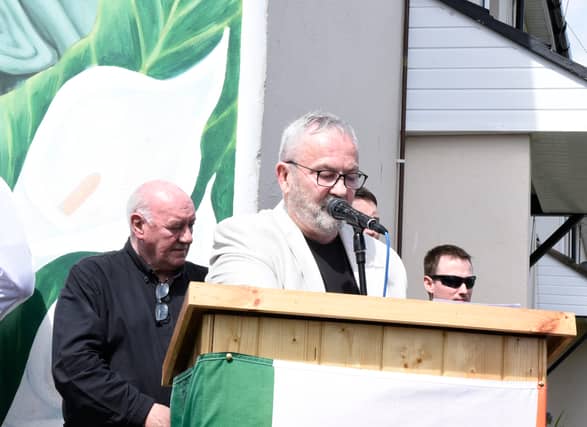

Commemoration marks 45th anniversary of Volunteers George McBrearty and Charles ‘Pop’ Maguire
The oration at Sunday afternoon’s commemoration, which marked the 45th anniversary of Volunteers George McBrearty and Charles ‘Pop’ Maguire, was delivered by former Republican prisoner and author, John Crawley.
The two men were shot dead by undercover members of the British Army on May 28, 1981.
“We remember Volunteer George McBrearty and his comrade Volunteer Pop Maguire with pride,” said Mr Crawley, “and we remember the heroic hunger strikers who died and were dying for Ireland, as George and Pop lay riddled with British Army bullets at the bottom of Southway.
Recalling the tumultuous year of the Hunger Strike, Mr Crawley described it as “a pivotal year in the struggle for full Irish freedom”.
“By Thursday, May 28, 1981, the day George and Pop were killed in action, Bobby Sands , Francis Hughes, Ray McCreesh and Patsy O’Hara had already died. George and Pop would never know that six more IRA and INLA volunteers would starve themselves to death in resisting the British criminalisation of our freedom struggle,” he added.
“George McBrearty fought and died as a proud volunteer in the Irish Republican Army. He believed, and had every right to expect, that the term ‘Republican’ was not merely a suggestion but a resolute statement of intent”.
‘We remember all the men and women commemorated by this magnificent memorial who contributed so much to the struggle for Irish freedom’
Turning to the current political situation in the North, Mr Crawley said there were former comrades of George McBrearty who would have us believe that, had he lived, he would probably, like them, have moved on.
“By ‘move on’ they mean ‘move away’. Away from Wolfe Tone’s vision of national unity across the sectarian divide. Away from the Proclamation’s call for the Irish people to be oblivious of the differences carefully fostered by an alien government,” he added.
“That George would have moved on to new ground carefully prepared by the British government over a decades-long counter-insurgency campaign. That George would now be extolling a United Ireland rooted in British/Irish identity politics. That he would no longer refer to Ireland as our country, but think only in terms of ‘This Island’,” said Mr Crawley.
“‘Our country’, after all, is one nation. ‘This island’ is a geographic fragment containing two nations. That George would have internalised the conditions, parameters, and political architecture of the United Ireland demanded by Britain, should it ever come to pass, and would hope one day to proclaim victory by maintaining that’s what we were fighting for all along.
“Perhaps George would have entered Stormont and transitioned from a 23-year-old Irish revolutionary in May 1981 to a 69-year-old British government pensioner in May 2026, while boasting to anyone who would listen about his ‘journey’.
“George’s family, who loved him most and knew him best, know that George would never have been swayed by the pacification propaganda of misguided men and women who call themselves Republicans, yet work daily to undermine the authentic aims and objectives of Irish republicanism. That is to break the connection with England and to forge a joint civic identity as Irish citizens, oblivious of ethnic or sectarian differences. Differences that would become incidental in a genuine Republic remain fundamental in their ‘New’ Ireland, which is predicated on the old divisions.
“No-one can say with certainty what IRA volunteer George McBrearty would have believed today had he lived. But we know what he believed when he was killed on active service,” asserted Mr Crawley.
“George believed in the aims and objectives of the IRA as it existed then. The army in which he was a brave, dynamic, and dedicated combatant. The army that pledged never to desist until the announcement of a British declaration of intent to withdraw from Ireland,” he added.
“George’s IRA acknowledged that Unionists are pro-British for deep historical reasons that cannot be glibly dismissed, but are not the British presence and must never be made so. It recognised the British presence as Britain’s jurisdictional claim to Ireland and the civil and military apparatus that gave it effect. That’s the British presence George fought and died to resist.
“George was shot dead by armed employees of the British government, determined to maintain British rule in this part of Ireland.
“Did George fight and die to reform British rule? Of course not. He fought to end it. Those closest to him are in no doubt that George would never have rescinded his allegiance to the Republic by acknowledging the constitutional legitimacy of British rule in Westminster’s regional assembly at Stormont, nor would he have accepted that the Crown Constabulary, which protects and preserves it, rightfully retains a monopoly on the lawful use of force in this part of Ireland. George would never have encouraged Irish nationalists to become His Majesty’s constables and informers.
“Republicans who criticise Pax Britannica are often asked, ‘What’s the alternative?’ The alternative to the two-nation Shared Island is the one-nation Republic. The alternative to embracing differences in national allegiances for the sake of peace is to end those differences for the sake of peace,” said Mr Crawley to applause from those gathered at the commemoration.
Mr Crawley said Irish people were “continually cautioned to protect the Peace Process”.
“Peace is not a process; it is an established fact,” he added. “Pacification, on the other hand, is a process that occurs when an armed campaign is defeated or contained, but the root cause of violence remains intact,” he added.
“For the Brits, pacification is a systematic programme of military and political efforts to defeat an insurgency and achieve a desired result. In this case, to achieve normalisation, Ulsterisation (particularly police primacy), an end to armed resistance to British rule, and, crucially, an end to Irish Republican as a credible philosophy and a viable alternative.
“The alternative to pacification is not war; it is peace. The real peace that can occur when the root cause of conflict is addressed and not continually kicked down the road to be resuscitated in future constitutional arrangements that bake in the British/Irish cleavage in national allegiances.
“The 1918 General Election was the last time the British government would permit the national will to be tested in an Ireland comprising one political unit. They will never encourage an Irish unity that transcends the sectarian divide. How are we to achieve a national democracy within an All-Ireland republic remains a challenge that concerns republicans today.
“Despite all the challenges Republicans face and the resources arrayed against us by both jurisdictions in Ireland, the roots of the national flower run too deep to die. They may lie dormant for a generation or two, but they invariably spring to life again. We must work politically to achieve this reawakening,” held Mr Crawley.
Concluding his remarks, Mr Crawley said: “We remember all the men and women commemorated by this magnificent memorial who contributed so much to the struggle for Irish freedom.
“To the Volunteers killed in action, to those who died from other causes, to the brave Derry citizens who contributed to the struggle in any way, however big or small, and to all those who remain unconquered and unconquerable, we salute you and pledge our everlasting admiration and gratitude for your courage and patriotism. Up the Republic.”