
Councillors reject plans to abolish or amend 'Triple Lock' on Ireland's neutrality
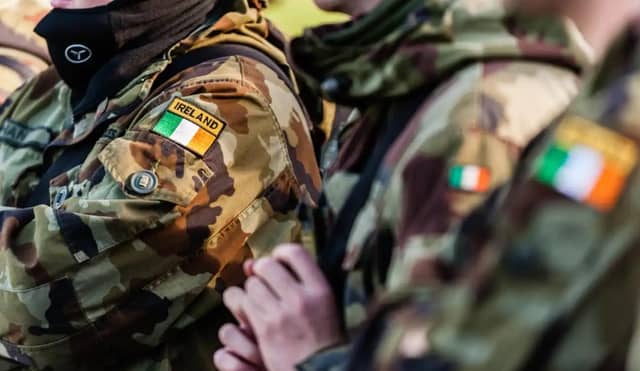

"The attack on the ‘Triple Lock’ has zero mandate from the public" - Cllr Gary Donnelly
Derry and Strabane councillors have backed a motion rejecting the abolition or amendment of the ‘Triple Lock’ on Ireland’s neutrality.
Proposed by Cllr Gary Donnelly (Independent) the motion was passed, without Unionist support, at Derry City and Strabane District Council’s June plenary.
Describing the Republic of Ireland as a “neutral state”, Cllr Donnelly said the ‘Triple Lock’ was a central component of that neutrality.
He added: “This means that its military forces can only be deployed on overseas missions that have been approved by 1. The Dublin Government, 2. Leinster House, and 3. Have a UN mandate.
“The ‘Triple Lock’ was secured following a rejection of the Nice Treaty and was introduced to allay the fears of the people of the 26 Counties that they would be dragged into NATO wars.
“There has been a constant campaign to undermine a proud Irish history of neutrality. The proposed Defence Armament Amendment Bill of 2025 will not modify the ‘Triple Lock safeguard, it will simply remove it.
“At a time when the world is barrelling down the road of war and Europe has planned to spend hundreds of billions of euro for the machinery of death, any ideas of diplomacy and dialogue have been thrown away. Neutrality makes warmongers uncomfortable,” said Cllr Donnelly, who added “the attack on the ‘Triple Lock’ has zero mandate from the public”.
Outlining his party’s support for the motion, Cllr Brian Harte (Sinn Féin) said the people of Ireland “cherish our neutrality”.
He added: “We value it deeply as part of who we are as a people. It is hardwired into our history, hardwired into our struggle against colonisation and oppression, our struggle for the freedom of our nation.
“Neutrality is how Ireland has built a strong, respected and honourable reputation in the world as a defender of human rights and international justice.
“Sinn Féin is strongly of the opinion that Ireland’s position of neutrality is one of our greatest strengths as a nation on the world stage.
“It is a shared value that binds us together, that looks out into the world and seeks not war but peace.”
Cllr Shaun Harkin (PBP) said the campaign to protect Ireland’s neutrality was happening right across the country.
“We are at a very dangerous moment because we can see the kind of warmongering that is going on in the Middle East. We also see Kier Starmar talking about slashing the welfare budget to fund warfare,” he added.
“We see members of the British Government talking about the need for conscription and talking about the likelihood of a war taking place in Britain in the near future.
“There is going to be increased militarism and, as always, it will be working class people that do the dying, while elites benefit from war.”
The full text of the motion on Irish neutrality read: “This Council expresses its dismay at and opposition to the Dublin government’s intention to abolish the Triple Lock, which governs the deployment of its Defence Forces personnel overseas.
“The Triple Lock has ensured that participation in overseas missions (with more than 12 defence personnel) would always require approval from: 1. the Cabinet 2. Dáil Éireann (Leinster House) and 3. that the mission they are being deployed on would have a UN mandate either from the Security Council or the General Assembly.
“In 2001, the people of the 26 counties, rejected the Nice Treaty over concerns that it would drag them into EU military structures that would threaten neutrality. To get the electorate to approve the EU Treaty, the government with the agreement of the other EU Member States, through a ‘solemn declaration’ introduced the Triple Lock.
“This Declaration was reiterated following initial rejection of the subsequent Lisbon Treaty. Therefore, this Council rejects any plans to abolish or amend the Triple Lock by the Dublin Government, considering the proposal signifies a breach of trust with the electorate and a serious diminution of neutrality.”