
Derry Dambuster to be re-united with his old squadron 75 years on
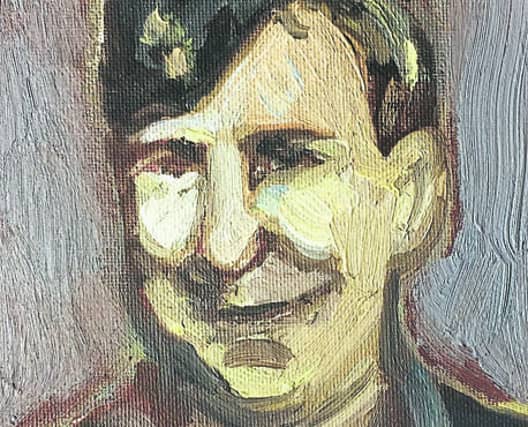

A portrait of the only Irish 'Dambuster', Derry man Richard Bolitho [above], will be unveiled next month along with paintings of his 132 squadron colleagues, to mark the 75th anniversary of one of the most historic raids of the Second World War.
Sergeant Bolitho, who was born in Derry city in 1920, was one of 53 RAF personnel killed during the Operation Chastise raids of May 1943, which saw British forces destroy two huge German dams, using new, purpose-built bouncing bombs.
The artist Dan Llywelyn Hall, who has painted the Queen and Amy Whitehouse, has invited families from all over the world to unveil their relatives portraits at a 'Dambusters Reunited' ceremony at International Bomber Command Centre in Lincoln on May 13.
Only two of the original Dambusters are still alive, 96-year-old George 'Johnny' Johnston, who will attend a private unveiling at the Dambusters Inn on May 14, and Canadian Fred Sutherland, who will unveil his portrait in Canada.
All the portraits will then be taken to London for a public exhibition in Mayfair. At all events, donations, prints and books will benefit charities associated with 617 Squadron such as: RAF Benevolent Fund, International Bomber Command Centre and Group 617.
Organiser Richie Bloomberg said: T"he only Irish Derry Dambuster Richard Bolitho will be reunited with his 617 Squadron also known as the Dambusters. Richard will join ALL his 132 squadron members in a historic exhibition by artist Dan Llywelyn Hall - the youngest artist to paint the Queen.
"Dan decided to reunite the squadron in May for the 75th anniversary (May 16) for a special unveiling taking place at international Bomber Command Centre in Lincoln that will be attended by families from all over the world. He was inspired to paint the squadron after sitting with the last British Dambuster, Johnny Johnson."
According to the Dambusters blog, compiled and written by the author Charles Foster, nephew of Dambuster pilot David Maltby, Richard Bolitho lived in Derry until he was seven.
He writes: "His father William Bolitho was a commercial traveller in the seed business, originally from Cornwall. He had stayed on in Ireland after meeting and marrying a local [Derry] woman, Jane Cuthbertson, the daughter of a land steward. Richard was an only child.
"In 1927 the family moved to England where they bought a hotel in Kimberley, Nottinghamshire. Richard moved in with his aunt Emily who owned a fruit and vegetable shop in the town. He was educated at the local Church Hill School and then won a scholarship to the nearby Heanor Secondary School (later Heanor Grammar School) in 1931. He joined the RAF in 1940, but wasn’t selected for aircrew training until early in 1942.
"After qualifying as an air gunner, he was posted to an operational training unit, where he crewed up with Max Stephenson, Floyd Wile, Don Hopkinson and Albert Garshowitz. The five were then selected for heavy bomber training and John Kinnear and Frank Garbas were added to the crew.
"Their first posting to 9 Squadron was cut short when Stephenson was killed while flying with another crew, and the remaining six were sent on to 57 Squadron at Scampton, and assigned to Bill Astell. They first flew together on 13 February 1942, but some six weeks later they were all posted to the new 617 Squadron."
Richard Bolitho's last leave before the Dams Raid was spent at his home in Kimberley, where he was accompanied by his colleagues Floyd Wile, John Kinnear and Albert Garshowitz.
Charles Foster reports: "All would die together near Marbeck in Germany just a few days later, in the early hours of Monday 17 May 1943, and they lie together in Reichswald Forest War Cemetery, having been reinterred after the war from their original graves in Borken.
"In 1946, three years after his death, his parents returned to Northern Ireland where they lived in the coastal resort of Portrush, and they lived out their days there."
Dambusting operation
Operation Chastise took place on May 16-17, 1943 when 617 Squadron used bouncing bobms to destroy the Mohne and Edersee Dams, causing massive flooding and moore than 3,000 deaths.
Two hydroelectric power stations were destroyed and several more damaged. Factories and mines were also damaged and destroyed. An estimated 1,600 civilians, about 600 Germans and 1,000 mainly Soviet forced-labourers died. Despite rapid repairs by the Germans, production did not return to normal until September.