
“Derry is no worse or better than anywhere else” for traffic accidents - PSNI Inspector claims
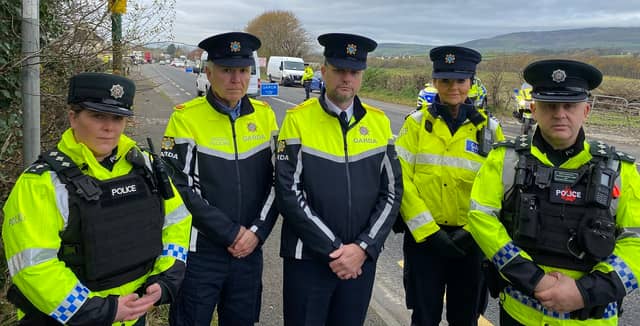

National Slow Down Day is a cross-border police operation aims to tackle rise in road deaths
Derry is no better and no worse than any other region for traffic collisions, according to PSNI Head of Road Policing, Chief Inspector Graham Dodds.
Chief Inspector Dodds made the claim on National Slow Down Day on Thursday, where officers from the PSNI joined their Garda counterparts along the border at Bridgend.
After five hours of Slow Down Day an Garda Síochána recorded the speed of 37,295 vehicles. A total of 65 drivers had been caught speeding. Some of the speeds included 158km/hr in a 120 zone, 146km/hr in a 100 zone, 98km/hr in an 80 zone, 72km/hr in a 50 zone.
Chief Inspector Graham Dodds said it was a chance to communicate with driversabout the severity of the issue.
“Speed is one of the biggest factors in the causation of fatal collisions. So with ourselves and our colleagues in an Garda Síochána we're doing an island-wide focus,” he said.
“We really wanted to reach out to the vast majority of the public who do observe the law to make sure they keep doing that and to ask them to call out that behaviour whether it's their family or their colleagues or their friends.
“Speed fits within what we call the 'fatal five', the five things most likely to get you killed or seriously injured on the road, and that's speeding, driving without a seatbelt, drink/drunk driving, driving while using a phone or driving without due care and attention.
“We want people to just consider those factors and the fact that they have the power to save lives, their life and everybody else's lives are in their hands, if they drive to their abilities.”
He said 57 people have lost their lives on the roads in the North this year and the South has 'equally terrible figures'.
“It's not just a number. It's 57 people and then countless hundreds of others who are affected by the ripple effect.
“Don't think in terms of statistics. Think of somebody who will not be at the table this Christmas, who will not be at somebody's First Communion, who will not be at a wedding, who will not be at a graduation.
“We deal with people who lost people 30 or 40 years ago. Those families are trapped on that day when they lost a loved one. Every day is like Groundhog day. They don't live really, they just exist because the pain and suffering of losing a loved one is massive.
“No matter how good you think you are, one slight mistake, one stone on the road or one slight swerve could kill you or lead you to kill somebody else and the devastation will not go away.”
He said it's difficult to pin one region as worse than another for traffic collisions.
“Derry is no worse or better than anywhere else. These people are island-wide and misbehave in different areas at different times for different reasons but the effects are always the same: death or serious injury.
“Recently up here we had the new A6, Claudy Road open and we did a lot of PR on that because people were on a 70 mile an hour road maximum and were thinking because it was a new road and it was very safe it would be great to do... 124mph, I think was one of the ones we got.”
However, Chief Inspector Dodds did say it tends to be two types of roads people speed on.
“It tends to be two broad areas. Either the really big, main, A roads where people are trying to get to shops or work and we also notice people doing it on the B roads, the country roads.
“Those country roads could be a 60 mile an hour limit but in most cases you shouldn't be anywhere near the 60. It might be a 30 or a 40 or a 20 depending on what the conditions are.
“We have found when new roads are open, some people are abusing them because they think ‘well it's a clear road, it's very modern’, and they think they can speed but as I said hitting a small stone or a bit of surface water could easily mean that it goes from being a fast journey to a very slow journey to the morgue.”
He said there is no journey worth risking a life.
“We regularly say to people, there is no journey that's important enough to kill yourself or somebody else. There's no message that is important enough to receive or send on a phone when you're driving.
“We can't tell you it just happens on these particular roads or those roads.
“These people are dangerous 24/7, 365 days a year and it could be on any road. It could be on the biggest road or it could be on the smallest road. That's why people need to drive properly and call out people who are not doing so.”
Chief Inspector Dodds also said there is not really a group of people in particular who get caught speeding, contrary to what many may think.
“It can be various age ranges. We are always keen to challenge that it's always a boy or girl racer behind all this. It's not. We see people of all ages, all social backgrounds, people from manual jobs to some of the most skilled and high profile jobs in the country.
“It just comes down to the fact that sometimes human beings can be impetuous and impatient, but that could get you killed.
“So you know, it's amazing the sort of people who get picked up. It's not one group. Again, that adds to the danger. These people are out amongst them and could be anywhere.
“Going forward we will be working with an Garda Síochána in operations similar to today but there won't be the warnings, it will be enforcement. It is a national threat across the island or Ireland to the lives of so many people.”
PSNI and Gardaí stood in various locations in Derry to carry out checks and engage with the community. Mobile cameras and safety vans were in operation.