
Glenshane Community Development present evidence to Stormont Economy Committee
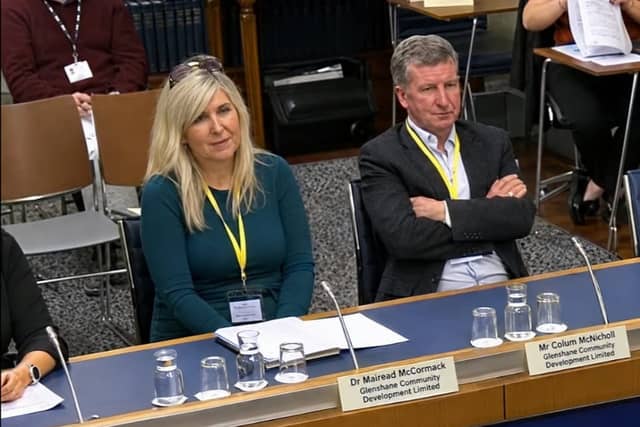

Dr Mairead McCormack, Chief Executive of Glenshane Community Development Limited, has called for the proposed Regional Balance Bill to recognise the significant economic inequalities that exist not only between regions, but also within individual council areas.
Appearing before the Northern Ireland Assembly's Committee for the Economy on Wednesday, November 4, alongside the organisation's Chairman and one of its founding members, Colum McNicholl, Dr McCormack welcomed the legislation introduced by Foyle MLA Sinéad McLaughlin as an important opportunity to address longstanding geographical inequalities across the North of Ireland.
Having led the Dungiven-based organisation since 1998, she emphasised the importance of ensuring that economic performance is assessed at a sufficiently local level to identify communities that continue to experience disadvantage.
"Dungiven and its local hinterland cannot be assumed to share the same circumstances as larger settlements such as Coleraine and Ballymoney simply because they fall within the same council area. "An improving council-wide average may conceal communities where investment remains limited and access to opportunity has changed very little," she told the Committee.
Established in 1989, Glenshane Community Development has spent 37 years responding to economic disadvantage through community-led investment, enterprise development, employment creation and the regeneration of local assets.
Today, approximately 489 people are employed across businesses and organisations operating from properties owned by Glenshane Community Development, reflecting the organisation's contribution to sustaining employment and retaining economic activity within the local community.
Dr McCormack told the Committee that Glenshane's experience demonstrated what communities could achieve through local initiative, but also highlighted the importance of equitable public investment.
She welcomed the proposed Regional Balance Strategic Framework, particularly its emphasis on departmental responsibilities, funding plans, measurable targets and implementation timescales.
"Regional disparities still persist. We welcome the proposed framework because it offers an opportunity to make regional balance a sustained responsibility across the whole of the Executive,” continued Dr McCormack.
Dr McCormack also stressed that meaningful measurement must extend beyond headline economic indicators to capture the practical barriers experienced by rural communities.
"Measurement should capture practical barriers such as journey times to employment and training, childcare availability, broadband reliability, affordable premises and access to services.
"Youth out-migration also matters. Where young people must leave to secure suitable employment, the consequences extend to local businesses, the future workforce and community sustainability."
Colum McNicholl, Chairman of Glenshane Community Development, also presented evidence to the Committee, drawing on his longstanding involvement in community-led economic development in Dungiven.
A local businessman and one of the organisation's founders, Mr McNicholl has been involved in efforts to build and retain community wealth for approximately four decades, predating the establishment of Glenshane Community Development as a limited company.
His participation brought the perspective of a local businessperson who had been directly involved in establishing the community-owned assets and enterprise infrastructure that continue to support employment and economic activity in Dungiven today
Together, Dr McCormack and Mr McNicholl outlined the experience of a community anchor organisation that has developed its own response to economic disadvantage while continuing to work in partnership with statutory agencies.
They also highlighted Glenshane's ongoing partnership with Causeway Coast and Glens Borough Council and DAERA in developing an enterprise hub in Dungiven, alongside associated streetscape and environmental improvements as part of the Growth Deal project.
The Glenshane representatives appeared alongside Gerard Deane and Mairaid McMahon of Community Foundation Northern Ireland, who also emphasised the importance of addressing inequalities within council boundaries and ensuring that regional balance becomes a long-term commitment.
Dr McCormack acknowledged MLA Sinéad McLaughlin's initiative in bringing forward the legislation and thanked the Committee for inviting Glenshane Community Development to contribute to its scrutiny.
"The significance of this legislation is that it offers an opportunity to move regional balance beyond a policy aspiration and establish it as a sustained responsibility across the Executive.
"For communities such as Dungiven, the real test will be whether that commitment translates into investment, employment opportunities and measurable improvements in people's everyday lives."