
Loughs Agency accused of no 'meaningful consultation' with Faughan Anglers on 'catch and release'
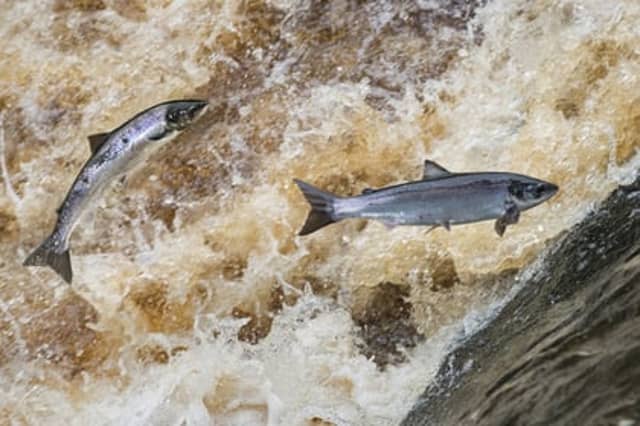

The secretary of River Faughan Anglers has accused the Loughs Agency of announcing its decision to move to ‘catch and release’ on the rivers Faughan, Roe and Mourne “without formal notice to the River Faughan Anglers”.
According to Gerry Quinn, the announcement “ignored the fact that the majority of fish caught on the Faughan are ultimately released by our anglers voluntarily”.
River Faughan Anglers manages the fishing of Salmon and Trout on the tidal and inland and freshwaters of the River Faughan and its tributaries.
“As custodians of the River Faughan, we believe we have a right to expect proper and meaningful consultation,” said Mr Quinn.
In a press release issued on Thursday (September 17), the Loughs Agency said it was introducing ‘catch and release’ from midnight Monday, September 21, for the remainder of the 2026 season, following “concerns over the numbers of returning Atlantic salmon” in the rivers.
It added: “The decision follows a review of the 2026 salmon monitoring data, including fish counter information from the River Roe, River Faughan and River Mourne. Based on the information available, Loughs Agency is not satisfied that the required management targets for Atlantic salmon have been met.”
Mr Quinn described the Loughs Agency as “forcing anglers to release all salmon caught because, allegedly, the fish counter figures do not meet a specified target”.
“This is despite the fact that they have acknowledged that their counter figures record only a partial count,” he added.
“The issue for our anglers is that catch and release prohibits the use of worm as a bait, most of our older anglers like to sit and fish worm, most youngsters new to the sport start off by worm-fishing.
“In the long term enforced catch and release is the death-knell for angling clubs.
“Faughan Anglers would expect this decision to be evidence based. It is not. The Faughan fish counter gives only a partial count; Loughs Agency staff have acknowledged this and the Faughan figure used to be described by the Loughs Agency as a partial count only.
“The fish counter channel is a mere 90cm wide, whereas the width of the river at that point is 25m. The fish can easily bypass this channel if they so wish and they frequently do. The Loughs Agency has proved this by tagging fish below the fish pass channel and discovered that some moved upstream without going through the fish counter,” said Mr Quinn.
Mr Quinn said Faughan Anglers did not believe ‘catch and release’ was “an effective tool in restoring flagging runs of migratory salmonids”.
“The evidence from the river Finn, or the Scottish Dee would seem to support this,” he added.
“We do not see a wider strategy or plan to address the reduced run of salmon and sea-trout in the Faughan or wider Foyle area, we see imposing catch and release as blaming anglers and ignoring the myriad factors affecting the populations of migratory salmonids in our rivers.”
In the long term enforced catch and release is the death-knell for angling clubs.
Providing context to the arguments of Faughan Anglers against ‘catch and release’ Mr Quinn said: “Many years ago, fishery scientists used to assure us that there were far too many salmon for their own good, and the commercial harvest of Foyle salmon was lauded as a positive management tool. They assured us that there was a harvestable surplus, and the efforts of anglers wasn’t even taken into account.
“Then, some twenty odd years ago, fishery scientists pivoted, and decided that there was no harvestable surplus, netting was stopped and restrictions were introduced on anglers. The River Finn, once a prolific salmon river, was initially closed to angling, then reopened on a catch and release basis,” he added.
“To this day the run of Finn salmon has never recovered. Anglers were never the problem.
“Further restrictions on anglers followed, with the introduction of carcass tags and catch limits. The salmon runs failed to show any improvement with the possible exception of the Covid years, when anglers far and wide experienced an abundance of salmon. This has been dismissed as an anomaly by fishery scientists.
“For the past 100 odd years local anglers have organised themselves to manage and preserve the fishing on the River Faughan, they have worked with the predecessors of the Loughs Agency over that period, often constructively, generally with mutual respect.
“We feel let down by the Loughs Agency. The more cynical among the angling fraternity might say that the Loughs Agency has supervised the inexorable decline of salmon runs in the entire Foyle system. It is highly likely that by now they have identified the problems within our rivers, there’s likely a widespread issue with water quality, we have cohorts of seals munching their way through salmon not only at seas but also in our rivers, something unheard of when I was growing up. We also have unprecedented numbers of cormorants eating the juvenile fish in their thousands,” said Mr Quinn.