
Sideline View – New ruling won’t make a marked change
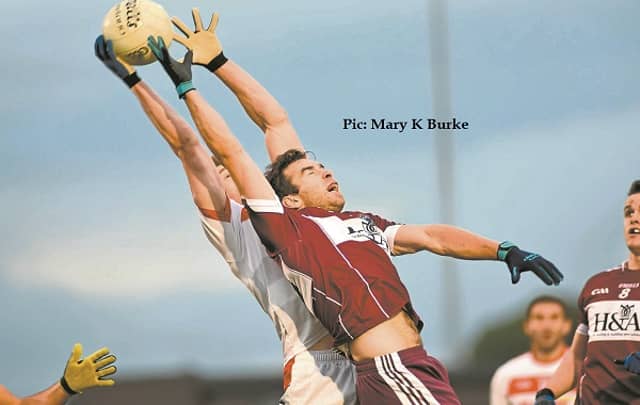

“The reason why we brought the mark in is the incidents of balls being caught in the middle of the field have declined rapidly in the last five years, so we’re sleep-walking towards the death of a skill.” – Jarlath Burns (February 2016)
HOLIDAYS are worth their weight in gold and for the first time in a lifetime mine no longer revolves around the school bell.
Recently with the club season slowly coming to a halt it was time to head east to the picturesque Polish city of Krakow. Time to recharge the batteries after a taxing yet rewarding few months covering the championships.
On top of Polish culture and all the good food on offer, the sport fanatic in me kicked in. A sports geek is a unique animal. After completing Kieran Donaghy’s book I delved into the world of Cavan goalkeeper Alan O’Mara.
The Breffni man’s story (The best is yet to come) is more than about just football. The emotional narrative centres on his struggle to deal with depression – itself an issue the GAA need to address. Thankfully O’Mara has started the ball rolling in this regard.
With ‘the mark’ coming into vogue next month, O’Mara’s ability to fend off all-star nominee James Clarke for the number one jersey got me thinking.
“There is no denying that James Reilly was one of the finest goalkeepers for Cavan,” O’Mara expressed. “However, the game had evolved beyond his style of goalkeeping; players now wanted a lower-trajectory pass that they would run on to, rather than a long, high kick”
CHANGED TIMES
It’s so true. In my brief time playing between the posts, the length of a kick defined a goalkeeper. A keeper that could kick to either wing was defined as having a ‘varied kick out’. How times have evolved.
Two years ago we took our U12 team to play Magherafelt in a championship semi-final. Though small in stature, their ‘keeper nearly beat us on his own. As soon as any of our kicks went dead, the nimble custodian had a spare ball in hand and precisely dispatched to a strategically placed player on the wing. Their counter attack hit us for six.
In this year’s U14 Final the accuracy both goalkeepers possessed was memorising. Ronan McKee (Magherafelt) and Conor McMullan (Bellaghy) had kick out accuracy of 64 and 66 per cent respectively. The off the ball running of their team mates had a huge part to play.
It is not restricted to football. In the mid noughties with Kilkenny’s half back virtually impregnable under the high ball, Donal Óg Cusack and Cork broke the trend and opted to go short.
In Cuala’s Leinster Final success over O’Loughlin Gaels, the Dublin team’s first goal from Colm Cronin was initiated at the other end of the pitch with a short puck out to corner back Oisin Gough.
With the mark set to be introduced into Gaelic Football from January 1 onwards, will it make that much difference?
With the amount of analysis in the game now, it is hard to envisage the preparation levels going much higher. Club teams are dissecting opponents apart ahead of games now - even at club level. One of the main areas of study is the kick out.
With teams dropping sweepers back and allowing a spare defender to open up the space to secure possession. Slaughtneil’s game with Kilcoo was the perfect example. Speaking after the game defender Karl McKaigue wasn’t concerned about securing possession and playing a dangerous game in their own defence. Possession was king as far as McKaigue was concerned.
Over the course of their seven game path to an Ulster title 51% of Slaughtneil’s 118 kick outs were ‘uncontested’ i.e. kicked to a team mate in space, unopposed and under no pressure. Either to a winger in space or to an unmanned defender. All 15 kicks in the Ulster Final were unopposed.
Over the championship Glen (47%) were closest in the ratio. Of the 187 uncontested kick outs in the entire Derry SFC very few would be given as marks next season as possession wasn’t secured beyond the 45 metre line.
At county level it perhaps would be a different story – but to secure the ‘uncontested mark’ would take meticulous practice. With the engine room mainly a congested zone, there are so many variables. The ‘keeper’s kicking accuracy. The range of off the ball runs my midfielders. The space left vacant. All outside the ’45’.
This takes hours and hours of practice - not many teams have this luxury, with so many other aspects of play needing allocated coaching time.
SAFE OPTIONS
Teams will still play safe and secure possession as a matter of importance. The high catch is a spectacular skill but with the win at all cost mentality that is present in the game now, it’s all about playing the percentages.
Given time through underage development the mark may indeed help the high catch. As long as coaches put ‘winning at all cost’ to one side, with the aim to promote the high catch to find the next Enda Muldoon, Patsy Bradley or Fergal Doherty.
It’s like the possession game that exists in an attacking sense. At the top level, with championship success balancing on a knife edge – teams will elect to recycle rather than risk a counter attack.
When Kieran Donaghy’s presence at full forward got Jack O’Connor’s long ball game going in 2006, every team in the country was trying to copy. At club level sky scrapers were being taken from the scrap heap and dusted down for a new role.
Colm Cooper being brought further outfield to revel in the space and escape the blanket defence. Armagh’s deployment of Jamie Clarke at wing back had a similar motive. Styles will evolve to suit trends in the game.
Referee Barry Cassidy awarded 7 marks when he refereed Queens in the Ryan Cup – the first game under the new rule. In the Leinster college league one game had the highest so far at 13 marks.
One aspect of the mark will scare managers - on their own kick outs. When the ‘keeper lands the long ball into the middle anyone can call a mark. His own players and the opposition. This could spell the end for teams punching ball back down the throat of the opposition full back.
If a manager has the tools to do so – the ploy may be to pack four men across midfield with the aim to win clean possession from the opponent’s restarts. And call mark. Armed with 5 seconds to pick a killer pass to unlock a defence it could prove a useful way of creating scores.
Like every development, it will be analysed to the nth degree. If the long kickout is counterproductive teams won’t use it. Simple as that.
If teams are blessed with a Darragh O’Sé or an Anthony Tohill things may be different. Jarlath Burns is right – it is fast becoming a forgotten skill. But the facts are simple – a team will play to its strengths.
Slaughtneil perfected it on Ulster final day. Cuala hurlers did it. The Derry U14 final was littered with long, probing passes to the wings. This in itself is a skill and teams will cut their cloth accordingly.
It makes for an intriguing year ahead.