
Trail to honour eccentric Derry bishop

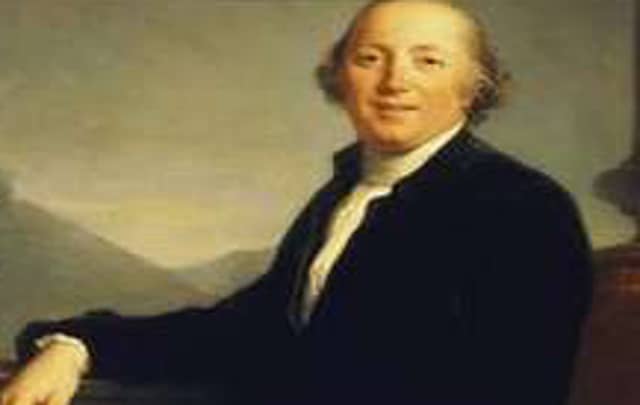

A tourist trail will be launched in Derry later this year to highlight places relevant to one of city’s most eccentric historical figures.
Frederick Hervey (pictured) was the fourth Earl of Bristol and the Bishop of Derry for a long period in the 18th century.
He was known as the Earl Bishop and his influence as a scientist, philanthropist, builder, patron of the arts and proponent of religious tolerance has been described as enormous.
He designed the iconic Mussenden Temple and the mansion that now sits as a ruin on the Downhill cliff top.
Known for his wild eccentricities and volatile temper, Hervey was a friend of kings and queens and leading personalities throughout Europe.
He particularly loved Rome and Naples where he was a popular figure, having lived for a time in both cities.
Derry city also had a special appeal for Frederick Hervey.
He was instrumental in the construction of its first bridge over the Foyle.
He contributed a large sum to the building of a Catholic church and refurbished the Bishop’s Palace which now a Masonic hall in Bishop Street.
He also had the first spire built on St Columb’s Cathedral.
The Foyle and Causeway branches of the University of the Third Age (U3A) have been researching the life of the eccentric clergyman.
As a result, they have developed a tourist trail of the some of the key locations in his life.
The trail will be launched in July.
As part of their research, members of the U3A groups recently travelled to Italy to visit the spot where the Earl Bishop died.
He died in July 1803 while travelling to the town of Albano.
A spokesperson for U3A groups described the visit as “poignant.”
“First there was a moment of silence and then a single red rose was laid in memory of the Earl Bishop’s love of Derry and the northern Irish coast. “Writer and broadcaster Ken McCormack described how on July 8, 1803 Hervey had been riding on the road to Albano – Castel Gandolfo is nearby – when he was taken ill.
“His clerical attire was so eccentric that a local farmer refused to take him in and with difficulty his manservant managed to get him to a disused stable.
“Here Derry’s colourful Earl Bishop passed away and was eventually taken back to his family home at Ickworth, Suffolk where he was interred in the crypt.
“The road to Albano is still much the same as it was in the Earl Bishop’s day – a narrow tree-lined path.
“Yet there is a difference now – after 212 years a red rose on the wayside revives memories of an outstanding personality who loved Ireland and all of its peoples and traditions.”