
Unionists raise concerns that name 'Londonderry' will be removed from Parliamentary map

by Cathal McGuigan
Unionist politicians have raised concerns that the name Londonderry will be removed from the Parliamentary map following upcoming changes to Westminster constituency boundaries.
The changes, which are set to come into force next year, will see the north’s Westminster constituencies reduced from 18 to 17.
Around a third of the current Mid Ulster constituency will become part of the Fermanagh and South Tyrone and Tyrone North constituencies, while around 44% of the current East Derry constituency, including Coleraine, will become part of the Dalraida constituency, predominately made of areas in Co Antrim.
The Foyle constituency is to remain largely unchanged while a new Glenshane constituency, made up of roughly half of each of the current Mid Ulster and East Derry constituencies will cover most of Co Derry outside of Derry city.
The UUP’s Richard Holmes, who stood in the recent Westminster Election, said that he was concerned that the county will be the only one that is not represented in the new constituency names.
The Causeway Coast and Glens councillor said it would be “a shame” to see the name Londonderry taken off the parliamentary map and called for it to be preserved.
“If these Boundary Changes come into effect next year, the constituency currently known as East Londonderry, will have a Republican, abstentionist MP,” he said.
“The name of Londonderry has been on the Parliamentary map since the 1600s. The eradication of the name is yet more evidence of the ‘de-Britification’ of Northern Ireland, which the DUP promised to stop back in 2001.”
“The eradication of the name of Londonderry from the Parliamentary map would represent a further sop to Republicanism.”
Mr Holmes said that he understood people may interpret the name Glenshane as a compromise between the use of Derry by nationalists and Londonderry by unionists, but added that some unionists were uncomfortable with the idea.
“The city name has long since been changed to Derry and there was no compromise. It would be nice at the county level, which was never called County Derry, it was County Coleraine before it became County Londonderry, it would be nice to see that name carried on,” he told the Co Derry Post.
“It’s certainly something that people bring up, particularly people from a Unionist background, who see it as another way of sort of stripping any kind of Britishness from the state.”
He said that the boundaries were still “provisional recommendations” and hoped that something could be done to retain the name.
“I’ve spoken to party headquarters about it in the hope of improving our response. They are provisional recommendations at the moment and I suppose it has to go through all the consultation stages yet,” he said.
“It’s certainly something that I’ve been arguing for in meetings recently and will definitely continue to do so. I’m sure we probably won’t be the only party doing it either.”
Mr Holmes also called on the DUP to put the issue “at the top of their agenda” in negotiations with the Conservative Party.
“As far as Unionism is concerned, the DUP are in the driving seat. They need to waken up!,” he said.
“I am passionate Unionist, proud to come from County Londonderry and proud to be British. We should be tolerant of others, but I will not accept the suppression of my culture and identity.”
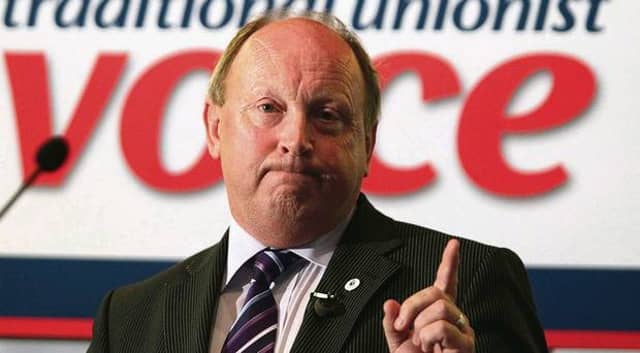
TUV leader Jim Allister has also hit out at the disappearance from the electoral map as part of the UK wide reduction of Westminster seats.
“It smacks of political meddling in a process which should remain free of political interference,” he said.
"How else does one explain why Londonderry is the only county of Northern Ireland not to feature in the name of one of the new constituencies?"
The Glenshane constituency will see East Derry loses the predominately Protestant Coleraine area and gain the nationalist town of Magherafelt. As a result, the historically Unionist seat, which has been held by the DUP’s Gregory Campbell for over 15 years, may be represented by its first Sinn Féin MP in the near future.
The boundary changes will also affect Stormont. While the number of MLAs was reduced from 108 to 90 in the March Assembly election, they will be reduced further to 85 by 2021.