
‘We Can Do Better’: An artistic journey into conflict and hope at Downhill House


The County Derry Post talked to Joe Caslin, one of the artists of the project to better understand the significance of 'We Can Do Better'.
On May 17, a new piece of art was unveiled at the Downhill House, a National Trust owned property in County Derry.
Called ‘We Can do Better’ is part of the IWM 14-18 NOW Legacy Fund. It is a national partnership programme of artistic work inspired by the heritage of conflict.
The piece of art tackles multiple themes from gender related violence to Northern Ireland challenges. It has been imagined by Joe Caslin, an Irish street art artist, art teacher and activist and six young women known as ‘The Kindred Collective’ all born after the Good Friday Agreement.
The artwork also features an augmented virtuality function, with each room in the mansion representing a distinct piece of art and theme.

How did you become an artist?
Joe: It is where I found contentment and freedom when I was younger. Whenever I was given the tools to draw or to make art, that's when I was most at ease, I just followed on from that. I loved making. In college, that’s what I went for. It was never like a clear decision. It felt like it was already in my bones.
Where do you find your inspiration?
Joe: From other artists, contemporary artists but more so maybe in the issues that affect the communities that I live in because a lot of my work has a huge amount of social awareness, a sort of social activism in it. It's bringing a thought or an issue to people and asking them to step into their shoes to consider maybe from another perspective.
What was the process of creation of ‘We Can Do Better’?
Due to the themes used in ‘We Can Do Better, was it essential to protect the young women's identities?
Joe: On the protest placards, for example, we put in sources so that when you scan them, you are brought straight to scientific documentation that proves what the women are saying. Because often when a woman speaks, her voice is belittled, and it's like, ‘Oh, no, no, you sit down there, what you're saying isn't true’. So we want you to heighten that and then we knew that the women were like standing out. We tried to protect them and put in safeguards. So the women are portrayed as birds but you see their first name. There will always be comments online where people can say whatever they want and as a consequence we need to mind them and we need to take care of them.
What was your role in ‘We can do better’? Were you the main artist?
Joe: It was a collaboration. I don't see myself as above. I came as a facilitator and kind of told them about the project. Throughout the nine months, we became equal. Part of the project was that the rules would reverse and they would write a design brief. They came to me and said 'this is the artwork that we want on the front wall'. This is what we want from you. So I did that. It was a collective and collaborative effort. The women were part of every decision of the project. It’s their voice and their thoughts that came to life.”
What is behind the choice of the title ‘We Can Do Better’?
Joe: Because we can do better! It was just something that we said quite early on in the project. It wasn't necessarily a throwaway comment, but it was a comment that everybody could understand. It’s meant to be reflective, the idea to consider what you've done or have not done and the idea that we can do better. We can do better for women, we can do better for this generation, we can do better for this place. There are lots of positions that the title can be placed into and it just worked.
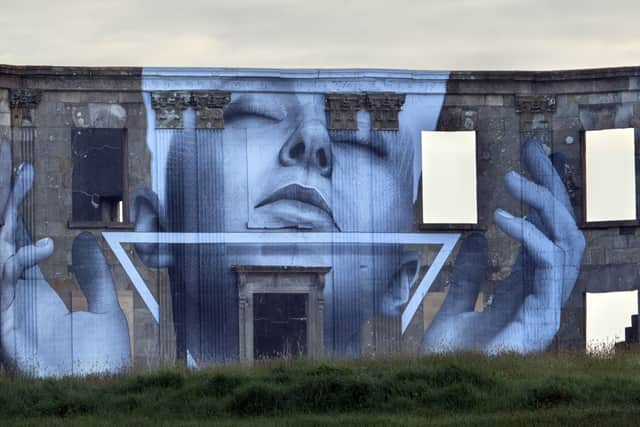
On the main facade of the Downhill House, people can observe a woman, is she a representation of the six young women of the Kindred Collective?
Joe: Yes, exactly! You have a woman whose eyes are closed, she's considering what we can do better. Her head is caught off and in the augmented reality experience we have put stuff that comes from her head, so you get to see inside her mind, you get to see what that's like.
Her hands are held up and she's holding this inverted triangle. That is an ancient symbol that goes across many civilizations of femininity. Then the two hands are up and that's a symbol of being caregiving, nurturing and just being present. We always considered that this project was giving voice to women. When you walk through the site, you actually walk through her voice box. You have to pass through her voice to gain access to the site. There are lots of little nuances in the drawing.