
Ballybofey's Matrimonial Tree has seen better days!


The distinctive 15-year-old sculpture is beginning to show its age and a combination of rust and discolouration is taking its toll
It is a landmark forged from ancient tradition embracing the twin themes of romance and connectivity but today the Matrimonial Tree in Ballybofey is not so much a bold statement, it's slightly bordering on becoming an eyesore.
The distinctive 15-year-old sculpture is beginning to show its age and a combination of rust and discolouration is taking its toll.
This unique landmark situated beside the bridge separating the twin towns is constructed entirely from sheet metal, stands at nearly 5m tall, and from tip to tip is almost 4.5m wide. Every inch of the tree has been hammered, rolled and formed into shape by hand, using traditional techniques. The internal ribbed skeleton is reinforced to ensure that it is completely robust, that is up until now.
It's a pity because there is a beautiful story about the tree and how it came about. The idea is based on an ancient Donegal tradition.
Local folklore indicates that when a couple was engaged to be married two different varieties of trees would have been planted next to one another. At the time of the wedding, these would have been grafted together and left to grow from thereon as one. The two trees would have retained their unique characteristics but formed a distinctive shape with the grafted section – like a bridge. Ancient examples of these Matrimony Trees can be found on the grounds of the old Summerhill House at Navenny, on the outskirts of Ballybofey.
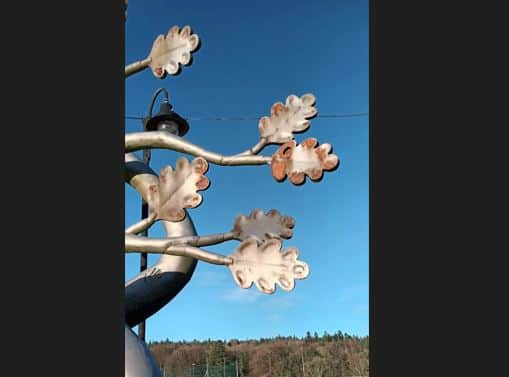
As you can see the rust is beginning to eat into the sculpture
The concept and artwork by English firm Cod Steaks take the form of a real Matrimony Tree but have been abstracted to give a unique identity to the town. Embedded into the ‘bark’ are foundry cast handprints, taken from local schoolchildren in Ballybofey. Each of the five national schools took part, with a print taken from the oldest and youngest pupils at Sessiaghoneill, Dooish, St Mary’s, Robertson and Glencovitt. The impression of local people has most definitely been made on the artwork, and it is hoped this will encourage pride and ownership of the piece.
The work was commissioned under the HEART project and supported by Donegal County Council Public Art Programme under the Per Cent for Art Scheme.
The tree still stands tall but holes are beginning to appear in some of the metal leaves and rust is bedding in taking the shine off the artwork.
Perhaps it's time for a local organisation to come together and either commission specialist repair work or lobby Donegal County Council to initiate some tree surgery!