
DNA test reveals further lineage of the Four Masters
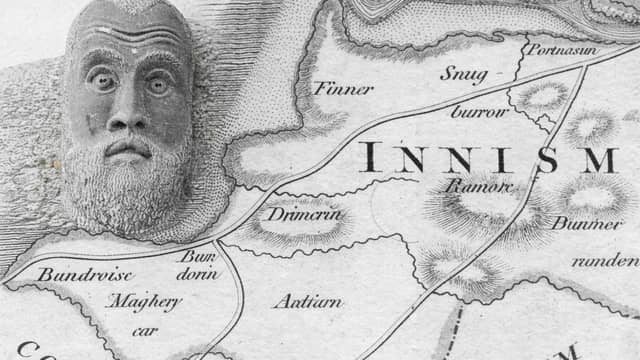

The test that the Bundoran Ó Cleirighs are direct descendants of Mícheál Ó Cleirigh’s cousin, Cú Choigcríche Ó Cléirigh, one of the Four Masters
The rediscovery of the Franciscan Louvain Papers record of Bundrowes Friary established that the Annals of the Four Masters were created in the Convent of Donegal at Bundrowes in Magheracar, Bundoran.
A DNA test now reveals that the Ó Cleirighs from Drumacrin, Bundoran, are direct descendants of Mícheál Ó Cleirigh’s cousin and fellow compiler of The Annals, Cú Choigcríche Ó Cléirigh.
As Ireland’s leading Four Masters historian, Dr Bernadette Cunningham recently said in a Mayo lecture, the Annals were compiled in “Bundrowes, which is on the outskirts of modern-day Bundoran.”
Bundoran’s Ó Cleirigh history is sourced back 700 years to one of her main townlands, Drumacrin, which stretches from Main Beach through Main Street to East End and out into the countryside past the bypass to Rathmore. Recorded in Cú Choigcríche’s Ó Cleirigh Book of Genealogies, the O’Donnell’s granted “Drumacrin in Magh Ene” to the Ó Cleirighs in c.1348.
Sean O’Cleary recently found out about the Four Masters Y-DNA37 test. He said: “We are the proud descendants of Flan O’Cleary, from Drumacrin in Bundoran, his son, Connor, who owned land in Rathmore, and their first cousin, one of the Four Masters, Cu Choigcriche.”
All three men were third cousins of Mícheál and first cousins of Chief Historian and Poet of Red Hugh O'Donnell, Lughaidh Ó Cleirigh. The Bundoran Ó Cleirigh lands belonged to Lughaidh. He is recorded there as "Lughaidh Ó Cleirigh of Bundoran, chronicler" in 1603.
Although the Mícheál Ó Cleirigh Summer School claims that Mícheál “was born in Creevy” in Kilbarron, there are no historical records of Mícheál in Kilbarron, only in the Bundoran lands in Magh Ene. It is now likely that Mícheál was educated as a chronicler by his chronicler-cousin and teacher, Lughaidh, in Bundoran.
Sean said: “Flan’s family lost their Bundoran land in Drumacrin when English soldier Folliot became landlord, but Flan’s son, Connor and his family line rightfully reclaimed their Bundoran land back.”
While Flan and Connor’s Bundoran family remained rooted in Magh Ene, their cousin Cú Choigcríche transplanted to Mayo in the 1650s. Sean said: “One of Flan and Connor’s descendants, P. Cleary from Bundoran, and one of Cú Choigcríche’s descendants, J. Cleary (Mayo), remarkably matched in a DNA test.”
This Four Masters DNA match creates a historic Ó Cleirigh bridge “between the Bundoran O’Clearys and Cu’s family in Mayo.” The DNA match reveals that the Bundoran O’Clearys are more closely related to one of the Four Masters, Cú Choigcríche, than the Kilbarron O’Clearys – though all belong to the same south Donegal Ó Cléirigh family.
The DNA match also provides insight into the location of Cú Choigri̒che’s recorded homeland of “Ballycleary” before he moved to Mayo. In the Historical Dictionary of Gaelic Placenames (2006), which was kindly shared by Dr Cunningham, “Ballycleary” is suggested to refer to “Clarksfort” (Cleary’s Fort) in the townland of Lisacholly, 4km east of Bundoran in the ancient plain of Magh Ene.
Located in Ballynamanagh (The Monks’ Town), “Clarksfort” was an important Ó Cleirigh settlement. However, the one mistake that the Dictionary makes is that it omits the historical context that during Cú Choigcríche’s time, “Clarksfort” was not in the Parish of Kilbarron but in the Parish of Inishmacsaint (Magh Ene Parish).
In response, Sean shared that “Our ancestor James O’Cleary told our grandfather that ‘Ballycleary’ was the family place-name for the O’Cleary’s Bundoran lands.” Given that the DNA match genetically relates the Bundoran Ó Cleirigh lands with Cú Choigcríche’s “Ballycleary”, this also aligns with the historic interpretation that has been made with Cú Choigcríche’s fellow annalist, Fearfeasa Ó Maolchonaire from Ballymulconry, Co. Roscommon.
Based on the scholarship of Fr. Paul Walsh and M.J. Connellan, the Royal Irish Academy notes that “Ballymulconry” refers to a “group of townlands” that belonged to the Maolchonaires. In that respect, “Ballycleary” then refers to the group of townlands that belonged to the Bundoran Ó Cleirighs in Magh Ene. The DNA match also establishes this family-land relationship.
Oral history and the native tradition also support the connection between Ballycleary and the Bundoran Ó Cleirigh lands. On Fair Days, accounts from old cattle-drivers who drove their cattle through Magh Ene called the Ó Cleirigh’s ancestral land in Drumacrin, “Clery’s Land” and “Clery’s Town” (Ballycleary).
Since Cú Choigri̒che’s name translates to “Border-Hound”, it appears he was named after the historic south Donegal borderlands that define the Bundoran and Magh Ene landscape. Additionally, like Mícheál, Cú Choigri̒che was probably educated by his chronicler-cousin, Lughaidh, in Bundoran.
Sean also highlighted that “We are very proud that our O’Cleary kinsmen in the Bundoran lands on the Donegal side of the Drowes, took care of their cousins Michael and Cu, who compiled the Annals at Bundrowes, the old name for Magheracar, Bundoran.”
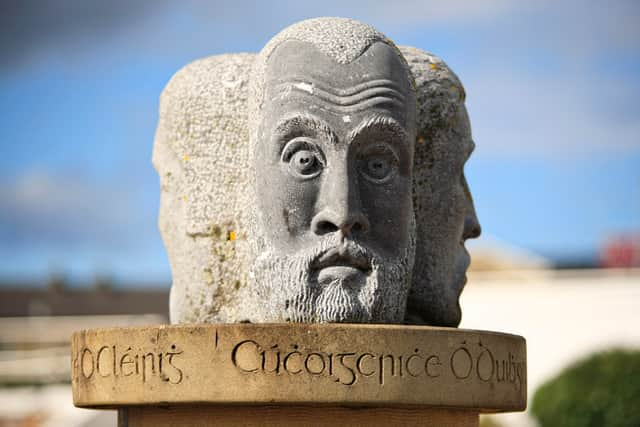
With the scientific evidence of Mícheál Ó Cleirigh’s cousin and right-hand scribe, Cú Choigri̒che’s DNA matching with the Bundoran Ó Cleirighs – we can now clearly see that Brendan McGloin’s sculpture of Cú Choigri̒che (2002), located outside Bundoran library, artistically tells the truth to the Bundoran historical community.
Cú’s sculpted triskele-head, soulful, limestone eyes and historic heart set on a sandstone column are deeply rooted to his Magh Ene home – blooming on the same branch of the Bundoran Ó Cleirigh family tree.