
Health & Happiness: Reflecting on Bealtaine and the Majesty of May

Columnist Aileen Casey is a Buncrana-based writer, parent and healthy-living enthusiast with a background in early childhood care and elderly support
There is always great reverence for the turning of the seasons in Ireland.
Long before roads cross the countryside and clocks dictate the rhythm of the day, the old Celtic year moves gently from one seasonal festival to the next, each carrying its own customs, beliefs and atmosphere.
The land itself remains central to life, and the passing of the seasons is observed carefully and celebrated properly.
The Celtic calendar is traditionally divided by four great festivals: Samhain, Imbolc, Bealtaine, and Lughnasa.
Samhain marks the beginning of winter and the darker half of the year. Fires are lit across Ireland as communities gather together while the nights draw in. It is believed to be a time when the veil between this world and the next grows thin, giving rise to many of the stories and traditions still associated with Halloween today.
Imbolc arrives at the beginning of February and is closely associated with St Brigid, fertility, healing, poetry, and the first stirrings of spring beneath the earth. Candles are lit in homes, holy wells are visited, and blessings are sought for the season ahead.
Then comes Bealtaine. The great welcoming of summer.
Celebrated on the first of May, Bealtaine is one of the most important festivals of the Irish year and symbolises warmth, growth, protection, fertility, and abundance.
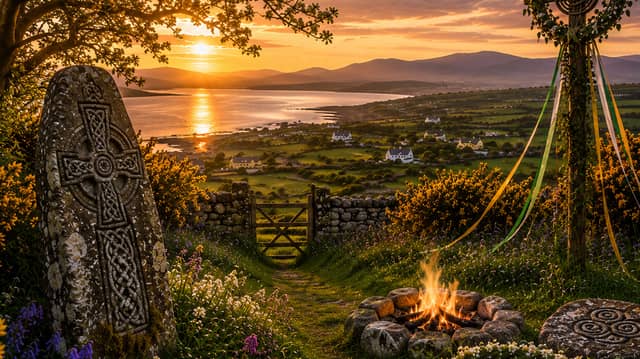
Across Ireland, ceremonial fires burn on hillsides through the night. Livestock are traditionally guided between twin bonfires before being brought towards summer pasture, a custom believed to offer blessings and protection.
The name Bealtaine is thought to derive from “Bel’s fire” or “bright fire,” linked to ancient Celtic sun traditions. Fire itself holds deep symbolic importance in Ireland for centuries, representing purification, renewal, light, and life.
May morning dew also carries significance in Irish folklore. It is often gathered at sunrise and believed to promote beauty, good health, and good fortune throughout the coming year. Hawthorn branches decorate homes and farmyards, while yellow flowers such as primroses and marigolds are placed near doorways to ward off misfortune.
There is poetry in these traditions. Not merely superstition, but an attentiveness to the world that surrounds people each day.
The old Irish understand the moods of weather, the movement of tides, the flowering of hedgerows, the return of birdsong, and the gradual stretching of evening light after winter. And nowhere does May reveal itself more beautifully than across the Irish countryside.
In places like Inishowen, the arrival of Bealtaine still feels almost timeless. Hawthorn blossoms gather in white clouds along narrow roads. Gorse burns golden across hillsides.
The evenings lengthen slowly over Lough Swilly, while the coastline takes on a softer, brighter quality beneath the May light.
The dawn chorus becomes fuller too at this time of year. Blackbirds, robins, thrushes, and finches fill the mornings with birdsong before the day has properly begun.
Irish folklore long holds birds in special regard, often associating them with wisdom, guidance, and messages carried between worlds.
The land itself seems more alive during May. Fields deepen into richer shades of green, gardens awaken fully, and sea air carries the freshness of summer approaching.
It is little wonder the old festivals place such importance on this season of growth and renewal.
Later in the year comes Lughnasa, the harvest festival associated with gathering crops, fairs, horse trading, music, dancing, and storytelling. Named after the Celtic god Lugh, it celebrates skill, abundance, and the fruits of labour after the growing season.
Taken together, the four festivals create a calendar shaped entirely by nature and community. There is something admirable in that older rhythm of life.
The seasons are not rushed through unnoticed. They are acknowledged and marked carefully. Gathering together matters. Music matters. Storytelling matters. The land matters.
Even today, traces of those traditions remain quietly woven through Irish life. Bonfires still appear in parts of the country. Holy wells are visited. May bushes are decorated in some rural areas.
Agricultural fairs and summer gatherings continue the spirit of Lughnasa. And every year, once May arrives, people naturally drift outdoors again to walk shorelines, sit in evening light, and enjoy the return of longer days.
Perhaps that is the lasting beauty of Bealtaine. It reminds people to notice the season they are standing in. To appreciate the light stretching itself later into the evening sky. To admire the hedgerows blooming once again after winter. To gather together while the warmth lasts.
The old Irish believe deeply in the connection between people, place, and season. And every May, Ireland still seems to honour that belief in its own gentle and enduring way.