
It Occurs To Me: Suffer little children
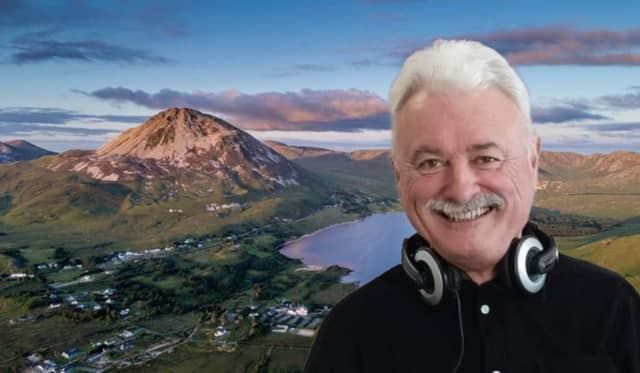

In this week’s column, Frank Galligan tells the story of Derry man Jon McCourt, who at the age of three was sent to the Termonbacca children’s home where over a third of the 29,000 children incarcerated between 1922 and 1995 were from Donegal
Jon McCourt and I are sipping coffee in Bishop Street in Derry. We have known each other for over thirty years, and despite his imposing height of 6’7”, one feature has never changed…the deep pain and hurt in his blue eyes.
Jon has long acknowledged his Donegal side…his late mother was from Dunree, near Buncrana. His father was a Presbyterian from County Antrim, who converted to Catholicism when he met his mum, and the family lived in Ballykelly where Tom McCourt was in the RAF.

Jon McCourt says that one aspect of the Termonbacca experience that angers him greatly is that ‘the Irish Government has washed their hands of it, because it’s in Derry’
Despite Jon being told many years later by a number of his mother’s many siblings that they would have taken the four McCourt children between them, the parish priest made the ultimate decision…the children were going to Termonbacca and the Sisters of Nazareth.
His mother was pregnant with Annette, when a car collected Jon, Eddie and Andy and took them away. He was three years old and was sent to a particular section of the ‘home’, his brothers to a separate part. He would not see them for 10 years!
One of his most vivid memories is having the soles of his feet whipped by a nun when he was four, as he had wet the bed. Bedwetting was common because of the sheer terror…as Jon told me, “...the punishments were bad enough but the anticipation was just as bad.”
Later, he was battered on the head with a wooden towel holder and suffered a subdural haematoma. It was a culture of violence and many of the nuns seemed to relish cruelty. Jon told me of the Scottish child abuse inquiry published in 2019, led by judge Lady Smith, who found that thousands of children in four homes run by the order endured systematic violence and degrading emotional abuse for more than 50 years.
Fear, hostility and confusion
Lady Smith said that the children were deprived of the dignity, compassion and care they were entitled to and found that the order had a culture based on obedience, intolerance and abuse.
“The Nazareth houses in Scotland were, for many children, places of fear, hostility and confusion, places where children were physically abused and emotionally degraded with impunity.
There was sexual abuse of children which, in some instances, reached levels of the utmost depravity. Children in need of kind, warm, loving care and comfort did not find it. Children were deprived of compassion, dignity, care and comfort. It was suggested in evidence that applicants may have colluded to present fictitious accounts about their time in their care, fuelled by resentment towards their families and an appetite for compensation. I reject all such suggestions.”
In her 140-page report, she detailed cases of: “Persistent sexual abuse of boys and girls at all four homes, with one nun facilitating the abuse of a girl by men including priests.
Children punished routinely with belts, canes, sticks, broom handles, hairbrushes and crucifixes.
Children who wet their beds being beaten, given cold baths or forced to wear their wet sheets.
Children being force fed, including when they were vomiting the food back up.
Runaways being beaten on their return.”
What Jon found particularly telling in Lady Smith’s report was the nun’s directory which enforced extremely strict rules, including requiring children to sleep on their backs with their arms crossed over their chests, and it allowed “severe corporal punishment”, including whipping and caning. Children were routinely cleaned with Jeyes Fluid, a strong commercial disinfectant, or had carbolic soap forced into their mouths. The Termonbacca experience was the same.
The Troubles and health issues
Jon was released at the age of 13, his sister Annette having been sent to the Nazareth Sisters as well. By this time, his mother had a ‘wee flat’ in Creggan and in due course, all of the family were reunited there. She died in 2012, aged 98… “We were all with her”, Jon tells me. Ten years ago, he told the NI Historical Abuse Inquiry: “I remember, when I was about five years old, being constantly beaten by one particular nun, to get me to stop writing with my left hand.”
He said this was a common practice at the time before adding: “They were messing up with how we were wired.” He also told the inquiry he blamed unionist domination in Londonderry in the 1950s for him ending up in Termonbacca. He said he spent 10 years in the home “not because my mother didn’t love me”, but because unionist leaders would not build homes for Catholics in the city.
Growing up as an angry teenager in Derry in the late 1960s, he first got involved with the Civil Rights movement and in due course joined the Official IRA.
“I was actively involved between 1969 and 1976”. There’s an old photo of Glenfada Park on Bloody Sunday, which he carries with him, showing Joe Mahon, Michael Quinn and the unmistakable 6’7” McCourt. Joe and Michael were shot dead… miraculously, Jon was unhurt. By 1976, he was disillusioned with the violence. “I realised that the ultimate civil right was the right to life, and Father Neal Carlin telling me that his favourite Commandment was ‘Love Thy Neighbour’ but how can you love your neighbour if you don’t love yourself.”
Anybody who had been through Termonbacca had massive challenges when it came to self-love. Jon became the chairman of Survivors North West and a vocal campaigner for the rights of those who had been abused. Through all of this, he had some serious health issues. “The doctor tells me that most of it was stress related, but one incident in London in 1978 was the catalyst for future health issues. ATM machines were relatively new at the time, and two guys mugged me at one…although I fought them as best I could, one of my ribs punctured a lung and I got pneumonia. It flares up every so often and I have to be very careful.”
One aspect of the Termonbacca experience that angers him greatly is that “the Irish Government has washed their hands of it, because it’s in Derry. Yet, of the 29,000 children incarcerated between 1922 and 1995, over a third were from Donegal, and some from Sligo. I’m in touch with survivors from Ardara, Letterkenny, Inishowen and other places.
“There were six fellas who were in Termonbacca at the same time as me who have since died in circumstances that were directly linked to their psychological condition stemming from the abuse. They were thrown into a system that was supposed to care for them but in reality it was a system that had been corrupted. It abused and utterly failed the children left in its care and people have to take responsibility for that.”
A few weeks ago, he and other campaigners met with First Minister Michelle O’Neill and deputy First Minister Emma Little-Pengelly at Stormont, and he is at pains to urge survivors to come forward before the Redress deadline passes on April 2.
Like dust, I rise
Emile Zola wrote: “If you shut up truth and bury it under the ground, it will but grow, and gather to itself such explosive power that the day it bursts through it will blow up everything in its way.” At times during Jon’s interview, I have paused for breath momentarily and have been close to tears, as the ‘young boy’ recalls the sheer terror and the fear of the 1950s and 60s. At one juncture, he laughs as he recalls the first Civil Rights march in October 1968: “We weren't afraid of the police, we were afraid of the priests!” After an hour and half, we conclude our chat and shake hands. Outside, on a blustery Bishop Street, Jon lights up the ubiquitous ‘fag’ and leans on his walking stick. He was conferred with the Freedom of Derry and Strabane at a special ceremony in the Guildhall before Christmas 2023, and when I next meet him there, it will be the opening night of the Jazz Festival and he will be resplendent as ever in a colourful Zoot Suit and Fedora. As I pass by the Diamond War Memorial on the way down Shipquay Street, I am reminded of the wonderful Maya Angelou and her poem, “Still I Rise”:
‘You may write me down in history
With your bitter, twisted lies,
You may trod me in the very dirt
But still, like dust, I'll rise.
Did you want to see me broken?
Bowed head and lowered eyes?
Shoulders falling down like teardrops,
Weakened by my soulful cries?
Leaving behind nights of terror and fear
I rise
Into a daybreak that’s wondrously clear
Bringing the gifts that my ancestors gave,
I am the dream and the hope of the slave.
I rise.’