
Killybegs Coast Guard Unit - Dedication, vigilance and training key components


Amazing volunteers give untold hours to train and upgrade skill sets in order to keep our coasts and seas safe
In most cases, joining the likes of the Killybegs Coast Guard unit is a form of “giving back to the community”, says its current Acting Officer in Charge, Shane McCrudden.
“Most of us around the coast are experienced in some way of either directly or indirectly losing a loved one, or being in a situation where you could have lost a loved one,” he pointed out.
And being involved in any helping agency or organisation is not a matter of simply waiting on the other end of a phone, he explained.
The Killybegs station is based in the new pier at the Fishery Harbour Centre, some 200 metres away from the local fire station, which is located outside the secure area of the harbour.
“You show up to your scheduled training, it could be once or twice a week. I have been in the unit 12 years and Michael Love, who just retired from the unit, was with us for 27 years.
“When he joined the equipment back then would have been fairly similar but the likes of vehicles have come on in leaps and bounds. And the station that we have here now in Killybegs is the biggest in the country and very good.
“I have had the pleasure of being in most but not all of the 44 stations around the country, which work under the umbrella and state funding of the Department of Transport, but we ourselves are all Volunteers.”
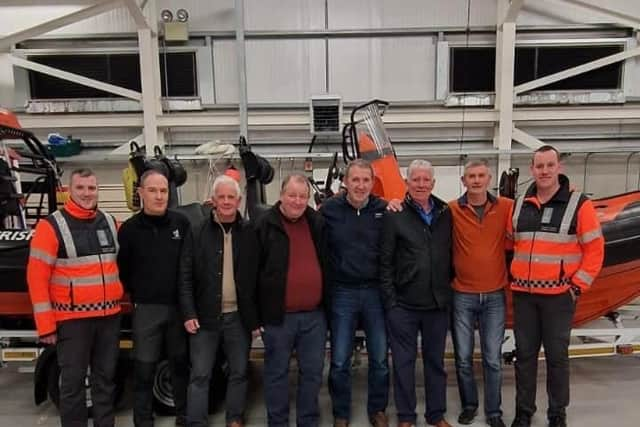
Caption: Past and present members of the Killybegs Coast Guard Unit who recently gathered together to pay tribute to former Officer in Charge of the Killybegs unit, Michael Love after 27 years of dedication as a volunteer
“We also help the ambulance service to transport casualties from inaccessible areas to the ambulance so they can be taken to hospital.
“Then you have units with boats that have coastal capabilities, such as the ribs, with the D-class ones for shallower waters such as lakes.
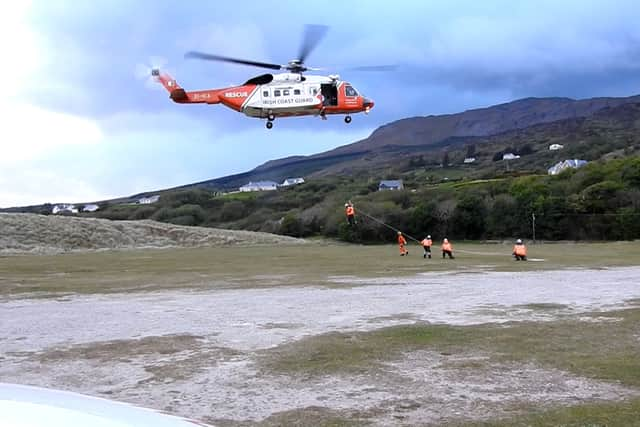
Caption: Training on the old Killybegs GAA ground at Fintra and a briefing by the Heli crew on casualty extraction both on and off the aircraft. The training on the highline technique is for winching a casualty in the event the Heli can't land. Training takes place at least twice a year with the aircraft to keep skills at a high standard for when we work with the aircraft.
Shane added that more recently the drone function has become important in search and rescue efforts along part of the Donegal coast.
“The Coast Guard have recently bought fairly advanced drones that are a game changer. They are not all-weather but they can go out in plenty of rain and higher wind speeds. And they have a camera on them called FLIR (Forward Looking Infrared) and that can spot casualties from hundreds of metres off.
“They can be involved in coastline searches, where it is too dangerous to put a rib because of the surf or inclement weather or if someone is missing in a dense or heavy fog, this camera can pick up heat signatures.”
“So every unit has a search unit at the very least and some units will have the boat function, where others will have the cliff function on top of that, whereas Killybegs has all three - the cliff, the boat and the search.”
In one case, at the Mulroy unit further up the Donegal coast, they have a four function unit with a drone on top of the boat/cliff, Shane further explained.
Intensive training
In the first year of joining, the volunteers partake in a number of basic courses including manual handling, first aid skills and attaining a VHF radio licence. It also includes basic search components, with the latter containing a high level of art and skill.
Then depending on what functions the unit has, volunteers could then move into the climbing aspect of it.
This could be as a cliff top operator and might eventually lead to being the trained rescue climber, to go down and up the ropes, to use the stretcher and become a cliff top leader.
Shane recalled one notable event where such skills were required.
“I can’t say this for definite but I can say with great confidence that we were involved in one of the highest rescues in the history of the State on New Year’s Day in 2013, when we abseiled down 450 metres to extract a casualty off Slieve League.
“We got the casualty to the top and bar being hungry and mild hypothermic, the casualty was fine and onwards to the hospital for an assessment.
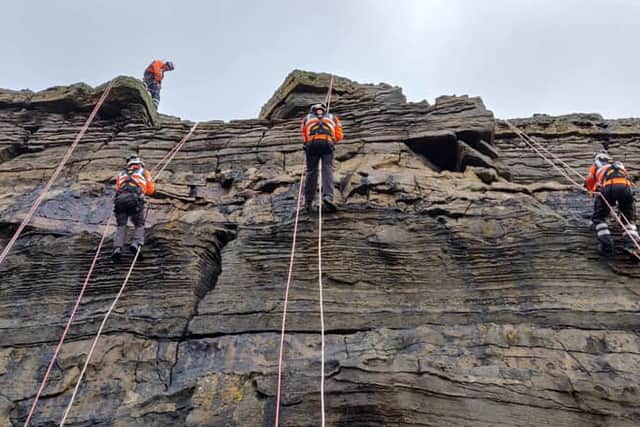
Caption: Killybegs Coast Guard Team training on their regular training cliff at Muckross Head, Kilcar.
The Killybegs unit covers south west Donegal, but there is Bunbeg Coast Guard in Gweedore, Mulroy CG in Downings, the Greencastle unit and finally one based in Tory island, the latter becoming one of the busiest units during Covid as they helped out in terms of meals, prescriptions and heli-landings.
Shane said there is a special camaraderie amongst volunteers and most would actually know each other on a first name basis.
He said: “It basically becomes your second family.”
The Killybegs unit itself comprises 27 volunteers with “three more sitting and ready to go” pending usual Garda vetting procedures.
Not every volunteer is involved in every call out as all have a full time job.
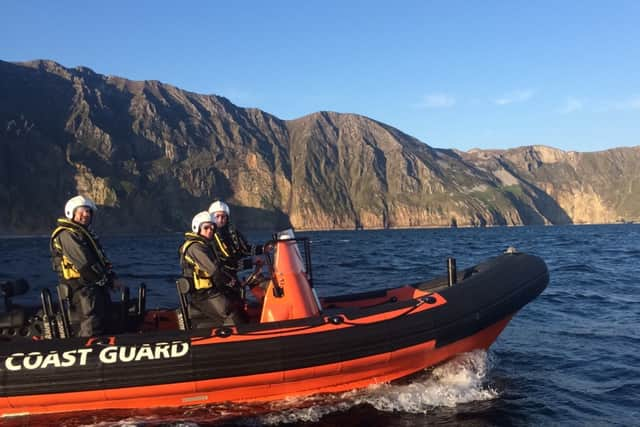
Caption: The Killybegs coast guard RHIB (Rigid Hull Inflatable Boat) at Slieve League which would be a regular area for Killybegs Coast Guard to train in.
At present they have an eight-metre Delta rib, with two 150 hp Yamaha engines with two of everything onboard, to ensure the safe return of any trip out, back to base.Killybegs also has three 4x4 jeeps, a five seater transit van as well as an all terrain vehicle, a Polaris Ranger.
“The terrain that the Polaris can go over is unbelievable,” Shane added.
The Coastguard never go out on a call unless instructed by Malin Head and volunteers are from all walks of life and inter agency cooperation is essential including whether the operation is marine led or search and recovery under the auspices of An Garda Siochana.

Caption: Killybegs Coast Guard Team training with the Sligo based Irish coast guard rescue helicopter, Rescue 118.
Finally, Shane said that one of the most important groups of people that help out with the unit are people with local knowledge, whether that be farmers on the land or pot men who know where it is safe to travel along a stretch of coast.
“Without them, we would be so much poorer and I would just like to say thank you to everybody that is involved with the unit, directly or indirectly.”