
Tory Island from the 1930s is featured in a new book

"At the time of my visit one man was a hundred years old and was looking for another wife"
Islands and the people who live on them are always fascinating and Tory Island with its own unique scenic attractions, and archaeological and historical heritage is perhaps the most alluring of them all.
They say time stands still on this four kilometres long by one kilometre wide rock approximately 12 kilometres from Donegal's north-west coastline, but how can you tell?
One way of gauging would be to get a copy of a new book called The Islands of Ireland.
The cover of the new book
For all his wistfulness about recording a way of life on the edge of change, Mason’s accounts are always affectionate and full of warmth and devote space to explaining what it was like to land there, how the locals treated him and ultimately what he saw and heard.
He observes while the island was one of the most desolate, it was also one of the most interesting.
"It is composed of hard siliceous rocks with a very thin covering of soil; the peat is nearly all gone and the island is being rapidly denuded of its pasturage, which is being cut away for use as fuel. Even on the common, which is reserved got grazing, I saw large strips of naked rock where the surface 'scraw' has been removed. I hesitate to think of the future of the inhabitants if this denudation is not checked." he observes.
Mr Mason noted the lack of English speakers but remarked locals are eager to learn as they know emigration is an economic necessity and realise without it they can not make a living outside the Gaeltacht.
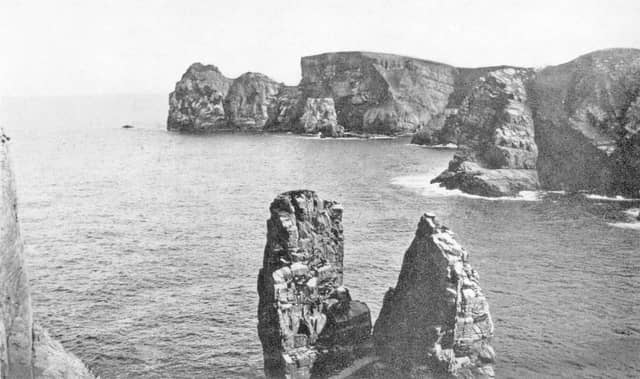
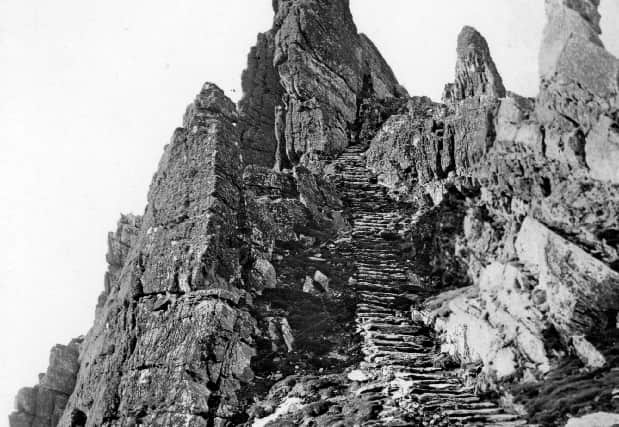
In relation to the actual geography, Mr Mason discovers there are no trees on the island and the side facing the Atlantic is bounded by high cliffs.
"These cliffs are worn into fantastic pillars of rock or tors, from which the island takes its name. I need hardly say the name has no connection with a modern political party."
He also devotes space to how wrecks used to play an important part in the economics of the islanders.
"Everywhere one sees portions of iron ships - the hearths are tiled with iron plates, foot bridges over drains outside the cottages are composed of iron plates and I even saw a homemade harrow whose teeth were ships' bolts."
Mr Mason discovered the people of Tory frequently live to a great age.
"At the time of my visit, one man was a hundred years old and was looking for another wife.
The author was intrigued by the notion that the island had its own 'king' saying it was easy to understand the persistence of tradition and the spoken word in what he called a long-living primitive and isolated community.
"...and nowhere have I observed this emphasised so strongly as on Tory Island. Prehistoric myths and legends are mixed up with events of medieval history and recent happenings, and the whole jumble is narrated as if it were a single tale of the occurrences of a few years ago."
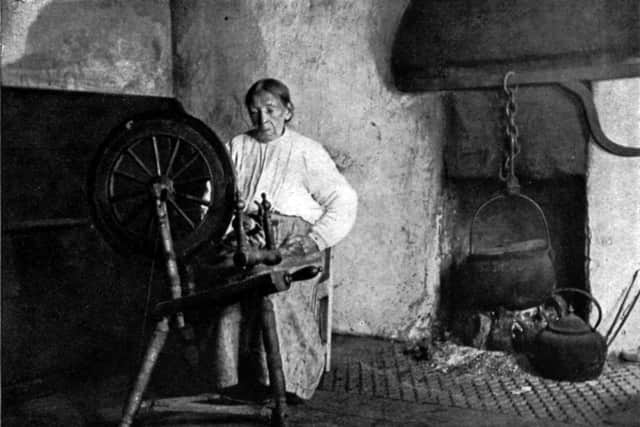
A lady spinning, one of the few occupations on the island
His notes also recall the tale of Tory clay, its ability to repel rats, and its association with the Dugan family, the Round Tower and other early Christian antiquities such as the Tau cross, the cursing stone, the fate of the gunboat H.M.S. Wasp and how the boats on Tory were even more interesting than the farming implements and how they supplied the link in the evolution from the round coracle to the modern long currachs or canoes in general use along the west coast of Ireland.
The new book is published and distributed by Stenlake Publishing Limited, contains 168 pages and 178 illustrations, and features a number of islands around our coast but Tory is the only Donegal entry. It retails at £15.95 and is available at all good bookshops. Further info can be had at: www.stenlake.co.uk