
Walking through 1,400 years of Fahan History
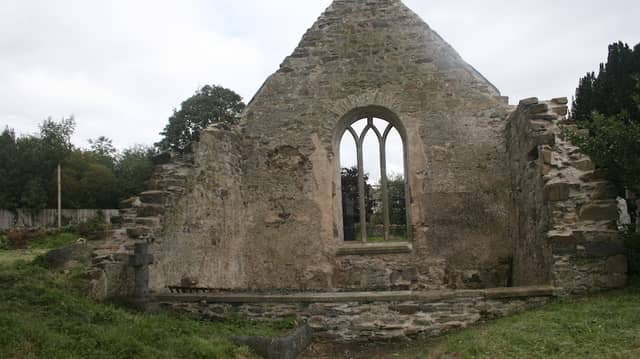

Fahan Community Development Partnership CLG will be holding a guided tour of its historical graveyard this Sunday as part of Heritage Week.
Fahan Community Development Partnership CLG will be holding a guided tour of the historical graveyard and its environs during Heritage Week.
The walk will take place on Sunday, August 24, at 2.30 pm. Everyone is welcome and the event is free of charge. This event starts at the car park beside St Mura’s Church of Ireland.
The village of Fahan in Inishowen nestles in the shelter of the hills on the eastern shore of Lough Swilly. The quiet harbour and rich farming land have ensured that it has been a suitable place for human habitation for many centuries.
The relics of the inhabitants evident in the area bear witness to this. The prehistoric fort of Grianan of Aileach overlooks the site of a monastery founded by Saint Colmcille in the 6th century.
The first abbot of the monastery, Mura, gives his name to the village – Fathain Mura. This was a centre of learning for 800 years until its destruction in the 16th century. Although it is now a cemetery, the site hosts numerous artifacts from the era, including the magnificent Saint Mura’s Cross. Nothing remains of the original monastery except Saint Mura’s cross slab.
The Cross is unique as it bears an inscription in Greek. This inscription is visible and is a prayer. This is the only known early Greek inscription on a stone cross in Ireland.
The Plantation of Ulster saw an influx of Protestant settlers, mainly from Scotland, who left their impression on the landscape, which is evident from the proliferation of Big Houses and the numerous graves from the 17th to the 20th century. The most famous of these is the grave of nursing pioneer Agnes Jones, who lived in the nearby Fahan House.
The grave of Horatio Nelson is a curiosity that attracts much attention. It is also evidence of the close connection between Fahan and the Royal Navy. Lough Swilly has provided safe anchorage for naval vessels for hundreds of years. This was evident when the British North Atlantic Fleet was transferred here during World War 1.
The ruins of Fahan Old Church, built in 1622, one of the oldest plantation churches, Fahan New Church (1822), and the Rectory are all part of Fahan’s history. The New Church contains a stained glass window designed by Evie Hone. While the Rectory was the home of hymnist Frances Alexander, who wrote ‘Once in Royal David’s City’ and ‘All Things Bright and Beautiful’ among her many compositions.
All of these events and much more are commemorated in a pleasant guided walking tour, suitable for all ages, through this fascinating area, and it lasts about 90 minutes.
All of these events and much more are commemorated in a pleasant guided walking tour, suitable for all ages.
For further information, go to: www.fahanheritage.ie