
Adversities of canoeing 400km of the Shannon

In 2019, Gwen Wilkinson set herself the challenge of building a canoe and paddling it the length of Ireland, along a network of inland waterways. This story reflects on her time in Leitrim
Gwen Wilkinson set out from the shores of Lough Erne and navigated a 400km journey to the tidal waters of the River Barrow in Ireland.
More than just a travelogue, ‘The Waters and the Wild’ explores the interwoven histories of the people and wildlife that shaped Gwen’s journey.
As the adventure unfolds, she also shines a light on pioneering women who have left their mark on Ireland’s landscape – both natural and cultural.
The following is what she wrote about County Leitrim.
It is well past noon, and I need to keep moving downstream. There’s another ten kilometres of this wild water ahead, which should bring me to Jamestown.
The Blueways kayaking guide estimates a journey time of three hours, so I should arrive there just in time to pitch the tent before sunset. At the foot of the slipway the river lies in wait, taunting and tugging at Minnow’s keel as soon as it touches water.
I climb into the hull and brace myself for round two. At least this time I won’t be caught off guard.
Rivers are powerful adversaries.
They can be your enemy and your undoing. A small open canoe is unequally matched against such a powerful opponent. The only weapon at my disposal is a twin-blade paddle. It is made of wood and is a beautifully crafted object in its own right.
The paddle has the added advantage of having a two-part adjustable shaft. By adjusting the ferrule joint, the blades can be set in two different positions, feathered or parallel. Generally, I keep the blades feathered, so that they are at right angles to each other.
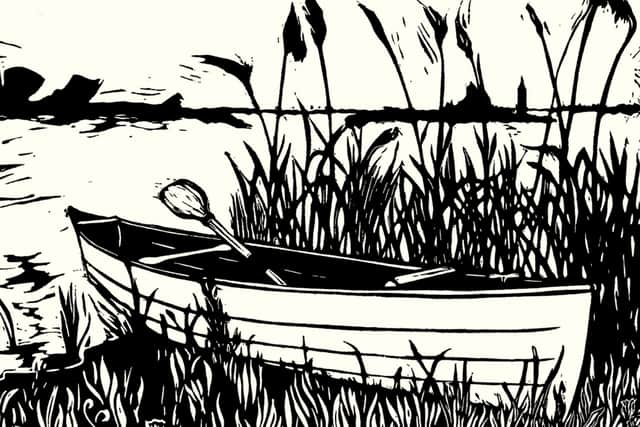
Before leaving Carrick, I had repositioned the blades so that they were parallel, mirroring each other on either side ‒ this limits the stroke of the paddle, but increases the breaking action.
Given the still strong current, I decided that I wouldn't need much forward propulsion, just a means of steering.
The river surges on, and with it goes the canoe, bobbing about like Susan Mitchell’s proverbial ‘cork on a wave’. I flash past ritzy marinas, where row upon row of floating pontoons are filled with luxury private and chartered hire boats. There’s a whiff of the Riviera about it all.
The vernacular Shannon boat is plastic-hulled and painted ubiquitous white with go-fast stripes. Each multi-storey vessel has tinted windows, and many are kitted out with swimming platforms.
All are equipped with steering wheels, bow and stern thrusters and even windscreen wipers. If there is a traditional Shannon boat, I have yet to see one, though it’s good to see the river being used and being important to the local economies.
The river hurries on, curling in a tight bow around the town, then racing eastwards, bracing sharply south, west and back east again. In these upper reaches, the river is erratic and confused as it figures out the optimum route down to the waiting sea.
Below Carrick the river spills into Lough Corry, where it has a chance to simmer down and relax its hold on the canoe.
The water is suddenly submissive and I am briefly back in control, able to dictate pace and direction. The waterscape is littered with foam, mini bergs of dirty polystyrene that tumble and scud about. Leaving the lough, the river pinches in again, but is still puzzling out which way to run.
Now it doubles back, heading north-east, in the opposite direction. It feels as if I am on a wild goose chase through the countryside.
It’s at this point that engineers and navigators decided to take matters into their own hands, building a canal and bypassing surplus lengths of coiled and shoaly river. The Jamestown Canal is a short stretch of artificial waterway, incorporating a lock on its lower reaches.
It’s a big relief to exit the river and enter the tame, stationary waters of the canal. Albert Lock is not listed on the Blueways guide as a designated camping ground, but it appeals to me because it is well off the beaten track and away from curious onlookers.
I rise bright and early to find that the weather has at last turned in my favour, and I will have a strong following wind to help me on my journey. I stow the bulk of my camping gear in the canoe’s stern. This lifts the bow high out of the water, helping the canoe track straight downwind, a simple trick that will save me valuable paddling energy.
The gusty wind and strong current ferries the canoe effortlessly downstream, depositing me at the entrance of Lough Boderg. River traffic is confined to a channel running down the centre of the lough since the shores are too shallow for most vessels. Hugging Boderg’s rocky eastern shoreline, the canoe runs fast, cresting and surfing the waves.
It’s a joyous and exhilarating ride once I overcome an initial fear of broaching and capsizing.
The canoe takes the pacey conditions in her stride, and I’m impressed with her performance, even though she is designed for flat-water paddling.
Within an hour I reach the far end of the lough, where the shores converge to form a narrow pinch-point as the river flows into Lough Bofin.
The sheer volume of water squeezing through the tight gap creates a powerful current. Boats heading upstream struggle against the flow, and when I arrive there’s a bottleneck of vessels waiting to pass through. Even with engines running at full throttle, their progress is painfully slow.
Anchoring the canoe in a reed bed, I sit back and watch the activity unfold. When the coast is clear, I let the current whisk me through and out into Lough Bofin.
Setting out across Bofin, it is as though I have passed into a different world. Where Boderg was vigorous and rushing, Bofin is slumbering, silent and eerily still.
The white-knuckle ride abruptly ends, and I am back to self-propulsion again. The shoreline is full of shallow recesses that are off limits to the average boat. Relaxed and unhurried, I dip in and out of coves to explore hidden inlets.