
Ancient Leitrim remains tied to Fionn Mac Cumhaill legend are older than Newgrange

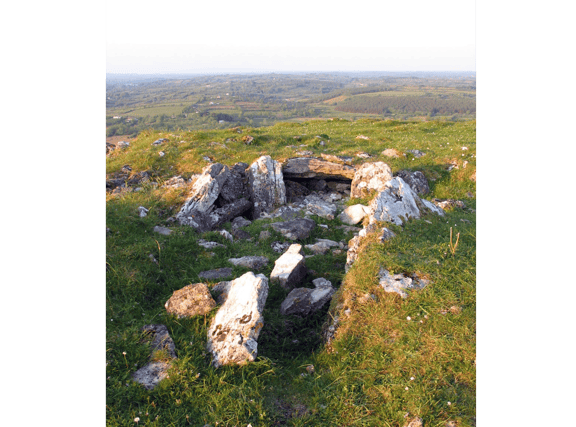

New analysis challenges centuries-old belief linking tomb to Fionn and Gráinne
A Co Leitrim burial site long associated with legendary warrior Fionn Mac Cumhaill and his wife Gráinne has been found to date back more than 5,600 years — thousands of years before the pair are believed to have lived.
New scientific analysis of human remains discovered at the Sheebeg passage tomb has revealed the bones belong to an adult male and female from the Middle Neolithic period.
The findings challenge long-held local beliefs that the ancient cairn near Keshcarrigan was the burial place of the famous couple from Irish folklore.
The research was carried out by neuroscientist Peter Halligan and osteoarchaeologist Niamh Daly, who examined bones held by the National Museum of Ireland for more than 90 years.
Radiocarbon dating conducted at Queen’s University Belfast confirmed the remains predate other major prehistoric sites, including Newgrange and Stonehenge.
Discovery dating back to 1930
The remains were originally uncovered in 1930 by local schoolteacher and archaeologist John O’Hara and landowner Peter O’Connell, the grandfather of Prof Halligan.
At the time, the discovery of two skeletons — believed to be male and female — fuelled speculation that the site was linked to Fionn and Gráinne, making headlines in Ireland and abroad.
The pair were found buried in an almost upright position within the tomb, adding to the mystery surrounding the site.
However, the excavation took place shortly after new legislation regulating archaeological digs had been introduced, and the men had not obtained a licence. While they were warned to stop, no legal action was taken as authorities accepted they had acted in good faith.
Some of the bones were brought to Dublin and placed in the National Museum of Ireland, where they remained largely unexamined for decades.
Myth meets science
For generations, the Sheebeg cairn has been steeped in folklore. Stories linking the site to Fionn Mac Cumhaill date back centuries, while composer Turlough O’Carolan is said to have written his famous piece Sí Bheag, Sí Mhór near the location in the late 17th century.
Earlier archaeologists had believed the tomb dated to the Bronze Age. However, the new findings place it much further back in time — in the Neolithic period, around 3,500 BC.
Prof Halligan said he had long been interested in uncovering the true origins of the discovery made by his grandfather.
He noted that without the decision to bring the bones to Dublin, further scientific analysis may never have been possible.