
Finucane inquiry to assess MI5 ‘awareness and involvement’ with UDA agent
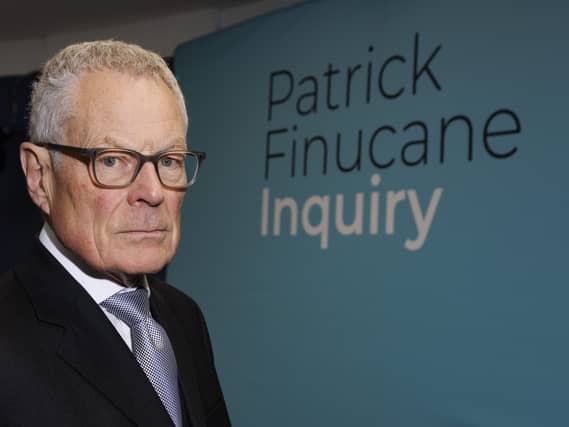

The issue was compared to Operation Kenova where late disclosure of materials led investigators to reverse conclusions on MI5 knowledge of Stakeknife
The Pat Finucane Inquiry must determine the “extent of MI5’s awareness and involvement” with a UDA agent linked to the solicitor’s murder, counsel has said.
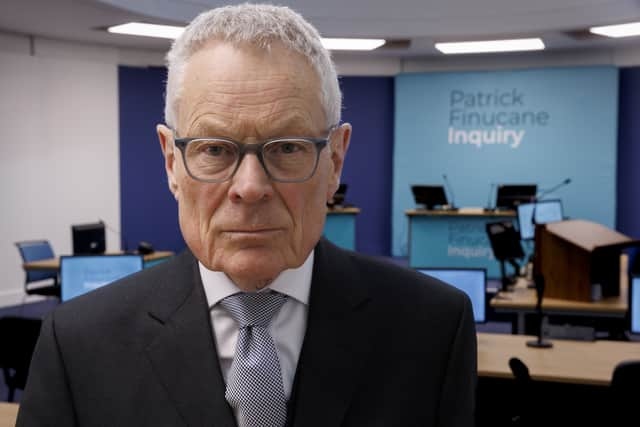
The inquiry’s chairman, Sir Gary Hickinbottom, has heard he must evaluate whether there has been “missed or overlooked material” from MI5 in previous probes into the killing.
Counsel compared the issue to Operation Kenova, where the late disclosure of MI5 documents led investigators to reverse their conclusions on the level of security force knowledge of and involvement with the agent known as Stakeknife.
Mr Finucane was 39-years-old when he was shot dead at his family home in north Belfast in 1989 by the Ulster Defence Association.
The attack has been found in a series of probes – including a 2012 review into the case by Sir Desmond de Silva QC – to have involved collusion with the state.
The Finucane family has been campaigning for decades for a public inquiry to establish the extent of security force involvement.
At the inquiry on Wednesday, junior barrister Alex Jamieson continued the opening statement for counsel to the inquiry by outlining the role of MI5 and restated that the legal teams have, as yet, had “no consideration of any closed or secret material”.
“As I stand here, I do not yet have any idea what that material may or may not say, and so no inference as to its content can be taken from the opening that I now give,” he said.
Senior UDA member Brian Nelson, now deceased, was an agent of the British Army’s Force Research Unit (FRU) and was found by the de Silva review to have “played a direct and important role in the conspiracy” that led to Mr Finucane’s murder.
Nelson, who operated under the codename 6137, was also examined in other probes for his roles in the killings of 27-year-old Gerard Slane and 29-year-old Terence McDaid.
Highlighting questions over MI5’s knowledge of FRU activity, Mr Jamieson said an MI5 secretary was stationed within the unit in what was described as a “merely administrative” file-maintenance role.
“However, the role of that MI5 secretary was also considered by the Operation Kenova investigation into the notorious PIRA member and FRU agent, notoriously codenamed Stakeknife,” he said,
“Kenova reported that at least until 1986, one of the tasks that that secretary had was to transcribe the audio cassette recordings at each meeting between FRU agents and their handlers.
“The inquiry will want to review this issue to consider whether it applies to the issues that we are considering, and if so, what additional awareness MI5 may have gained through the function of that secretary.”
Mr Jamieson said that the extent of MI5’s knowledge of FRU’s operations “featured in prominence” in Kenova.
“I raise it because in the light of that investigation, and after the interim report had already been completed, it emerged that MI5 had been in possession of an important tranche of disclosure, which had not hitherto been provided to the Kenova investigators,” he said.
He added: “The effect of that late disclosed material was to cause the Kenova investigation to entirely reverse its conclusions about the extent to which MI5 had had knowledge of Stakeknife and his activities.”
Mr Jamieson read an extract from the Kenova interim report where they concluded: “MI5 was not responsible for how Stakeknife was targeted or run, and could not sensibly be criticised for the conduct or operation of the FRU or any of its agents.”
He compared this to the final report which read: “MI5’s knowledge was not limited.
“On the contrary, further MI5 material (the late disclosure) demonstrates that it had much greater awareness and involvement in the running of Stakeknife throughout the entirety of its operation as an agent than previously thought.”
Mr Jamieson explained that Kenova found that the principal security advisor to the secretary of state, the director of covert intelligence (DCI) was briefed by the FRU commanding officer every four to six weeks on their “most significant cases”.
One such case was Stakeknife, but another, Mr Jamieson highlighted, was Nelson.
“Whilst Kenova’s conclusions were made in the context of Stakeknife and the particular through arrangements for the handling of that agent, the inquiry will have to closely consider those factors for ourselves,” he said.
“In respect of Stakeknife it is striking that the late disclosed MI5 material caused the Kenova investigation to reverse entirely its earlier view that MI5’s report had been limited, and to finally conclude that the service had a ‘much greater awareness and involvement in the running of that agent’.”
He said the inquiry would need to scrutinise disclosure provided and “form its own conclusion about the extent of MI5’s awareness and involvement with Brian Nelson and any other relevant agents”.
“To fulfil that task properly, the inquiry will want to develop an understanding of what went wrong with disclosure in Kenova, why the late disclosure material was considered so significant, and whether there may similarly have been missed or overlooked material in the disclosure that was provided to the de Silva review.”
Lead counsel to the inquiry Matthew Hill concluded by saying their statement had attempted to touch “each of the groups and agencies” involved in Mr Finucane’s death, listing the UDA, the Special Branch of the RUC, FRU and the Army, the security service, and the UK Government.

“We will not understand the death of Patrick Finucane unless we understand the interactions between those groups and organisations,” he said.
“How information flowed the frictions and the tensions involved and the oversight or lack of oversight that governed those relationships.”
He added: “Sir Desmond found – and the government of the day accepted – that the murder of Patrick Finucane involved state collusion.
“Others have suggested it was state direction.
“These are the most serious allegations in a democratic society governed by the rule of law.”
Mr Hill further highlighted that the inquiry is not bound to the conclusions of the de Silva report and has additional legal powers.
Sir Gary said the narrative laid out “has identified questions that remain unaddressed or unsettled by the de Silva report and the previous reviews” and begun “identifying the issues which this inquiry needs to address”.
The inquiry is expected to resume in November.