
Stormont official accepts responsibility for Fivemiletown cattle cull


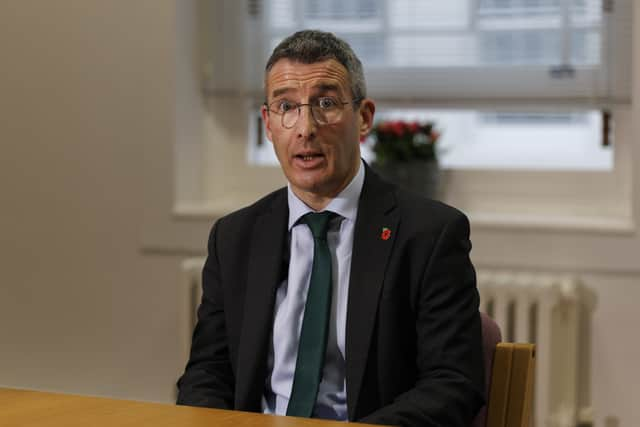
Katrina Godfrey, the permanent secretary in Daera, told MLAs: ‘If you are looking to know who is responsible, it’s me.’
The senior official at Stormont’s Department of Agriculture has taken full responsibility for the cull of 51 cows in Co Tyrone.
Katrina Godfrey, the permanent secretary at the Department of Agriculture, Environment and Rural Affairs (Daera), was speaking in relation to the shooting that left animal carcasses exposed in open fields and has been described as “like the Wild West”.
An external review by former Irish chief veterinary officer Dr Martin Blake into the operation in Fivemiletown in June said officials acted lawfully.
Daera’s Humane Slaughter Team carried out the cull of the cattle on land on June 29 and 30 following a court order which resulted in a lifetime disqualification of the keeper and a deprivation order.
Concerns have been raised by some political representatives and farmers about the public nature of the incident, leading Agriculture Minister Andrew Muir to order the external review.
The minister faced calls to resign from the Ulster Farmers’ Union and was also the subject of a failed motion of no confidence brought by the DUP.
He repeatedly said he did not authorise or direct the operation.
Ms Godfrey was asked by MLAs on the Agriculture Committee what learnings there were for her in the review of the incident and its recommendations.
“There is always, I think, for any accounting officer who is responsible for big, complex operations, I think for any of us, if we don’t spend time – and actually our accounting officer letters are really clear in this – you carry accountability, but you also have a specific duty to look at lessons learned,” she said.
“I think the accounting officer process recognises that in big, complex organisations, and you will know this from your own work lives and your own experiences, things do not always go perfectly, and the obligation I have is to make sure that we reflect and learn and apply lessons.
“The other thing I would mention, there is a world of difference in terms of evidence between a culture of accountability and a blame culture, and I never want to get into a position where, in the department I am responsible for, we get that distinction wrong.
“Because we know from evidence that if we tip down into a blame culture, that does a number of things.
“All of the evidence will tell us that it makes people less likely to highlight when things are going wrong, and that means we’re less likely to be able to fix them.
“So for me, there is no conflict between accountability and making sure that we respond, but if you are looking to know who is responsible, it’s me.”
Earlier in the session DUP MLA Michelle McIlveen said she had “raised questions about Dr Blake’s conflict of interest having worked closely with the department in the past” and she was “not then surprised that no-one was named to be held responsible”.
Ms Godfrey responded: “It’s very clear, I carry accountability for what happens in my department, I’m the accounting officer.
“If there are areas where we need to look at either learning development or performance management, those are areas that, you will know from the engagement rules we have with committees, we will never get into discussing HR matters, but if you need to know who carries accountability, it is me.”
Ms Godfrey referred to the report’s highlighting of efforts made by Daera staff to support the farmer in selling the animals, that were ultimately unsuccessful, and acknowledged that there was a question if they took too long to find an alternative solution.
She said: “There is a court order, the herd keeper must have the animals taken from him in whatever way is deemed most appropriate.
“That should have been done after the two-week period of appeal concluded, staff gave a lot more time to try and (find a) solution.
“In the end, Dr Blake’s conclusion was that from a veterinary professional perspective, the approach was not just lawful but necessary and appropriate, but he does identify that there was scope to look at a graduated approach that wasn’t taken.”
Brian Dooher, chief veterinary officer at Daera, who was giving evidence to the committee, also conceded they “didn’t consider a graduate or a phased approach wasn’t considered to the disposal”.
“Our initial priority is to help the herd keeper or support him to ensure he can sell the animals, and only after that do we consider other options,” he said.
“In this case, taking into consideration the nature of the farm, the nature of the animals, and the condition and the facilities on the farm, this was felt the most humane, the best welfare approach to enacting the deprivation order, in short, so that’s where we were with it.”