
Kilkenny chef remembers being at last big fight in Croke Park - Muhammed Ali v Al Lewis
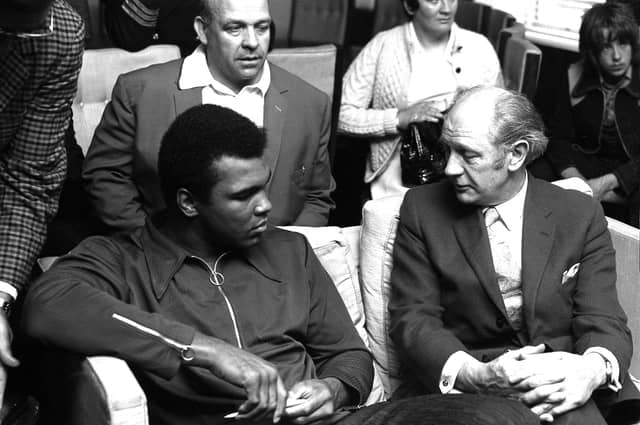

In advance of the historic Katie Taylor v Flora Pili fight in Croke Park, this Saturday, local man Eugene McSweeney shares his memories of being at the last great ‘fight night’ at GAA HQ - the night Muhammed Ali faced Al ‘Blue’ Lewis.
When I was attending secondary school in Portlaoise, my dad was a great lover of sport, and he had a particular fascination with Cassius Clay, who would later become known throughout the world as Muhammad Ali.
In February 1964, my dad and I got out of bed at around 3.30 in the morning and went into our back kitchen to listen to Clay's first fight with Sonny Liston. The fight was being broadcast live on BBC radio. I can still remember the excitement of those early hours and the fascination Ali created. Even then, there was something special about him.
Eight years later, in 1972, my life had changed considerably. I had recently returned to Ireland after training and working on the continent for five years and was working as Head Chef in Killiney Heights Hotel, Dalkey, Co Dublin..
It was from this new chapter of my life that I learned that Muhammad Ali was coming to Dublin.
He was scheduled to fight Al "Blue" Lewis, a heavyweight from Detroit, at Croke Park on 19 July 1972. I decided that this was an opportunity I couldn't miss, and I brought my younger brother Richard with me. Richard was only fourteen years old at the time.
There was something particularly special about it for me. Eight years earlier, I had listened to Cassius Clay fighting Sonny Liston in our back kitchen with my dad. Now I was working in Dublin and was about to watch that same man, now Muhammad Ali, fight in front of me at Croke Park.
It was quite a journey from our back kitchen at home to the middle of Croke Park.
The fight was promoted by Butty Sugrue, a Kerryman, former strongman and publican. He had persuaded Ali to come to Ireland, partly because of Ali's Irish connections. Ali's great-grandfather, Abe Grady, had emigrated from Ireland to America in 1860.
There was also a very important sporting reason for the fight. Ali needed to get back into shape as he prepared for another attempt at regaining the World Heavyweight Championship.
He was still rebuilding his career following his defeat to Joe Frazier at Madison Square Garden in 1971. His refusal to serve in the Vietnam War had also cost him several years of his boxing career and had made him a controversial figure in America.
In Ireland, however, Ali was welcomed with open arms.
Croke Park was the only large outdoor venue in Dublin capable of holding an event of this size. When Ali first arrived, he trained at the handball court in Croke Park but that soon changed when Ali demanded a proper boxing ring.
Ali stayed at the Opperman Hotel in Kilternan with his entourage. He was not just a great boxer; he was also a brilliant publicity man who understood how to capture the public imagination.
One of the publicity events involved one of Ireland's finest hurlers, and a great Kilkenny man, Eddie Keher. Ali was introduced to the game of hurling and was given some instruction by Keher. The newspapers and public loved it.
Ali even signed a hurley for Keher, who still has this unique memento.
On another occasion, Ali was interviewed by Cathal O'Shannon for RTÉ. The interview took place in Studio 1 on 17 July 1972, just two days before the fight, and was first broadcast on the evening before the contest.
Fight Night — 19 July 1972
The big day finally arrived.
Richard and I made our way into Croke Park and took our places in the old Canal Terrace. The gates opened at 6 pm, with the main fight scheduled for 8.45 pm.
Our tickets cost £2 each, while the programmes were 25 pence. Seats in the lower Hogan Stand cost £5, with ringside seats considerably more.
The boxing ring was set up in the middle of the pitch and covered against the elements. Thankfully, it was a lovely summer evening, and there was a tremendous crowd in attendance.
It was only later that I discovered that many of those in the stadium had not actually paid to get in. They had scaled a wall at the far end of Croke Park and managed to get inside just as the National Anthem was being played.
The exact attendance has been reported differently over the years, but there was certainly a huge crowd in Croke Park that evening.
At last, Ali and Blue Lewis entered the ring.
Ali weighed 218 pounds and Lewis 224. Lewis was a former Ali sparring partner and was known as a strong, heavy-handed fighter. Ali himself told RTÉ before the fight that the two had sparred previously and that Lewis had hit him hard enough to crack a rib.
Ali wore white trunks, while Lewis wore black.
From the opening rounds, Ali showed the difference in class. He used his speed, movement and jab to keep Lewis at a distance, moving around the ring and picking his opponent off with quick combinations.
Lewis was awkward and game, but he found it difficult to pin Ali down.
Then, late in the fifth round, Ali landed a right hand that sent Lewis to the canvas.
Lewis got back to his feet and survived the round. To his credit, he did not give up. He continued to come forward and managed to land some solid punches of his own.
As the later rounds went on, Ali seemed increasingly comfortable. He moved around the ring, flicking out his jab and making Lewis chase him.
By the eleventh round, Lewis was exhausted and unsteady on his feet.
At 1 minute and 15 seconds of the eleventh round, referee Lew Eskin stopped the contest and awarded Ali a technical knockout victory. The fight had been scheduled for twelve rounds, but the referee decided that Lewis had taken enough punishment. RTÉ's archive confirms that Ali won by an 11th-round technical knockout.
The fight itself was not one of Ali's greatest performances, but nobody in Croke Park seemed to mind.
The crowd had come to see Muhammad Ali, and they had witnessed him win in Dublin.
As soon as the fight ended, ringside fans surged towards the ring. People wanted to get close to Ali, shake his hand or simply touch one of the most famous men on the planet.
The excitement was extraordinary.
It took a considerable amount of time for Ali and Lewis to make their way back to their dressing rooms through the crowd.
Ali was reputed to have received a substantial purse for the fight.
But for Richard and me, the money and statistics were not what mattered.
We had watched Muhammad Ali.
In America, Ali's name had been controversial at that time because of his refusal to fight in Vietnam. But in Ireland, he was embraced. Here, he was simply "The Greatest."
For fourteen-year-old Richard and me, standing in Croke Park that summer evening was something we would never forget.
Eight years earlier, when I was still at secondary school, my dad and I had got out of bed at 3.30 in the morning to listen to Cassius Clay's first fight with Sonny Liston on BBC radio.
Now, eight years later, I was standing in Croke Park with my younger brother, watching that same extraordinary man, now Muhammad Ali, fight in front of us.
It was quite a journey — from our back kitchen at home, listening to Ali on the radio with Dad, to the middle of Croke Park watching him with Richard.
Richard and I travelled back to Portlaoise that night tired but very happy.
We had seen Muhammad Ali.
The Greatest.