
Kilkenny studio leads supported arts practices in Ireland

KCAT staff discuss the centre’s past, present, and future
Fifteen kilometers south of Kilkenny City at Callan’s Abbey Meadow, the Kilkenny Collective for Arts Talent (KCAT) is home to Ireland’s leading supported arts studio. Founded in 1999, KCAT is a multi-disciplinary arts centre with a deeply inclusive ethos, providing its artists with the necessary support to facilitate their practices, while otherwise operating like any professional studio.
Declan Kennedy, who has been Studio Coordinator at KCAT since its inception, explains that, when he and his co-conspirators arrived, the building was a semi-derelict sausage factory (adding for posterity that the bacon factory stood on an adjacent site). “There were leaks in the roof. The floor was really cold and damp. We had cardboard underneath people’s feet to keep them warm while they were working,” he says. “KCAT started with nothing but luckily got enough funding to build this kind of arts centre in Callan.”
Today, a bright, capacious chamber on the ground floor is a gallery in the summer and a social and classroom space from September to May. “It’s full of energy and joy,” says Centre Manager Melissa Tsang. “As part of our practice, we have tea breaks in the morning, we have lunch break, and we have afternoon tea break. It's partly built in so that people can get a rest, but also it's quite a social aspect of coming here. It’s not just about making art; we’re very connected. We all – staff and volunteers and artists – eat lunch together, we all have tea together.” KCAT’s courses and “open studio” hours can be attended by anyone, and Tsang notes that retired people, local architects, and the town GP have all come along. “People talk about inclusion as a side project or whatever,” she says, “but it really is ingrained into KCAT’s being.”
Upstairs, fourteen artists maintain permanent studio spaces, which Kennedy oversees. Kennedy explains that most artists in the studio started out on KCAT’s courses and displayed a “real commitment to it, like this is something they really wanted to do, it meant something to them. Because it is a big commitment. Most of them don’t get out of the studio once they get in,” Kennedy laughs. “You become a lifer.”
“Most of the artists upstairs would identify with having a disability,” Tsang explains. “We don’t use that word around here; you don’t hear it often. Obviously everybody’s ability varies. So, for some folks, it’s the administrative-type things and supporting communications, and setting up exhibitions, and things like that. For some folks it could be physically getting a thing out of a shelf and setting it up.”
In the upstairs studio, large windows expose a view of an old stone church and the sun on the meadow below. Each artist has their own workspace, where their materials and works-in-progress are left to be picked up the next day. When external artists visit KCAT, Kennedy says, “most artists come in and go: ‘I’m jealous! I could work here!’”
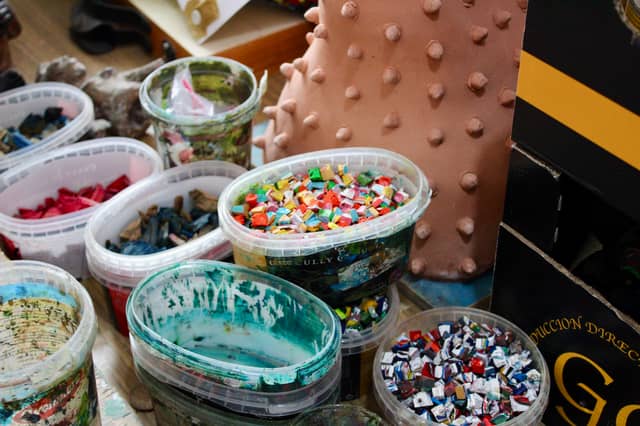
“A studio is like your bedroom,” Kennedy posits; it is uncouth to intrude on one’s studio. So when pots of dried acrylic cubes began accumulating on studio artist Declan Byrne’s desk, nobody asked any questions. Next, objects began to go missing from the still life subjects box. “He knew where the box was,” says Kennedy, “and if he liked it, he’d take it out.”
Byrne began his practice as a painter and still enjoys this medium, but perhaps his most iconic pieces are everyday objects – a pair of shoes, a coffee pot – encrusted with fragments of dried paint. He harvests waste acrylic from old palettes in the studio, accumulated over months or years, and indexes it by colour for use in these sculptures. Byrne’s sculptural work has even begun to influence his paintings – the canvas he is currently working on is dappled with tiny coloured squares – creating a neat cycle of reincarnation.
“The KCAT studio is probably one of the most creative studios you can see, where everything sort of has potential. It’s one of the things I like about Declan’s work; he sees the potential,” says Dr Dominic Thorpe, artist and KCAT collaborator. “The practices are still one hundred per cent self-directed,” Thorpe continues. “The facilitation is hands on as much as possible,” but in respect of the art, he says: “We don’t want to get in the way.” Kennedy explains that KCAT artists spend full days from nine to three or four in the studio. “It’s a professional practice,” Thorpe adds.
KCAT’s ethos of inclusivity and interdependence has roots that precede its existence. KCAT was founded by the Camphill Communities, a volunteer-led movement whereby people with and without disabilities live communally. A key figure in bringing the Camphill Communities to Ireland was the late and locally-celebrated Patrick Lydon, who first founded a community at Ballytobin, near Callan. KCAT began when a Camphill resident George (Georgie) McCutcheon began a prolific art practice. “Patrick Lydon at the Community decided Georgie needed access to proper art materials and exposure,” says Kennedy. “KCAT started around Georgie and more and more people came, and it built like that.” McCutcheon even designed KCAT’s beguiling logo: the five-legged cat. Tsang pointed out the original drawing, which is framed alongside a letter from McCutcheon and a more conventionally two-legged owl. McCutcheon had presented the owl also for logo consideration, but it didn’t develop the same clout as the KCAT cat.
In recent decades, the HSE has cancelled the registrations of several of the Camphill Communities of Ireland, including the centre at Ballytobin. The remaining communities are subject to inspection by the Health Information Quality Authority (HIQA) as “Designated Centres for Disabilities", and the Camphill Communities of Ireland now describes itself as a “modern regulated social care organization”.
While KCAT is not a Designated Centre, as a constituent of the Camphill Communities of Ireland, it is, for some purposes, defined as a social care organisation – a description that does not resonate with Kennedy. “We don't consider ourselves a day care or day service” he says. “We’re not that at all. If anything, most of the artists in the studio, they get a break from what I call ‘the institution’, where they’re being minded and watched, and everything has to be watched. They can come here and relax, paint at their own pace and rhythm. It has a huge knock-on effect because they would have had behavioral issues before, but when this guy goes to KCAT, there’s no problem. It’s that simple,” although, he clarifies, “it’s not simple what happens up there. It’s really skilled facilitation to allow people to be themselves while encouraging them to just get on with their thing.”
Many KCAT artists have achieved significant commercial success, exhibiting their work nationally and internationally. Declan Byrne has exhibited at UNT Art Galleries in Dallas, Beyond Festival in Leeds, Project Ability Glasgow, Freight Gallery in Fremantle Australia, Gallery Prabbeli Luxembourg, and the Art Brut Biennale Hengelo in the Netherlands. In Ireland, he has shown at the Linenhall Arts Centre Castlebar, F.E. McWilliam Gallery Banbridge, Atypical Gallery Belfast, West Cork Arts Centre Skibbereen, Farmleigh House Dublin, Galway Arts Centre and Crawford Gallery Cork. Byrne also has work in the Irish national collection, the art collection of the State, inclusion in which signifies a major vote of confidence in an artist’s practice. This summer, Byrne co-curated the All That Colour exhibition at KCAT, compiling a selection of his pieces and the work of an artist of his choosing, Jane Fogarty.
Kennedy explains that some KCAT artists are not interested in the commercial aspect of art, which gives them a certain freedom to continue working without the performance anxiety that sometimes intrudes once an artist gains notoriety. Equally, Tsang describes how other artists are keen to build their businesses. “There are folks here like Diana [Chambers], who will, if you meet her, every time you see her, will try to hustle and get you to buy a print,” Tsang laughs. She notes that there is even a risk of KCAT artists’ disability payments being jeopardised when the income from their work reaches a certain threshold.
For artists on its courses, KCAT takes a 20% commission on sales, with this figure being higher for the fourteen studio artists because of the level of support provided “in exchange for very low member rates,” Tsang explains. “Generally, I'd say the art here is priced maybe lower than a lot of art at other institutions,” she says, with pieces usually being sold for between €200 and €2,000 and priced by KCAT based on demand, time spent, and materials used.
Despite the success of KCAT artists, and noting that “it’s hard to be an artist generally”, Tsang believes progress can still be made in arts inclusion in Ireland. “Sometimes there's like a line between mainstream or large, institutional art and community art, or what you might call ‘arts participation’, and for me, I question: where is that line?” She finds that KCAT is sometimes “still categorized as arts participation, as opposed to a leading institution that supports inclusion, when there aren't a lot of places that do inclusion like we do, like so holistically.”
An issue Tsang has been considering recently is having artists’ policies and contracts written in plain English. She says: “A lot of your contracts, [are] like 30-pages long and super wordy and ‘hereto’ and ‘moreover’ – it’s unnecessary. So how do you simplify this and make it still an agreement, but it’s actually usable. Even down to that level of inclusion, I would love.”
Tsang also considers the drawbacks of KCAT’s rural location. “We're quite small, and we're also quite rural, so there are challenges in being rural,” she says, “versus being in an urban centre. I wonder if we were built in Dublin, would it be the same or not.” She adds: “It's a huge barrier to inclusion, because, like, the bus only comes once a day. You miss the bus, you can't come,” she says. “There are a lot of challenges there that we deal with on the side – that we see every day.”
When Kennedy and his colleagues set out to create KCAT, they had extensive contact with and travelled to inclusive studios around Europe. “There wasn’t much art and inclusion 25 years ago in Ireland,” he explains. But even today, KCAT is the only supported studio of its stature in the country. “There’s not anywhere that is full time or professional,” says Kennedy. He highlights the Cúig supported studio in Cork, which had its funding withdrawn, and Arts Ability in Wexford, which has also ceased operations. “People don’t realise how valuable it is, and if it goes, it goes, and you don’t get to replace it. And it would be horrifying, I think, if something like that happened,” says Kennedy. “KCAT's been doing this kind of thing for 25 years, but why haven't more folks done this?” Tsang wonders. “I don't know.”
KCAT does not have an artistic director, so its creative trajectory is driven by the artists’ interests and ambitions. “The different artists individually have different goals,” says Tsang, noting that a lot of the artists are keen to travel again, either to exhibit internationally or to take up residencies. “We have to work on a strategy,” Tsang says, “but right now, it's a funding game.”
Once given a spot in KCAT’s studio, “nobody has tried to get out,” Kennedy laughs. “They love it. Sure look, they get to travel the world with their work. They have exhibitions everywhere. They probably come and realise wow, this is amazing, so they have their place in the world. That’s really what they have.”
KCAT is hosting an exhibition for Kilkenny Arts Festival 2026 from August 6-21. Allday & Everything is a retrospective exhibition of Diana Chambers’ work to date and will be on display at the KCAT Centre in Callan. You can support and find out more about KCAT’s work at https://kcat.ie/.