
Regulator ‘has the stomach’ to challenge Man City owners says chair David Kogan


The IFR has the power to force directors off boards and even to force owners to divest from clubs in the most serious cases.
The chair of the Independent Football Regulator says his organisation “has the stomach” to take on Manchester City’s owners should it need to.
The IFR has the power to force directors off boards and even to force owners to divest from clubs in the most serious cases where they are found to be unsuitable.
City have been found guilty of breaching Premier League rules over a nine-season period by an independent commission. The verdict, published in September, found they clearly intended to circumvent league rules through a series of “sham” arrangements which inflated revenues and disguised losses.
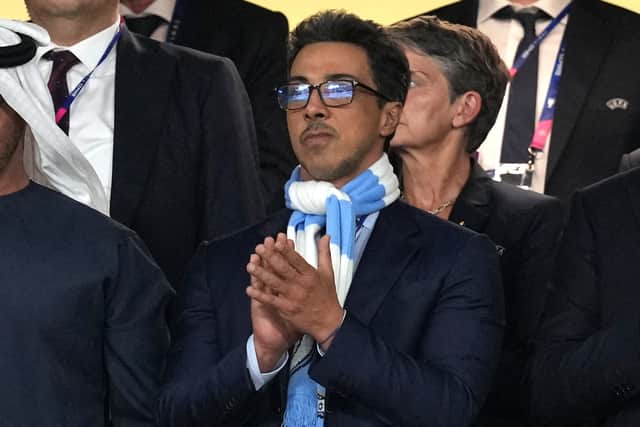
City have appealed against the verdict, but should it be upheld it seems almost certain the IFR would then conduct its own assessment, and Kogan was adamant there would be no fear from his organisation in doing so, despite the size of the club and the political connections of its owner Sheikh Mansour, who is the deputy prime minister of the United Arab Emirates.
“We will absolutely have the stomach (to take on City),” he told MPs on the Digital, Culture, Media and Sport select committee.
“Would I, given my choice with an organisation that has a relatively new, fairly young staff that’s been going for less than a year, would I have chosen to have this particular issue in our laps this early? Well, probably not.
“But the truth is, if we don’t act, assuming those circumstances are triggered, if we don’t act, what is the purpose of having a football regulator?
“We have to absolutely clearly be seen to be doing the job that you, as legislators, have asked us to do, and we absolutely will do that, whatever that means.
“Forget the name of the club. Forget the size of the club. Forget the scale of the issue. We cannot simply ignore our statutory duties in relation to a club because it happens to be of a certain size.
“We absolutely will have to take the appropriate action as laid out in the legislation, depending on the circumstances as they come to us, which are the evidence that’s been presented and collated by the independent commission of the Premier League, and by any judgment that takes place on that evidence through an appeal.
“Does the evidence, if we come to assess it in relation to individuals, stand up in terms of the legislation as being a cause for concern? And if it is, we will have to act appropriately. And that is the only test, not the politics around it, not the place where it came from, not the size of the club. It is the only test because without that, you cannot have an effective regulator.”
MPs questioned how any legal action against City could be funded.
IFR chief executive Richard Monks told MPs it had been given “assurances” that the Government would provide cash to take on any litigation arising from any major case, which he stressed would only be embarked on if the advice was that the regulator would win.
In that instance, he said, the Government would be paid back directly. If the case was lost, the clubs would return the money to the Government through the levy they pay to run the IFR.
Monks said where forcing an owner to divest is considered appropriate, a sale can be forced even if the owner does not feel the sale price reflects a club’s value.
“If we determine that an owner is unsuitable, then the owner has a period of time in which to then sell the club on their own behalf,” he said.
“That is not set down in the (Football Governance) Act. That could be three months. That could be six months. Then, if they are unable or unwilling to sell in that time, then we appoint a third party who will oversee that sale, and the third party will get the best possible price for that club within a set time period.
“If that price is under what the owner is prepared to sell (for), so be it.”