
Almost half of babies in England delivered by Caesarean last year

The total number of babies delivered fell to its lowest level since comparable data began more than a decade ago.
Almost half of babies born in England last year were delivered by Caesarean section, figures show.
The rise comes amid an increase in more complex pregnancies, midwives said.
The total number of babies delivered fell to its lowest level since comparable data began more than a decade ago.
New figures from NHS England shows there were 540,329 babies delivered in England in 2025/26.
Some 47% were by Caesarean section, up from 45% the previous year.
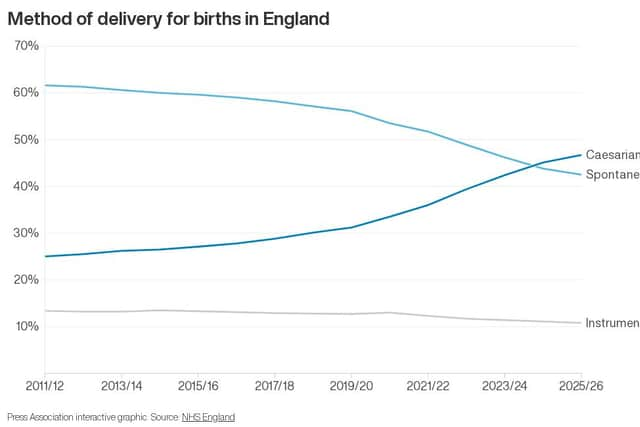
Of the Caesareans, a little over half (25.7% of the total) were emergency procedures, the figures show, while 21% were planned.
Caesarean sections were most common among mothers aged 40 and over, accounting for 60% of deliveries.
More than four in 10 deliveries (41%) among women aged 20 to 29 were by Caesarean section, as well as almost half (49%) among women aged between 30 and 39.
Caesareans were least common among women under the age of 20, at 30%.
Of the total deliveries, over four in 10 (43%) were classed as spontaneous, meaning there was no surgery or tools such as forceps.
A little over one in 10 (11%) were instrumental, where doctors use the likes of forceps or suction cups to guide the baby out safely.
Fiona Gibb, director of midwifery at the Royal College of Midwives (RCM), said: “Safe staffing is about far more than the number and type of births.
“That is why the RCM has long called for workforce planning to reflect the current population’s needs and complexity.
“The rise in Caesarean births could reflect a change in maternal population needs, maternal choice and systemic pressures.
“While there has been a small reduction in the number of births overall, what we are seeing nationally is a rise in more complex pregnancies.
“These women will often need additional midwifery support throughout the antenatal and postnatal periods. That is why it’s never been more important to have safe staffing levels to deliver safe, high-quality care to women and their families.”
The number of babies delivered in England fell to a new low since comparable data began 14 years ago.
The 540,329 total for 2025/26 was down from 542,235 in the previous 12 months.
In 2015/16, there were 648,107 babies delivered.
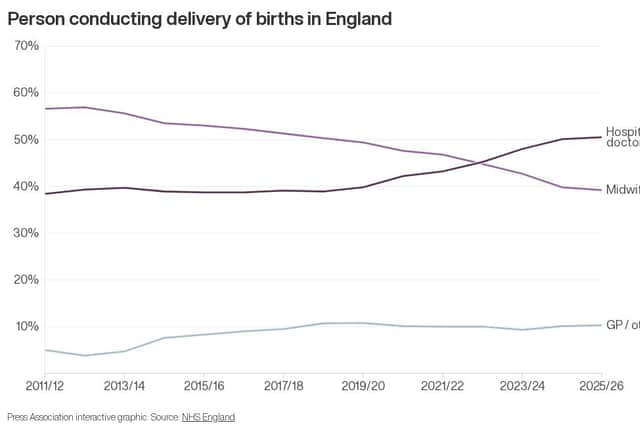
Hospital doctors conducted roughly half of deliveries (50.5%) in 2025/26, the highest figure on record, and midwives conducted 39.2%, the lowest on record.
A rise in complicated births requires more acute postnatal care, according to Dr Gibb.
“For too long, we have seen midwives on postnatal wards being called on to plug staffing shortages on labour wards, which inevitably affects the quality of care and the time midwives have to care for women and their babies,” she added.
“This is at a time when we know more and more babies who need extra monitoring are being cared for on postnatal wards. It’s crucial that we count babies as individual patients when calculating safe staffing levels and postnatal ward staff ratios.
“This is even more important now that we are seeing an increase in readmissions to maternity services. That said, preventing hospital readmissions after giving birth, where possible, needs to be a key priority.
“There are, of course, associated costs, but the greater cost is to the future health of women and their babies.”