
Interest rate hike ‘firmly on table’ after inflation rises to 11-month high


Experts have said the latest official inflation data has reinforced expectations of a rate hike in November.
Inflation rising to the highest rate in almost a year makes it more likely that the Bank of England will hike interest rates next month, with living costs set to rise further this winter, economists think.
Experts have said the latest inflation data from the Office for National Statistics (ONS) has reinforced expectations of a rate hike in November.
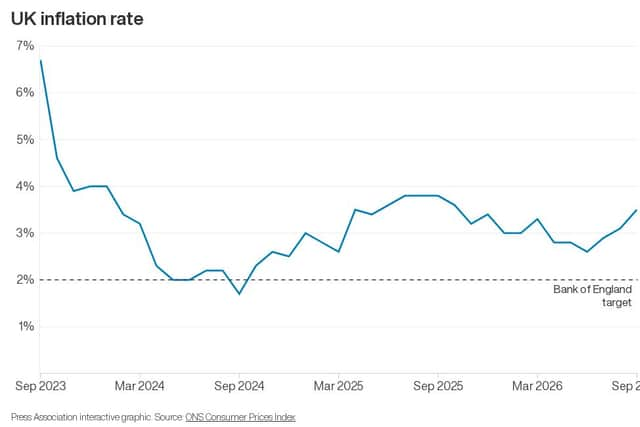
The ONS said Consumer Prices Index (CPI) inflation was 3.5% in September, up from 3.1% in August.
This was the highest rate in 11 months and above the level that economists had been forecasting for the month.
It means the price of goods and services across the economy are rising at a faster rate than they were before, and inflation is drifting further away from the Bank of England’s 2% target rate.
A major driving force of higher inflation last month was motor fuel prices, which rocketed by 30% in the year to September, the latest figures showed.
Petrol and diesel prices have been surging since the start of the US-Israeli war with Iran which has squeezed global oil and gas supplies and driven up wholesale prices.
Living costs are expected to rise further in the months ahead as households face higher energy bills this winter.
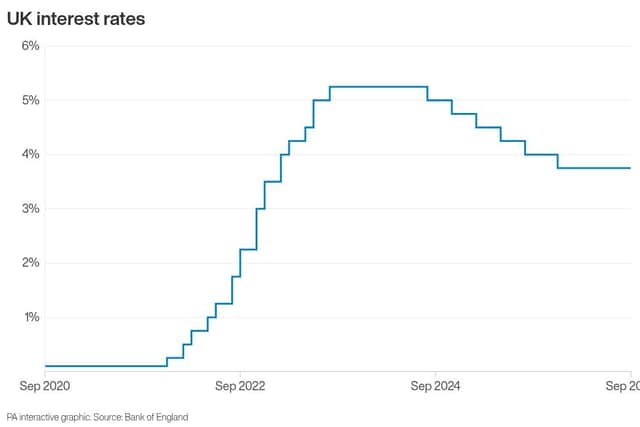
Many economists are therefore expecting the Bank of England to hike interest rates next month to keep a lid on inflation and stem the risk of so-called “second-round effects” emerging, meaning things such as higher wage demands.
Martin Sartorius, lead economist for the Confederation of British Industry (CBI), said September’s inflation rise means an interest rate hike was “firmly on the table” at the Bank’s next meeting in November.
He said the rate-setting committee will likely want to “guard against the risk of persistently higher headline inflation becoming embedded in future wage and price-setting behaviour”.
Sanjay Raja, chief UK economist for Deutsche Bank, said further rises in energy prices were “inevitable” and that ongoing tensions in the Middle East were delaying the likelihood of inflation coming down.
He is expecting rates to rise in November and then again in the months ahead.
Nevertheless, Danni Hewson, head of financial analysis for AJ Bell, pointed to a “silver lining for households” in that food prices were “relatively stable” last month.
Food and drink inflation remained the same, at 1.3% in the year to September, and prices fell by 0.2% between August and September.
But the ONS pointed to some experts who say competition between supermarkets to attract shoppers and resist increasing prices is keeping a lid on inflation, but this could be harder to maintain in the future.
“The knowledge that funding our lives is only going to get harder in the coming months will impact consumer confidence,” Ms Hewson said.
“If they can, people will look to pad out savings, but they’ll also postpone big ticket purchases and will be looking to the Government to step in when times get tough.”
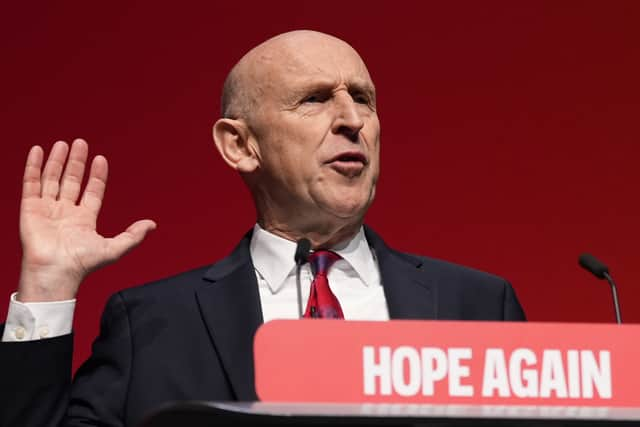
Chancellor John Healey, who is due to deliver his autumn Budget statement next week, has said he will “look to do more” to provide “breathing space” on living costs.
He said: “People can see prices rising. They see it at the pumps. They see it in their bills.
“They see it with monthly mortgage costs, and they can see it’s driven by the conflict in the Middle East.
“We’re a week away from the Budget, and I think if people look at what we did in the first week of the Government – £2 cap on bus fares, we cut VAT off electricity bills, we reduced business rates for pubs, clubs, and venues.
“And I will look to do more, as I can, to give a bit of breathing space on the costs of living and the costs of business at the Budget.”
Meanwhile, the September inflation rate is typically used to decide the level of increase for many benefits, such as universal credit, tax credits and disability benefits.
This rate is also a key part of the pension triple lock, which is used to decide how much pensions will increase by in the following April.
But the increase is based on either this inflation rate, average earnings growth between May and July, or 2.5%.
State pensions are, therefore, widely expected to increase by 3.9% next year based on wage growth figures which is the highest of the three.
The data also showed that Consumer Prices Index including Housing (CPIH), the ONS’s preferred measure of inflation, rose to 3.6% in September from 3.3% last month.
Retail Prices Index (RPI) inflation rose to 3.9% from 3.4% in August.