
UK inflation expected to have accelerated in September after fuel surge

The September inflation rate will be watched closely by economists as it is typically used to decide the level that many benefits will increase.
UK inflation is expected to have accelerated last month as higher fuel and energy costs continue to push up the cost of living, economists think.
The September inflation rate will be watched closely by economists as it is typically used to decide the level that many benefits will increase.
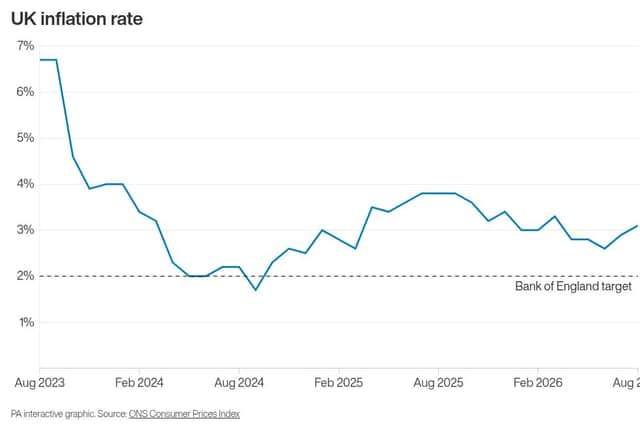
Most forecasters are expecting the rate of Consumer Prices Index (CPI) inflation to have risen to 3.4% in September, from 3.1% in August, according to a consensus provided by Pantheon Macroeconomics.
The figures will be confirmed when the Office for National Statistics (ONS) publishes them on Wednesday.
Overall inflation has been rising over the summer, fuelled by the Middle East energy shock which has pushed up the price of fuel and household energy.
August’s CPI rate came in at 3.1%, which is above the 2% target that the Bank of England is set.
Rob Wood and Elliott Jordan-Doak, UK economists for Pantheon, said they expect higher motor fuel prices to have been a major contributor to higher inflation in September.
This is largely driven by diesel, with average prices rising to surpass £2 a litre for the first time ever at the beginning of this month, according to RAC figures.
The economists also said prices will have risen after a temporary summer VAT cut on family attractions such as theme parks and zoos ended in September.
Sanjay Raja, chief UK economist for Deutsche Bank, said food price rises have been more limited thanks to “fierce” competition between supermarkets to keep prices low for shoppers, but he said this could change from September as the energy shock and extreme weather take effect.
He also cautioned that the cost of living is set to rise further, with an increase to Ofgem’s price cap on household energy bills kicking in at the start of October, meaning higher prices for dual-fuel households over the winter.
The International Monetary Fund (IMF) recently warned that cost-of-living crises fall harder on poorer households who dedicate a larger proportion of their income to everyday essentials such as food and energy.
Meanwhile, the September inflation rate is typically used to decide the level of increase for many benefits, such as universal credit, tax credits and disability benefits.
This rate is also a key part of the pension triple lock, which is used to decide how much pensions will increase by in the following April.
But the increase is based on either this inflation rate, average earnings growth between May and July, or 2.5%.
State pensions are, therefore, widely expected to increase by 3.9% next year based on wage growth figures which have already been published by the ONS.