
‘The lesbian line was a lifeline’ - The Galway activist who has spent decades campaigning for lesbian rights
Galway activist reflects on decades of campaigning as ‘Lesbian Lines’ bring stories to the big screen
Galway LGBTQ+ human rights activist Nuala Ward has spent decades campaigning for lesbian rights and helping women find support, friendship and somewhere to belong. Seeing those years brought to the big screen in Lesbian Lines left her in tears.
“When I actually saw the film, I just cried. I couldn’t stop crying,” she says.
Cara Holmes’ documentary, which has just gone on nationwide release, tells the story of the women behind Ireland’s first lesbian helplines. For Nuala, it brought back the struggle to find safe places to meet, the hostility they faced and the people who quietly opened their doors.
There were memories, too, of volunteers who have since died and friendships that have lasted decades.
“We were very close and, you know, we all looked out for each other,” she says. “We’ve all kept in touch to this day.”
Nuala, 60, grew up in Curraghnaboll, about seven miles outside Athlone. The youngest of 15 children, with nine sisters and five brothers, she now lives in Annaghdown after many years in Galway city.
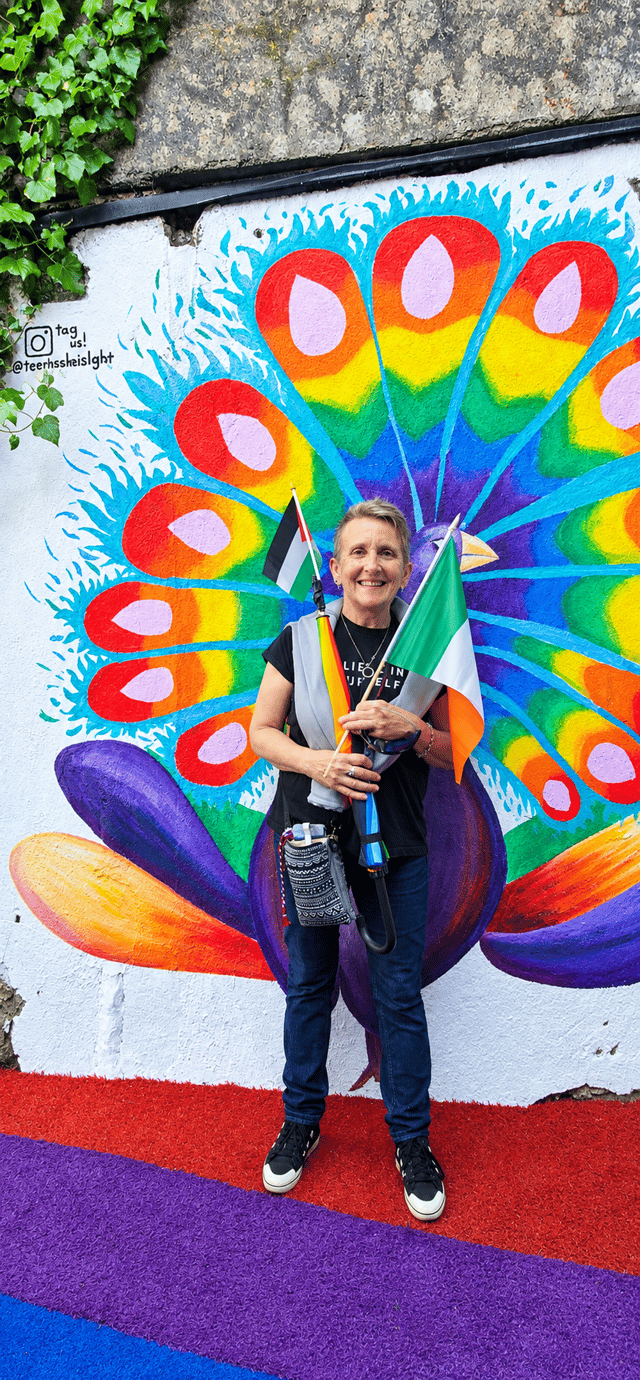

Since the film’s release and her appearance on RTÉ’s Liveline, calls and messages have arrived “from all over the place”. Among those who rang was Maura, a Galway woman in her nineties who watched the documentary with her daughter. She spoke of how much it meant to them both to see lesbian women’s stories told on screen.
She remembers Mick Taylor of Taylor’s bar with particular affection. Volunteers training with the Cork and Belfast lesbian lines had struggled to find a venue once they explained what it was for.
One evening, as they discussed where to hold the third stage of their training, Mick asked what was going on.
“Sure, you can use my sitting room upstairs,” Nuala recalls him saying.
He was among the “amazing people along the way, who were very helpful and supportive without question”. She remembers that kindness alongside the abuse shouted at her and people spitting at her in the street.
The Galway Lesbian and Gay Helpline opened in 1988. Its first call was abusive. It shook the volunteers, but genuine calls followed.
“The lesbian line was a lifeline, and I don’t use the word lifeline lightly,” Nuala says.
Women told volunteers they had been close to suicide.
“And the only thing that stopped them was that they could pick the phone up.”
Married women rang frightened of losing their children. Others struggled with isolation or religious shame. Some became familiar voices. Others never rang again, leaving volunteers wondering what had happened to them.
Their privacy still matters deeply to Nuala, who stresses the care the filmmakers took to protect callers’ identities.
Finding a base brought its own challenges. At one stage, volunteers were helping gay people come out while answering the phone from an actual closet.
“I remember going up to see it for the first time,” she says. “When we went in, there were mop buckets and, you know, cleaning stuff.”
There were no windows and just enough room for a desk, a filing cabinet and two chairs. Yet the helpline could be someone’s “only point of connection” with the community.
Volunteers offered befriending and kept lists of gay-friendly doctors, counsellors and other services. Even a medical appointment could leave someone wary of saying too much.
“You didn’t know how they were going to be,” Nuala says.
Some callers were home on holiday and wanted to meet people. Others simply wanted a gay-friendly plumber. The volunteers helped with everyday concerns as well as calls from women in distress.
Volunteers also advertised Thursday-night gatherings for lesbian and bisexual women in Clogs, a Galway pub where musicians and other local characters mixed. Elsewhere, welcome came with conditions.
“They’d say, ‘Well, you can come, but you can’t advertise it,’” she recalls.
A women’s bar upstairs in the Galway Arms later became a popular monthly gathering. A feminist group originally ran it while exploring plans for a women’s resource centre. When the group disbanded, Nuala kept the nights going with help from others. What began as a gathering of five or six women grew into a packed room.
She remembers asking an older woman why the atmosphere felt so different from an ordinary nightclub.
“She said, ‘Nuala, you have to remember. We never had our teenage years as ourselves.’”
Those few hours on a dance floor offered a freedom some women had missed growing up. Being visible on the streets was harder.
When Nuala was organising Galway’s first Pride march in 1989, two friends from Macnas, Natalie and Jane, asked how it was going. She had no venue and nobody willing to march with her.
“I wasn’t going to walk down the street on my own,” she says.
Both women were heterosexual, but they didn’t hesitate.
“We’ll do it. We’ll march with you, Nuala.”
Galway Pride is now Ireland’s longest continuously running Pride festival. In the early parades, however, Nuala would pass people she knew without acknowledging them.
Some watched from the pavement, appearing to be out shopping, unable to risk being publicly identified with the march. She knew not to wave or call their names. Afterwards, they would tell her how much they had enjoyed it.
“It was an understood thing,” she says. “You wouldn’t out them.”
Natalie, now living in Berlin, texted after listening to Nuala’s Liveline interview on her commute.
At home, Nuala had her mother’s support. One sister joked that she alone had followed their mother’s advice to “stay away from boys and don’t get into trouble”.
Her mother, who was religious, supported marriage equality and lived to see it pass before her death in November 2015.
“I was happy that she saw that,” Nuala says.
Nuala never married. What mattered was having the choice.
“What’s good for the goose is good for the gander.”
A visit to Áras an Uachtaráin to meet President Mary Robinson in the mid-1990s stands out as an important moment for her and the wider LGBTQ+ community.
Her contribution was recognised in 2019 when NUI Galway awarded her an honorary Doctor of Laws for her human rights advocacy and community service.
She also helped found AMACH! LGBT Galway, a community development charity launched in 2010. It runs Teach Solais, the West of Ireland’s first dedicated LGBT+ resource centre.
She is glad to see that progress, but worries that the blatant homophobia she remembers is becoming more visible again.
“I can feel that coming back,” she says.
At this year’s Galway Pride parade, she says she witnessed a man lunging towards participants. A volunteer stood between him and those marching, keeping him back without engaging with him.
“It really did shock me,” Nuala says.
It brought back memories of the hostility she and other older women faced when younger. Young people also encounter abuse online, making the work of groups such as shOUT! particularly important to her. She praises its staff for giving young LGBTQ+ people a safe space to be themselves.
Younger volunteers carrying that work forward give her hope for the future. She is proudest of the people who have given their time over the decades and the spirit of inclusion they helped create.
“I am so proud to see that community spirit that we had and that we created back in the 80s continues.”