
Mayo Titanic emigrant’s pocket watch to fetch up to €72,000

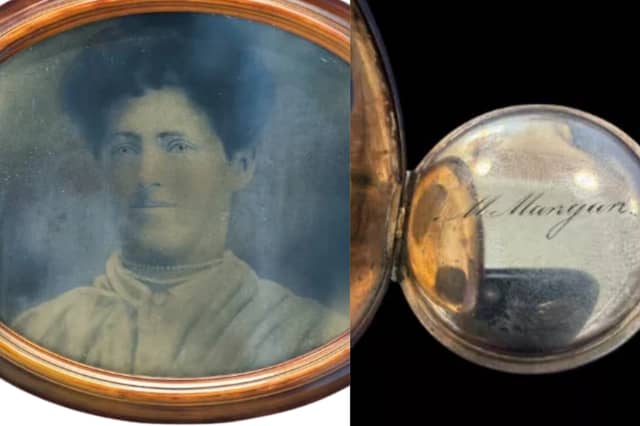

The watch belonged to Mary Mangan, a 32-year-old from Carrowskeheen in Addergoole, near Lough Conn, who died when the liner sank in April 1912.
A pocket watch that belonged to one of Mayo’s Titanic emigrants will go on sale tomorrow, more than a century after it was recovered from the North Atlantic.
The watch belonged to Mary Mangan, a 32-year-old from Carrowskeheen in Addergoole, near Lough Conn, who died when the liner sank in April 1912. It is being sold by her family at Henry Aldridge & Son in Wiltshire, England, on 21 November (Lot 299). It is expected to fetch up to £60,000, or about €72,000.
One of the Addergoole 14
Mary was born in Addergoole on 8 September 1879. Like many young people from the west of Ireland, she emigrated to the United States, probably around 1906, and her sister Ellen is believed to have gone with her. Her brother Edward had settled in Chicago.
In early 1912 she returned home to visit family. Local accounts say she came back to see her sick mother and to seek her consent to her marriage, and she was engaged to a fellow emigrant named Walsh, from Crossmolina. Her diamond solitaire ring would not have gone unnoticed by neighbours. Her ability to make the journey home showed she had done well in America, and the ring would quickly have convinced them that her fiancé had too.
Mary joined the Titanic at Queenstown (now Cobh) as a third-class passenger, on a ticket costing £7 15s. Ellen chose to stay in Ireland. Mary travelled with the group now remembered as the Addergoole 14, who left north Mayo that April hoping for better lives in America. The group was led by Catherine McGowan and included siblings John and Mary Bourke and Catherine Bourke, all bound for Chicago.
Eleven of the 14 were women and three were men, aged from 17 to 42. Eleven of them died. Only three survived, all of them women. It was the largest group from any one place in Ireland on the ship.
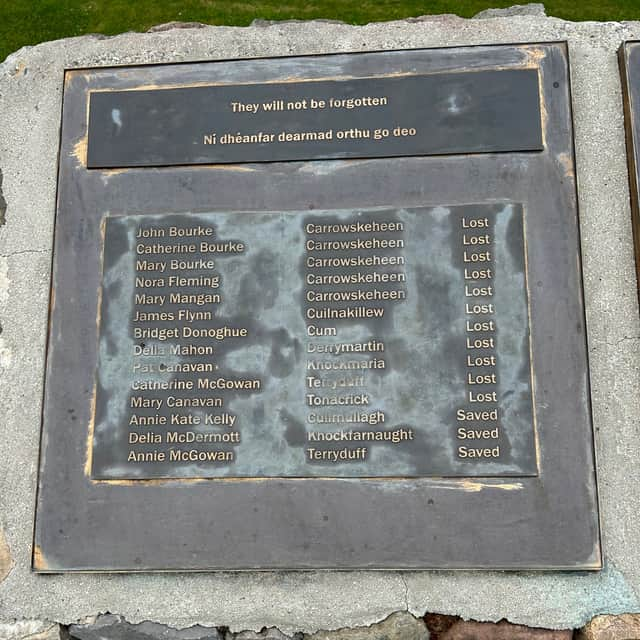
Very little is known about Mary’s final hours. The only recorded mention comes from Mayo survivor Annie Kelly, who recalled running with Mary and the Bourkes towards a ladder that would have led up to second class. Whether Mary made it to the upper decks remains uncertain.
Mary died in the sinking. Her body was recovered by the cable ship Mackay-Bennett and listed as body No. 61. The official Halifax record describes a woman of about 30 with light hair, wearing a green waterproof, a black coat and button boots. Among her effects were a watch engraved “M. Mangan”, a locket engraved “Mary”, a diamond solitaire ring and a bracelet marked “M. M.” She was buried at sea on 22 April 1912, and her possessions were returned to her family.
The Watch
The yellow metal watch is engraved “MM” on the case and “M. Mangan” inside. Its movement is heavily corroded from its time in the sea, and the face shows the damage it suffered. The auction house describes it as bearing the “obvious trauma” of the sinking.
The watch was recently displayed with the rest of the Mangan Collection at Titanic Belfast, and the sale marks the end of its time with her family.
Titanic Village
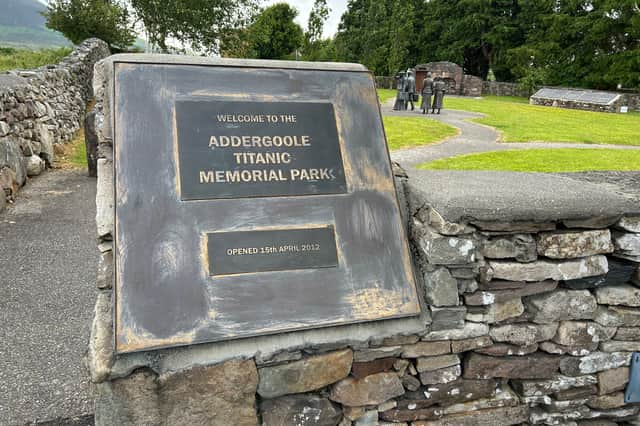
In Lahardane, the loss of the Addergoole 14 has never been forgotten. The north Mayo village has become known as Ireland’s Titanic Village, and the Addergoole Titanic Memorial Park stands there in memory of the fourteen neighbours and friends who set out together in 1912. Titanic- and emigration-themed stained glass windows can also be seen in the village.
The centenary in 2012 was marked with a week-long cultural programme from 8 to 15 April, which drew some 12,500 people to Lahardane. Television crews and reporters from around the world followed the story throughout the year, including the Netflix documentary Waking the Titanic, which uses re-enactments and interviews with descendants to tell the story of the Mayo villagers on board.