
The Leaving Cert 2008

Back to School Special
Keeping their doors open
With numbers dropping, a number of rural schools are struggling to hold onto their teachers
Anton McNulty
ALONG with the post office, shop, GAA club and pub, the primary school has been the backbone of every rural community, but in recent times – like the post office – they have been find it increasingly difficult to keep their doors open.
The local school has always been the pride of the community and nothing would galvanise a community more than organising a fundraiser to improve the facilities in the a. However, over the last 20 years a number of schools have lost teachers and even had to close their doors for good because of falling numbers, and this has become a constant worry for many schools and communities.
This predicament was very evident in areas like Achill and Tourmakeady which have seen schools closes and numbers fall in the last two decades. The lack of employment opportunities over the years in these areas has forced the young people of the area to settle in bigger towns and they are unable to send their children to their former school. One school which has seen schools around it close is Killateeaun National School, a two-teacher school located on the shores of Lough Mask in the parish of Tourmakeady.
Since he started teaching there in 1985, Principal TomΡs Heneghan has seen the enrolment numbers fall from 48 to 25, who will start next Monday. Of the four schools open in Tourmakeady in 1985, two have closed and the total numbers going to primary school in the area has fallen from 250 to 80 children.
“We are not in danger of closing or losing a teacher just yet but the falling numbers are a big worry,” explained TomΡs. “Young families are not settling in the area and families are small compared to what they used to be. The big worry at the moment is that a lot of people in the area were employed in the construction sector. So far nobody has emigrated but it is being talked about and that would be serious for the area and the school. There was a lot of emigration in the 1980s and that loss can now be seen in the drop in school numbers.”
TomΡs explained that four children had enrolled for the new school year but they have lost four children whose family had to return to England after their business failed to take off in the area.
“We have lost shops, the post office and holding onto the local school is very important because an area starts losing its identity when the school closes. If a school goes it is a big blow and in some cases is the last nail in the coffin of a community.”
The issue of the teacher/pupil ratio has become a major concern for many teachers who are unhappy with class sizes. Peter Carney, Chairman of the west Mayo branch of the INTO and principal of Carraholly National School in Westport, explained that if the enrolment numbers of a school fall below 50, the school faces the prospect of losing a teacher.
One school in danger of losing a teacher is Glencastle National School in Belmullet, which also caters for children with moderate to severe learning disabilities in the Erris area. The Principal, PJ Moran, said the school is currently a three-teacher school with 48 pupils but admitted that holding onto the third teacher is getting more difficult each year. Eight haved enrolled for the new school year but every year they have to keep an eye on how many are leaving the school and how many are joining.
PJ teaches fifth and sixth classes while the other two teachers teach from junior infants to first class and from second class to fourth class. If they were to lose a teacher it would make it increasingly difficult to juggle all the classes between two teachers, he said.
“If we were to reduce our teaching staff from three to two it would make things awfully difficult, especially so for me as principal because of all the paper work we have to do. It is difficult to juggle all the classes in a three-teacher school and losing a teacher would put more pressure on the teachers,” he said.
‘We had about six or seven weddings this year but they are not settling in the area’
CASE STUDY
BELBERRIG NS
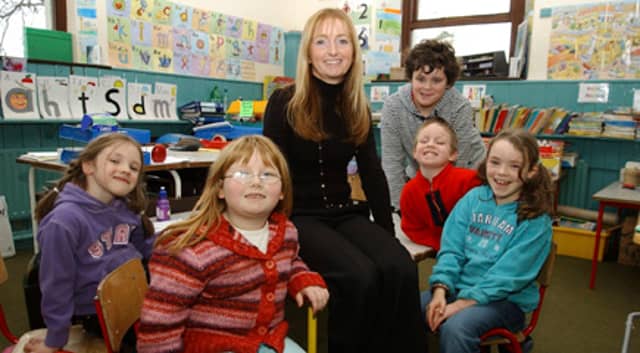
THIS September will probably be the last time national school students will pass through the doors of Belderrig Primary School in north Mayo for the new school year. After years of population decline in the area, only three pupils remain in the primary school which had 55 pupils in the 1980s.
Mary Kenny, the Principal of Belderrig Primary School and its only teacher, explained that the numbers at the school had been going down because no children were entering the school to replace the children leaving. Mary joined the teaching staff in 1980 and said it was only in the last five years that the numbers started to fall off dramatically.
“In 1980 we had 55 students, which went down to the 40 mark but we were able to maintain those numbers. The numbers started to go down to the thirties, twenties and settled for a while on 15 and 16 but there are no youngsters in the area. We had about six or seven weddings this year but they were all living away and are not settling in the area. There is disappointment in the community that the school is closing but it was inevitable and people have known that for the past three years,” she said.
Last year, there were seven pupils left in fifth and sixth class but this year only three are in sixth class – one boy and two girls. They had two teachers up until last year, but with no child entering the school in a number of years that has been reduced to one.
Mary said the children are well-behaved and the fact that it is such a small class, she is able to give them more time.
While the school has only three pupils, it is in receipt of Deis funding and has all the equipment of a normal school, while a Deis resource teacher comes to the school every week. However, despite the resources the school gets, Mary said the children were not able have the same fun at break time as a normal school and she is apprehensive about how they will manage when they go to secondary school.
“I don’t envisage any problems next year but we have one boy and two girls and while the boy gets on well with the girls, he won’t have any boys to play with.
“I will be able to teach the children on a one-on-one basis and that will help them but I would be worried about their transition to a bigger class,” she said.
Size and space debate rages
The Celtic Tiger years did not bring relief to many of the problems of Mayo’s larger primary schools, according to those with first-hand experience
Anna-Marie Flynn
WHILE many rural schools may be struggling to keep their doors open, that doesn’t mean its plain sailing for Mayo’s larger schools.
Two primary schools in the county have already reached numbers well in excess of 400, while a further ten have more than 200 pupils coming through the school gates on a daily basis.
While it’s not a hard-and-fast rule, on the law of averages, it’s fair to say that bigger numbers have a tendency to generate bigger problems.
Last week in Ballina, Principal of St Oliver Plunkett National School, Hugh Lynn, was preparing to welcome 243 pupils back to school on Monday morning, September 1. With one of the biggest roll-books in the north Mayo capital, the school is used to such high numbers. In 1989, over 310 pupils were attending The Quay-based school, but the substantial reduction has not resulted in space to spare.
Despite a government commitment to reduce pupil/teacher ratios to below international best practice of 20:1, schools argue that there has been no reasonable reduction strategies introduced to date. Counties along the east coast have the highest average classes, and meeting the pledged commitment in these Celtic-Tiger-developed areas will require an average reduction of seven pupils per class.
According to the INTO, figures for average class size masks the reality in a large number of schools where classes can be as high as 35.
Mr Lynn agrees whole-heartedly, but after years of struggling to accommodate pupils, while still maintaining high standards of education, he is not too optimistic about a change in the classroom size tide.
“Without a doubt, the biggest issue we are facing is class size. The growth in the area has been huge in the last few years with the explosion in the development of housing estates such as Riverside, Quignalecka and Moyvale which are all in the school’s catchment area. This obviously leads to increased enrolment annually. Last year we took in 40 children in Junior Infants; this year that figure is 36. The higher numbers mean classes will have to be split up. We don’t have an inch to spare. At the moment we are teaching a class in what was designed as a resource classroom and the children are literally squashed in.”
The non-national students also increased the roll-book lists but with economic changes now forcing parents to consider packing up and returning home to their native countries, it is not clear how long this trend will continue.
“We have a good representation of non-national pupils in the school and they have integrated very well. At this point, many of them have been in the school for a few years and are settled locally. In many cases, the children have even been in Ireland since birth. With the economy changing dramatically, those families are now likely to pack up and head home again. I know some parents who are considering their position at the moment. That is another factor we just have to take into account but of course it’s very difficult to predict how many families will leave, if any, at the end of the day.”
With a class average of 27 pupils in the colloquially-named Quay School, Mr Lynn is pragmatic about the future of Irish classrooms. “There won’t be anything done about it at this stage; nothing has happened to date and we have been shouting about it for a long time.”
Putting the high numbers of the 1980s down to larger family sizes, the Ballina-based teacher said modern facilities like computer rooms, specialised spaces, equipment and resource areas all place demands on space. The school is now in the process of constructing two permanent classrooms; and with nine mainstream teachers, learning support/resource teacher and ancillary employees, the staff level stands at 12.
While administration takes up much of his daily work, he admits it is the issue of finance that generates the most stress. “It’s really all down to money at the end of the day. We would love to be in a position to further our IT resources and get better facilities put in place. The funding is just not there. It’s difficult to be more progressive when the money is not available to back you. The Parents’ Association is fantastic here and supports us by way of contributions on a regular basis and the treasurer keeps a constant eye on the purse strings; you have to, every penny counts,” added Mr Lynn.
‘Apart from curriculum demands, there is a huge management side to every school’
FOXFORD CENTRAL NATIONAL SCHOOL
FOXFORD Central National School is one of Mayo’s most unique schools – standing alone in its vast parish on the edge of the Achonry diocese. Despite being situated just across the bridge from the six-school parish of Knockmore, the primary education of the entire population of Foxford and its environs rests on the shoulders of the north-east Mayo school.
With 275 children expected to come through the doors of the school next Monday, September 1, the roll-book is literally bursting at the seams.
Principal Sean Lavin told The Mayo News that as the sole choice in the parish, the school has never had any issue with keeping the numbers high. Now at a record level, next week will see 60 new faces coming into the school for the first time; 50 of whom are enrolling in Junior Infants.
With 30 children leaving senior classes at the end of the last academic year, this means September 2008 will see an increase of 30 new pupils overall.
In a bid to accommodate rising numbers, work has commenced on the school with the construction of specialised class space and a conversion of the general assembly area.
“We had to approach the Department of Education to get funding for extra class space as the numbers had reached capacity. Originally we were considering pre-fabricated rooms, but in the long-term, constructing the rooms is better for the school,” he said.
It is unlikely the facilities will be ready for the very beginning of this term, with doors opening next Monday, so, as a temporary measure, classes may need to be accommodated in the Town Hall.
But the development of two new classrooms means that two new teachers had to be appointed. The now nine-teacher school will have a staff count of 20 from next week.
“Staffing is a serious issue. Before we got the sanction for two extra teachers, we feared that the there would be 35 pupils in each of the two senior classes. Thankfully, now that we have the teachers, we will be better equipped.”
In addition to mainstream teachers, the school boasts three learning support teachers, an autism specialist, language support, three Special Needs Assistants, a school secretary and caretaker.
“Dealing with personnel takes up a lot of time. I don’t know how smaller schools, where the principal may take several classes, deal with the day-to-day issues. Apart from the demands of the curriculum, there is a huge management side to every school. We are just lucky here as the Board of Management and the diocesan people that are involved help in a huge way.”
Looking ahead, Mr Lavin expects the steady growth levels to continue and he predicts a need for a tenth classroom in the not-too-distant future.
Emer Gallagher
THE sums just don’t add up for many parents at this time of year. With the cost of educating a child from primary school to the end of their years in college estimated at over €60,000, it can be a frightening prospect for many families.
It can be hard to understand the concept of Free Education. Free?! Far from it. Back-to-school spending will force many parents into debt next month, according to a survey by children’s charity Barnardos.
The findings reveal that some parents must pay nearly €900 just to kit their kids out with books, clothes and shoes. And these estimates do not include school bags, sports clothing or equipment, stationery, or other extra-curricular costs.
Even junior infants is proving expensive, with parents having to fork out €367 for the average four-year-old enrolling in September. Clothing will be the biggest item of expenditure, at around €140, with the rest going on footwear, school books, photocopying fees and a ‘voluntary contribution’, in some schools, of around €120.
A survey of 500 parents of school-going children carried out by schooldays.ie in June and July discovered that the full eight years of primary schooling costs parents under €10,000, while six years of secondary education sets parents back around €12,700 and four years in college costs them a whopping €38,600.
The survey also shows that 76 per cent of parents believe that Transition Year is the most expensive time in second level school. The study by Barnardos reveals that the average bill for a 16-year-old fifth year student will be €880, with school books costing a whopping €330, followed by clothing at €250 and footwear at €110.
A Back to School Clothing and Footwear Allowance (BSCFA) is available to those who meet certain criteria, but there have been numerous calls to roll out this benefit for all families. In Mayo the BSCFA benefited a total of 3,002 families with an estimated 6,925 children last year. The total expenditure in the county in 2007 was €1.5 million.
The current BSCFA rates are €200 for children aged two to eleven years and €305 for children and young people aged 12 to 22 years. Barnardos wants the rates increased to €250 for younger children and €350 for older ones.
“While the Back to School Clothing and Footwear Allowance does contribute towards some of the costs, the payment is still not reflective of the true costs of uniforms and footwear,” said Fergus Finlay, chief executive of Barnardos.
“Uniforms are expensive, with individual pinafores and skirts costing up to €90 each. This puts real pressure on parents. The BSCFA is aimed at families in need, yet the income guidelines governing eligibility results in some families in low-paid employment, particularly lone-parent families, being ineligible.”
There is no national school book rental scheme in operation in Ireland and parents are paying over €100 for books for primary school pupils and €300 on secondary school textbooks. There is a school book grant scheme in operation in some disadvantaged schools. However, the application for funding and its distribution is at the discretion of boards of management and the school principals.
“Given that gaining an education is the best route out of poverty, it is unacceptable that the statutory supports available to assist parents are exclusionary of some families and difficult to access,” added Mr Finlay.
Schools are forced to pass on costs
THE VAST majority of parents (89 per cent) feel pressured to contribute to the running of the school through sponsored events, according to a recent survey. The research by Schooldays.ie earlier this summer found that 69 per cent of parents give their children additional money for school supplies and fund-raising events at least once a month.
“The costs can be high for parents at back-to-school time and indeed these costs can continue right into the school year,” explained a primary school teacher from north Mayo.
“But what parents must understand is that the schools are forced to look for money from parents to run the school. As well as that, fund-raising events are organised by teachers and staff during the year to meet costs.”
And what of the extra costs such as swimming lessons and music that pupils are encouraged to participate in? “Part of our PE curriculum is aquatics so we have to encourage pupils to take swimming lessons during the school term, but they have to pay €24 as the school cannot afford to foot the costs.
“Our school does not ask for a contribution from parents at the beginning of the year which means that we just have to ask for money throughout the school term. Sometimes I think it would be better to ask for the one-off payment at the beginning of the year instead of asking parents for money during the year. It is hard to expect parents to have money for everything in September however.
“Music lessons for the year amount to €64 and most of the pupils take on music. Other classes like dance, basketball and table tennis are organised by the school to benefit the children but unfortunately certain costs have to be passed on to the pupils.
“There is pressure to have the designer gear too, and from third class up, all the boys want to have the runners or jerseys that the soccer players have. This has to put some families in a tough position.
“The schools receive a Capitation Grant from the Government each year, which is substantial on the face of it but it just about meets the running costs of the school. In actual fact, the school is usually in debt at the end of the school year. It doesn’t cover any extras and the school doesn’t splash out on anything because it can’t afford to.”
Peer pressure and necessary expenses
DYLAN is nine years old. This year he will go into third class and now, more than ever, peer pressure is a big factor. “He is totally aware of the brands and this year he was determined to get a Man United school bag,” said his mother Linda. “He got the bag as a present and it cost at least €26. Up until last year I would have got away with getting a bag for €12.99 but there is no way I will be able to do that anymore.”
Linda bought Dylan a pair of trainers at a cost of €65 recently but she will not allow him to wear them at school for fear they would be ruined or put pressure on other children to have the same. Dylan’s school has a policy of black shoes only but this is not always enforced. “I think the school should enforce the policy fully because children put pressure on one another to have the nicest runners or the coolest brands,” said Linda.
Dylan’s school jumper will cost €27 and navy tracksuit bottoms are permitted which can be picked up in any of the major stores like Dunnes or Penneys. Linda expects that the school tracksuit will cost around €40 this year. Swimming lessons will cost up to €30 and out-of-school activities will add to the yearly expenses too as Dylan, depending on the current trend, is likely to take part in extra-curricular lessons.
“There are always other costs throughout the year that have to be met,” added Linda.
As an employee of a bookstore, Linda is fully aware of the varying prices of stationery. “I know a woman with two children, one in primary and one in secondary, who spent €86 on stationery alone. While this would be unusual, it does happen.
“The average booklist for the Junior Infant classes would be €50 and I would be lucky if €60 covers the cost of Dylan’s books this year.”