
Wave power
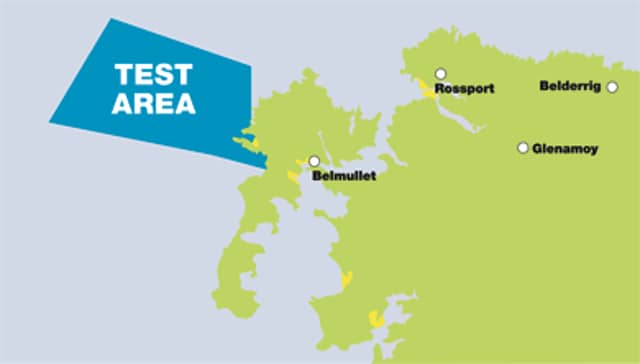

Mayo’s Atlantic waters could be the first in the world to provide commercially-developed wave energy.
Mayo has world-class wave power potential
Áine Ryan
MAYO’S Atlantic waters could be the first in the world to provide commercially-developed wave energy.
The Mayo News has learned that earlier this month one of the Marine Institute’s research vessels, the Celtic Voyager, tested the seabed off the Mullet peninsula, to assess its suitability for testing full-scale wave harnessing.
In an ironic twist, the waters tested are less than 20 miles from Rossport, and the site of the controversial Corrib gas project.
The Marine Institute contends that the west coast has the most energetic waves in the world. This has been affirmed by NUI Maynooth Engineering Professor, John Ringwood. He also believes Ireland has the best wave climate in the world and ‘there is no better place to tap into this resource’. He compared the west coast’s Atlantic wave power to the notorious swells off Cape Horn, saying our swell delivers an average 70kw per metre.
Director of the Institute’s Ocean Energy Programme, Mr James Ryan, told The Mayo News that the waters off counties Kerry and Clare have also been identified for so-called ‘full-scale’ testing. Quarter-scale testing is already at a more advanced stage at a test-site off Spiddal in County Galway.
“Mayo has the advantage of having the highest wave power [of the three identified counties]. Donegal, because it is actually sheltered from the prevailing winds by Mayo, has much less power,” said Mr Ryan. He observed that Mayo’s lack of a deep-water port is only one of around 60 variables that will influence the choosing of a test-site.
“It’s important to remember this is very much at a ‘blue sky’ far-sighted technological development stage yet. The recent Government Energy White paper projects about 75 mega watts being harnessed by 2012. This would supply the needs of 75,000 people,” he continued.
Mr Ryan added that while many experts believe such projections are ambitious, the Institute’s programme was a world leader in this field of renewable energy research.
As mentioned, positive early results have already been reported from the ocean energy test-site east of Spiddal in Galway Bay. The second in a series of wave energy buoys moored at the site survived wave heights of more than eight metres on New Year’s Day last, according to its designer, Mr Michael Whelan, of Ocean Energy Ltd, Cobh, County Cork.
Under the Government’s ocean energy strategy, the cost, reliability and efficiency of a number of wave buoy models will be tried out on the Spiddal site before deployment of a full-scale device in 2008.
Prof Ringwood believes Ireland should invest heavily in the exploitation of wave resources and become a world leader in this technology.
“He has compared the possibilities to Denmark’s success in exploiting wind energy, which now means it supplies 60 per cent of the world’s turbines.
Wave energy research was first undertaken in Ireland in 1980 at University College Cork.