
World leaders begin UN climate conference talks amid concerns over slow action

UN secretary-general Antonio Guterres urged the world to act in an opening speech.
World leaders have begun formal discussions at the United Nations climate change conference in Turkey, hoping to agree on concrete actions to curb global warming after a year of deadly floods, heat waves and other climate-related disasters.
But many heads of the world’s biggest polluting nations – including the United States, China and India – skipped the leaders’ summit at the Conference of the Parties, called Cop31, leaving a handful of nations and United Nations officials to urge action on climate change as a new report warns the gap between countries’ promises and real emissions cuts is widening.
UN secretary-general Antonio Guterres urged the world to act in an opening speech at the leaders’ summit following a colourful performance inspired by traditional folk dances from Turkey.
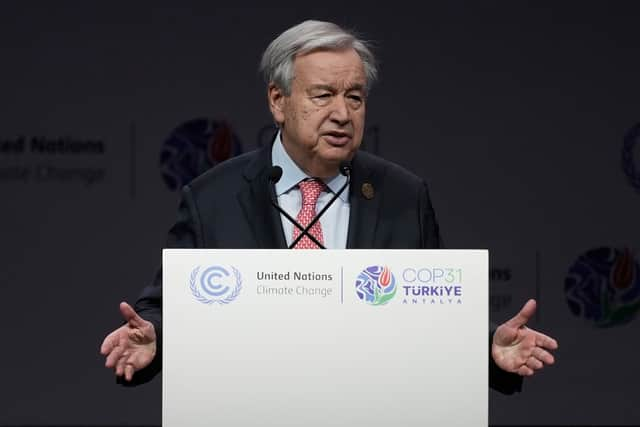
“We know the truth. Now we must act on it,” he said.
“Because climate action is more than a fight over a number or a thermometer. We are in the fight for our lives and our children’s future.”
Mr Guterres outlined four principles to be used in climate negotiations: ditching reliance on fossil fuels, adapting society for a warmer world, generating more financial assistance from rich nations to countries coping with climate change and nations working together instead of fighting.
He called the framework “a new Climate Justice Compact based on shared responsibility, shared security and shared benefits”.
“We do not need countries to agree on everything. But we do need them to cooperate on the things no country can solve alone,” Mr Guterres said.
More than 70 global leaders and senior government representatives are speaking at the leaders’ summit, but the heads of top climate polluters China, the US and India are not scheduled to be present.
“It really is a disgrace that just one of the seven G7 heads of state and only a handful of G20 leaders are attending this summit,” said Mohamed Adow, director of climate and energy think tank Power Shift Africa.
“The world’s biggest economies should be leading the response to the climate crisis, not leaving it to others.”
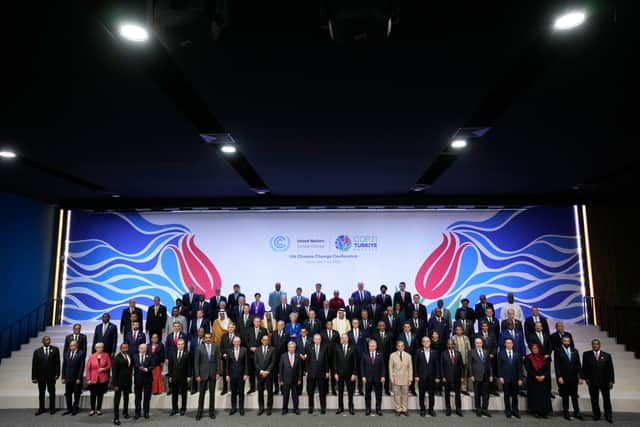
While European Commission President Ursula von der Leyen was present, many other European heads of state were notably absent from the summit.
“More than half of the top leaders of the EU countries are not showing up at the leaders’ summit,” Climate Action Network Europe Director Chiara Martinelli told The Associated Press.
“If Europe wants to help steer the global transition, it needs to show up and be part of it.”
What can and will be accomplished at Cop31 remains to be seen. Past talks have been criticised for making promises that later fell flat.
While delegates at the 2023 conference in Dubai agreed to transition away from fossil fuels such as coal, oil and gas — the leading contributor to climate change — subsequent conferences in Azerbaijan and Brazil ended with little agreement on reductions.
Last year’s Brazil conference produced a compromise agreement pledging additional money to help vulnerable nations adapt to climate change.
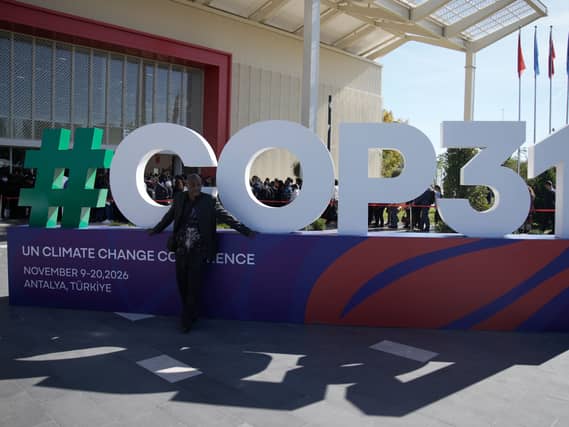
This year’s conference officially kicked off on Monday with Turkey hosting and Australia leading negotiations at a time of fears that the world is not moving quickly enough.
An annual climate change performance index published Wednesday by climate think tank Germanwatch and the New Climate Institute found the gap between nations’ climate plans and action on the ground is growing wider.
“Overall, current collective efforts are not enough to prevent catastrophic climate change. But we see clear potential for improvement,” Jan Burck of Germanwatch said.
Turkey and Australia, which are presiding over the climate talks this year, were ranked among the worst performers on reducing planet-heating emissions.
Scientists say global warming is likely to exceed 1.5C above pre-industrial levels of the early 1800s. Limiting temperature rise to that threshold was a goal set during the 2015 Paris Agreement and has been a focus of international negotiations.
The talks also come as the war in Iran has increased global prices of gasoline, oil and products made with them, such as fertilisers and pesticides.
That has pushed governments to rethink energy policies and investment in renewable energy sources like wind and solar.